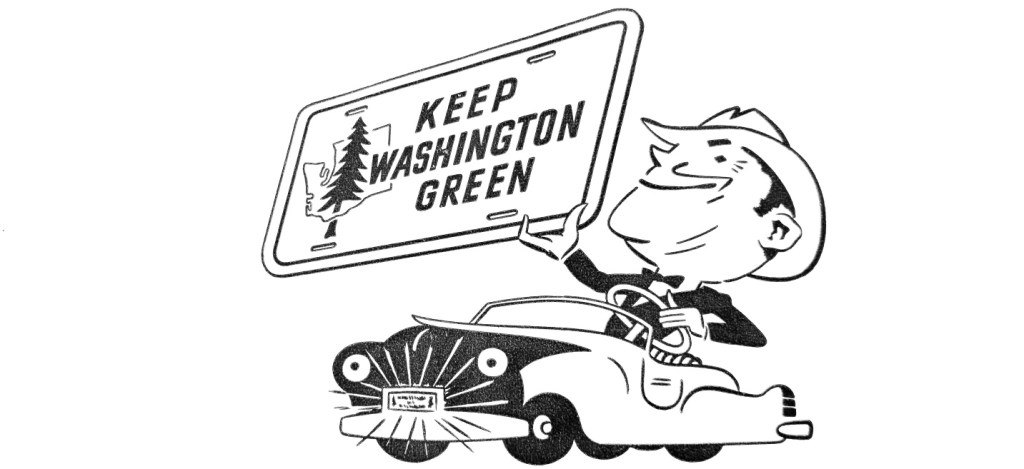
For decades in the mid-20th century, motorists traveling across Washington state were met with omnipresent pleas to KEEP WASHINGTON GREEN. The phrase appeared on roadside signs, pavement markings, billboards, and on private vehicles adorned with booster license plates and license plate attachments. It even came very close to becoming part of Washington’s official license plate.
It all was part of a movement that brought together industrialists and community groups, with origins in an official proclamation issued by Governor Clarence Martin on May 31, 1940. In it, the Governor identified an existential menace in the state: human-caused forest fires. His proclamation revealed that 60% of the state’s industrial jobs were related to forest products, and that 30% of all Washingtonians owed their livelihood to trees and their byproducts. More than 18,000 fires had burned in Washington over the previous decade, and “the depressing pall of smoke from these fires reddened the sun and blotted out our matchless mountain views,” impacting the tourism trade. It was time for the community to emphasize safety and responsibility.
At the time, the Pacific Northwest was still stunned by the devastating Tillamook Burns in Oregon. With the Second World War raging and wide anticipation that it would soon involve the United States, preventing fires was tied to national defense – forest resources would be needed to support the war effort, and fighting fires additionally would divert key resources and personnel from military needs (not a far-fetched idea; the Japanese saw forest fires as a potential weapon).
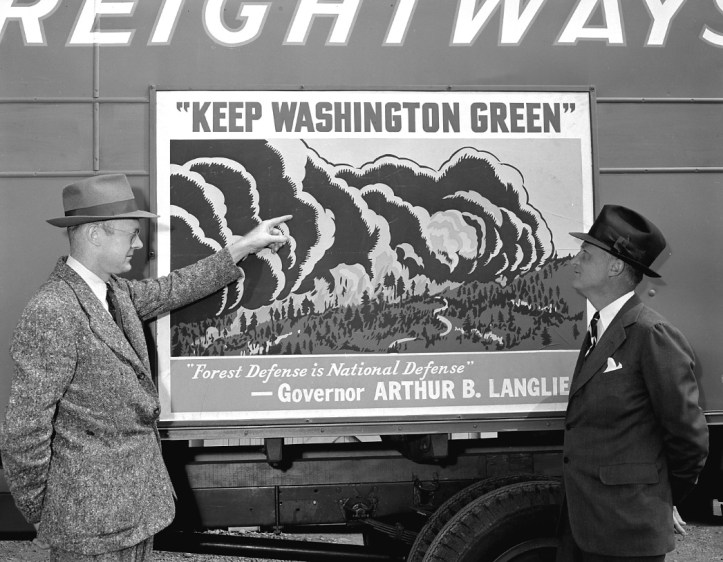
Educating the public to protect our natural resources was the key goal of Keep Washington Green. The emphasis was far more heavy on the resources than the nature: timber and logging played a major role in the state’s economy, and it was the destruction of jobs and economic output that was central to the messaging. Conservation of natural beauty was a nice side benefit. Pulp, timber, and logging industries were the biggest supporters of the Keep Green movement.
Governor Martin called for a “state-wide coordinated program of education and personal action to prevent forest fires,” which was launched from a meeting of “all interested groups and individuals” at the Olympia Hotel in Olympia on June 5th, 1940. At that meeting, the Keep Washington Green Association was officially born.
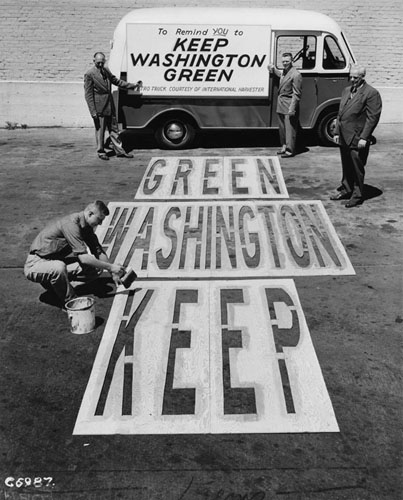
The resulting movement spent decades promoting fire safety, at a grass-roots level in civic and youth organizations, and with government and industry support in advertising and signage. Some of its most visible and lasting forms of advertising were car-based: license plate toppers, booster license plates, car window stickers, bumper stickers, and highway signage were key parts of its strategy, with surviving examples today carrying on the organization’s still-relevant message long after it ceased to exist.
The Keep Washington Green Association matured in stature, membership, and organization quickly after the end of World War II, and ramped up its operations in highly visible ways across the state. Its board was comprised of well-paid full-time executives with backgrounds in forestry, logging, and business, and it used its influence with businesses, government, and community and youth groups to instill a sense of shared responsibility and love for Washington state.
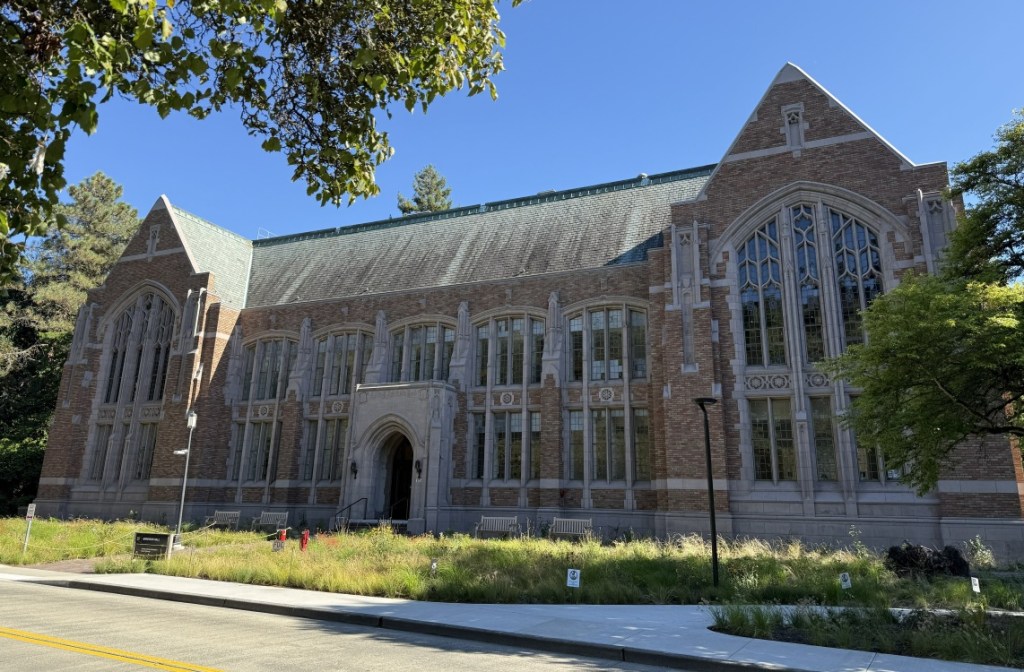
In early 1946, Dean Gordon Marckworth of the University of Washington College of Forestry gave the organization a formal home in the college’s Anderson Hall, and Keep Washington Green operations were officially based from the University of Washington campus for many years.
The Keep Green movement caught on nationally. Less than a year after KWG’s creation, Keep Oregon Green was founded. Keep Minnesota Green launched in 1944, and by the 1950s more than half of the states in the U.S. had a “Keep Green” organization.
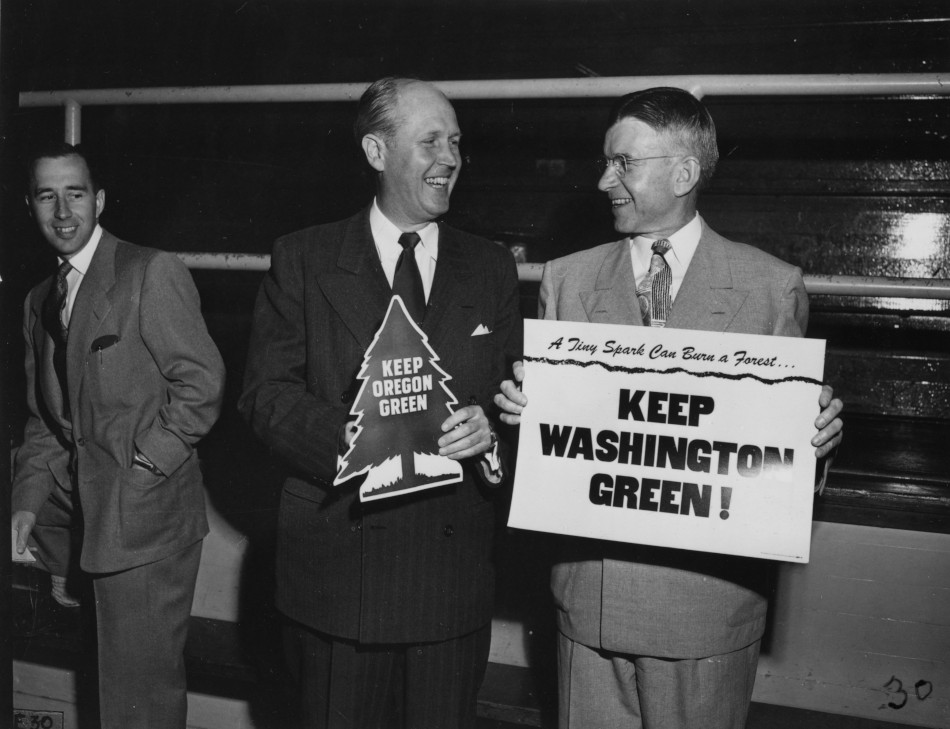
License plate toppers and attachments were a common marketing tool among Keep Green Movements everywhere, and Keep Washington Green used them heavily. The association also tried mightily to push the message on the official state license plates, and came agonizingly close to succeeding.
Keep Washington Green License Plate Toppers
Washington state may have started the Keep Green movement, but it was a somewhat late adopter of the hugely popular and successful practice of using license plate toppers (sometimes referred to as “attachments” or “extensions”) as a means of advertising. Keep Oregon Green had immediately seen their value and commissioned a topper in 1941, but it took their Washington counterparts more than half a decade to follow.
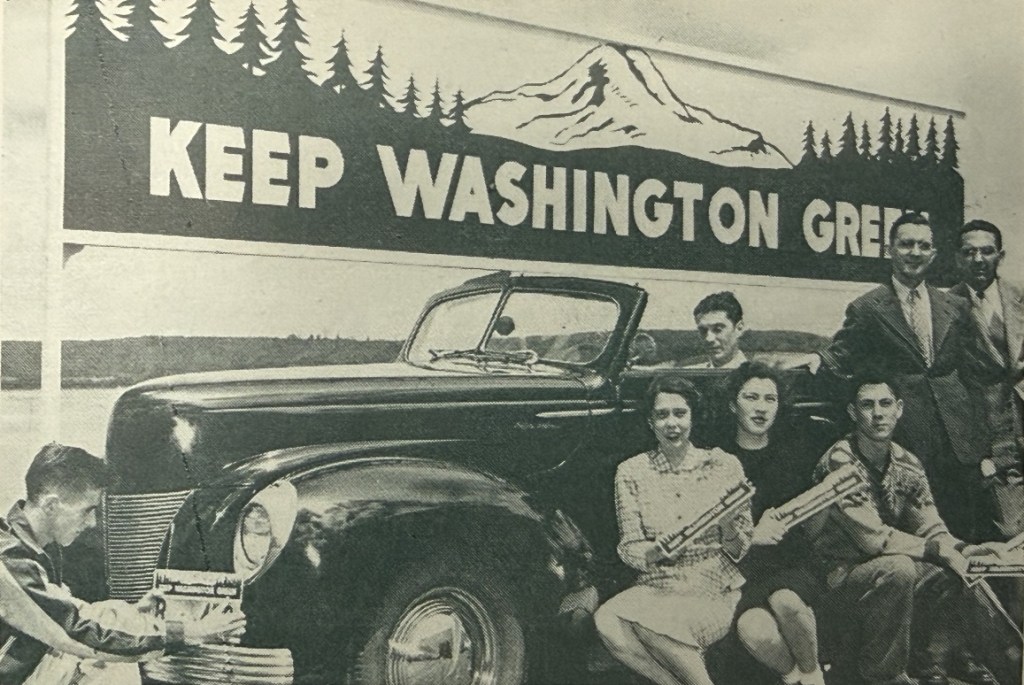
The first KEEP WASHINGTON GREEN license plate topper was developed in 1947, with a unique design showing a lush forest flanking an image of Mt. Rainier. The Young Business Men’s Club of Tacoma launched the first campaign to promote its sales, and over the next five years business leaders and community groups across the state took up the cause as well.
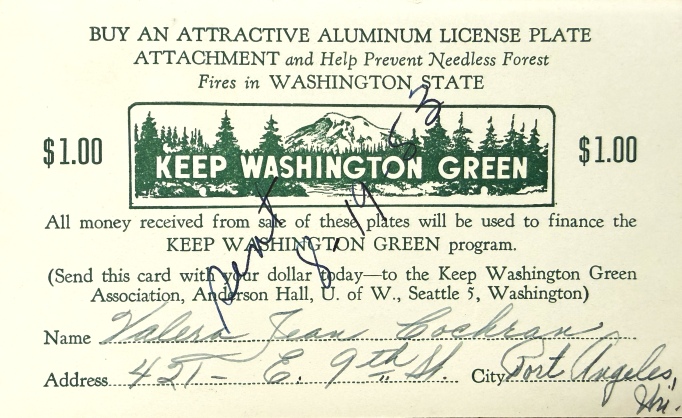
The toppers were manufactured by the Cole and Redmayne company of Tacoma, a printing shop that would later produce official license plates for the 1953 Governor’s Conference in Seattle. By the end of summer 1947, the organization had sold more than 3,000.
The topper design played a central role in Keep Washington Green’s branding, with oversized versions appearing as advertising signage.
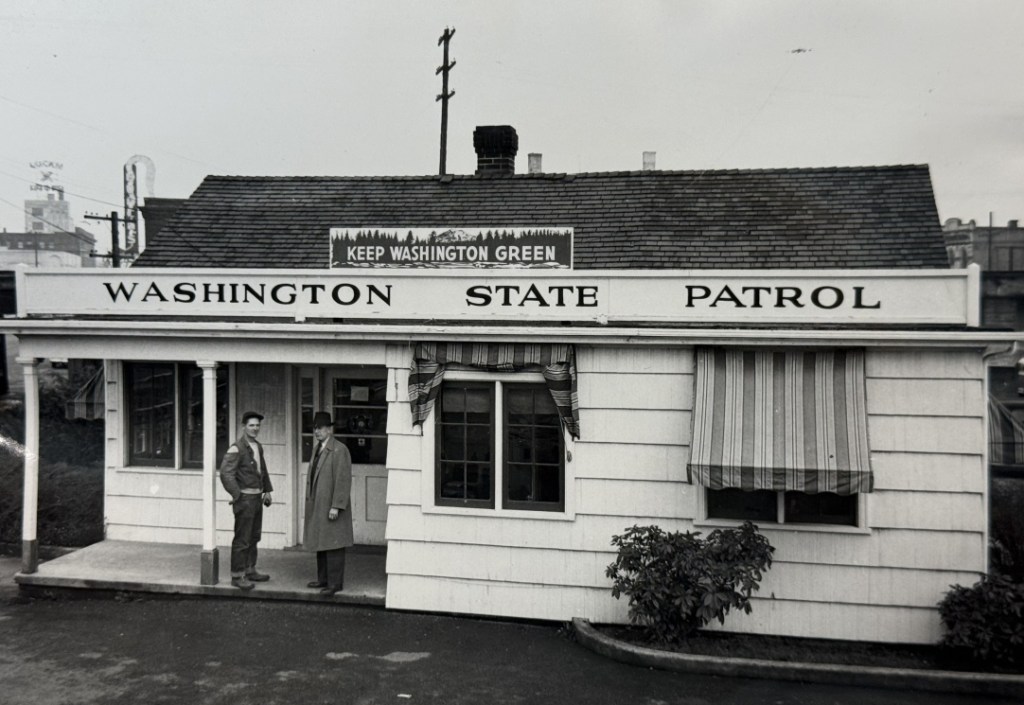
Officials and governments at the local and state levels displayed the toppers on their personal and official vehicles. In 1950, press reports stated that more than 10,000 had been sold.
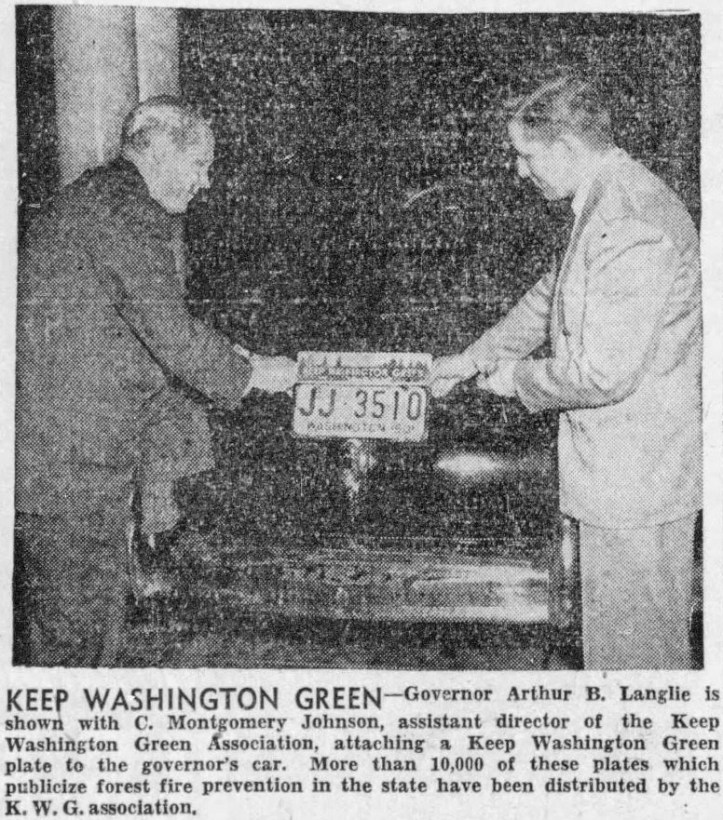
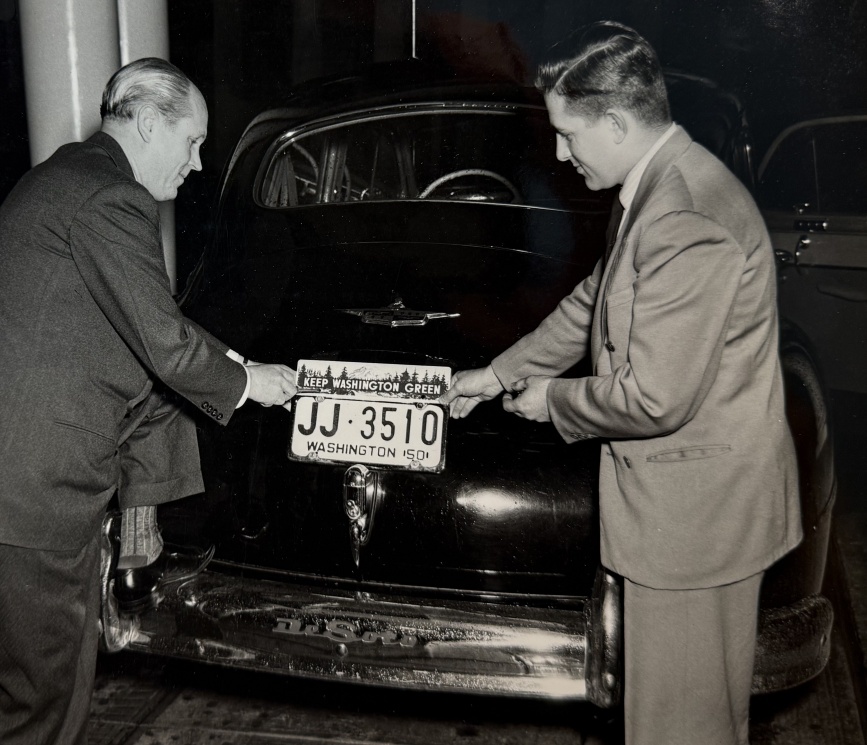
Records suggest these toppers were produced and distributed until around 1952.
Missed Opportunity: the 1949 Keep Washington Green License Plate
With the exception of the 1939 “Golden Jubilee” state issue, Washington’s license plate designs had always been rather plain, more noticeably so in the postwar years when graphics and advertising became more common in other states (neighboring Idaho was experimenting with skiers and potatoes and receiving plenty of attention for it).
The Keep Washington Green Association noticed and took action.
In June 1947, Keep Washington Green director Howard Brier, joined by beloved Seattle icon Ivar Haglund, was touring the state to promote the movement. The Columbian, reporting on their visit to the Vancouver Kiwanis, included a small mention that Brier had “stated that, in 1949, the slogan will appear on the regular Washington plates.” Similar statements appeared in newspapers throughout 1947.
Behind the scenes, KWG was indeed working with licensing officials to incorporate the designs of its license plate topper into the state’s general issue – the slogan and the graphics. It first broached the subject with the state in March 1947, and the Association’s membership was told in its August 1, 1947 meeting that stamping dies for the design were already being manufactured. Based on correspondence saved in the Keep Washington Green records at the University of Washington, the project almost succeeded, with general support from officials and viable designs completed. It likely could have been one of the most striking license plates in Washington’s history.
But it all fell apart as final logistics were being hashed out in early 1948.
Some of the background is explained in a letter that Keep Washington Green Trustee (and semicolon enthusiast) W.B. Greeley wrote to Governor Monrad Wallgren on March 15, 1948, in an attempt to save the project. He wrote:
Keep Washington Green has been working with the State Commission on Motor Licenses, for the last two years, to have the next license plates manufactured by the State include our slogan, on a little background of white mountain and green forest. We have been making this little emblem ourselves for the last two years; and distributing it throughout the State as part of our publicity for preventing forest fires. It would be very desirable to incorporate it in the official license tags of Washington; and the Commission has favored the idea. The designs have been prepared; and we have assumed that everything was set to have the next license plates include this little emblem and message for preventing forest fires.
His letter went on to summarize the bad news: the Commission had found that this design would result in a cost increase of $0.03 per plate, or $23,000 in total. There was not sufficient funding to cover these costs.
Greeley appealed to the Governor for his help and influence to find a resolution. Specifically, Greeley suggested that, because the proposed slogan and graphics would favorably promote the state on bumpers across the country, advertising or development funds might be allocated to the license plate project.
Two days later, KWG President Emmit Aston followed up with his own letter to the Governor, further expounding on the advertising benefits that would accrue to Washington by having its official license plate bear the slogan and forest design.
The Governor’s response is not retained in the surviving KWG files, but the result is clear: the license plate project was dead. A few weeks later, newspapers across the state confirmed as much, noting that Governor Wallgren “did not favor a proposal to install the slogan ‘Keep Washington Green’ on automobile license plates,” and that his “reason for disapproving the proposal was not given.”
While the final design of the 1949 license plate issue did at least include green, it was on a background of dull, gray, bare aluminum, resulting in what is maybe the most drab license plate Washington had issued.
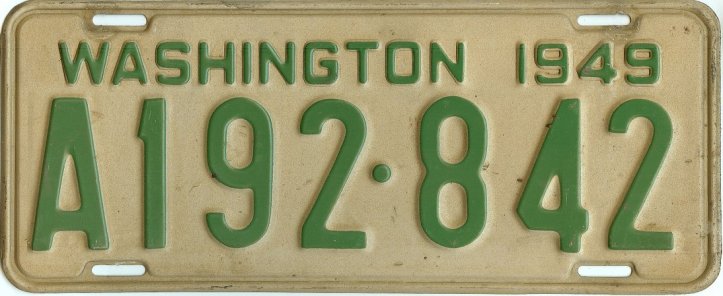
Meeting minutes from Keep Washington Green leadership show that the group was actively advocating for the slogan’s inclusion on the state’s license plates for several more years, to no avail (next door, Keep Oregon Green made a similar pitch for the 1950 Oregon license plate issue, and similarly failed).
Keep Washington Green – On Official License Decals
The Keep Washington Green enthusiasts never did get their way with the state’s license plates, but a small consolation was the appearance of “Keep Washington Green” on the backs of the windshield stickers used to renew license plates for 1952 (this metal-free method was necessary due to resource restrictions during the Korean War).
At the KWG leadership meeting at the Washington Athletic Club on July 14, 1951, Director Howard Brier recounted “his efforts for the last six years to get the ‘Keep Washington Green’ on automobile license plates,” and shared that he continued to discuss the issue with Governor Arthur Langlie (exactly when this dream died for good is unclear). At that same meeting, however, the director shared a letter from the head of the Department of Licenses with the happy news that the slogan would be printed on the 1952 windshield stickers.
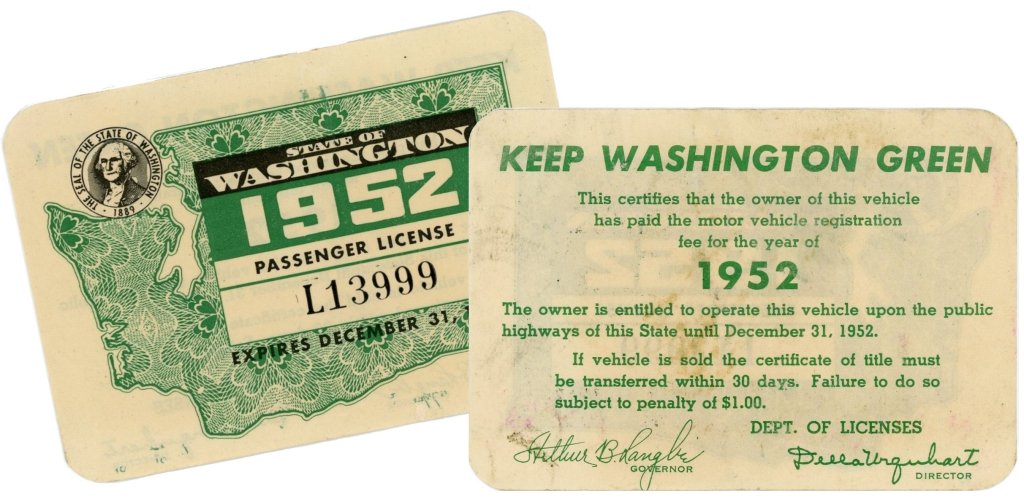
Front-seat occupants would get a constant reminder to practice fire safety throughout 1952, and often for many years after, since many people didn’t bother to scrape the sticker off their windshield after it expired. Unfortunately for Keep Washington Green, 1952 would be the last year Washington resorted to windshield stickers to renew license plates.
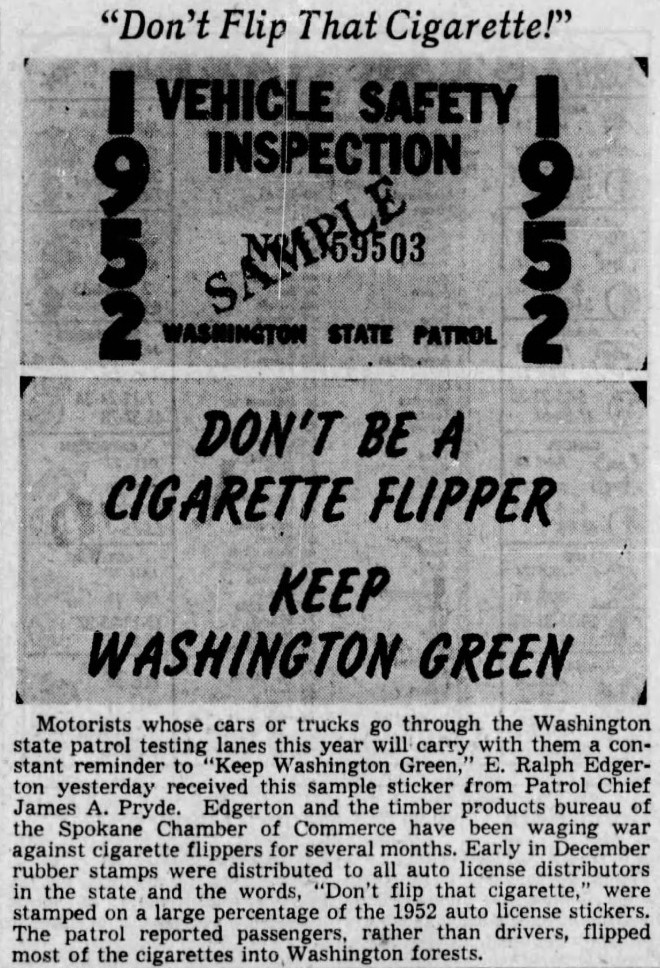
At various points, the “Keep Washington Green” slogan received criticism for lacking a specific call to action. The goal was clear, but what behavior was asked of the average citizen? “It doesn’t say how,” complained E. Ralph Edgerton, a member of the Timber Products Bureau, in a short article in the Spokesman-Review on December 1, 1951. Edgerton had appealed to the governor to add the phrase “Don’t flip cigarettes” to accompany “Keep Washington Green” on the 1952 windshield stickers.
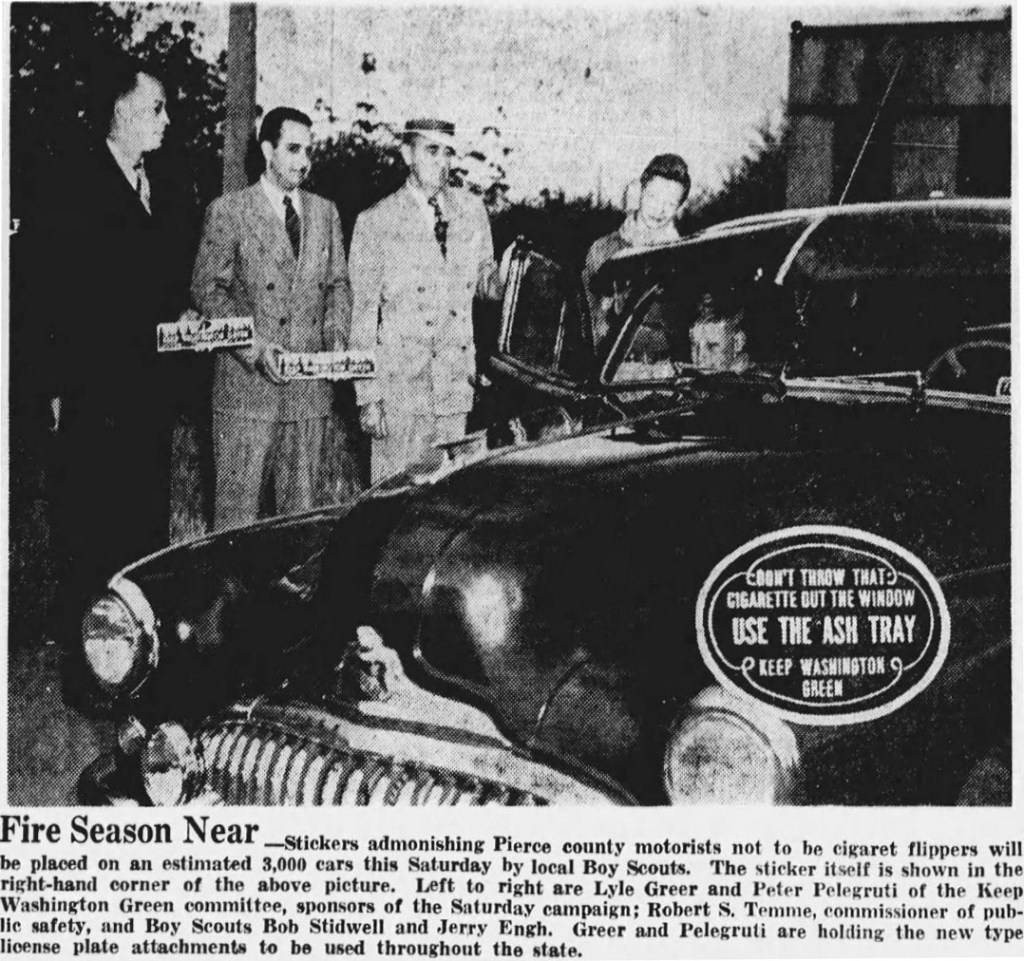
“Flipping cigarettes,” tossing lit butts out the car window, was always identified as a leading cause of forest fires, and one of the reasons so much car- and highway-based Keep Green advertising had been created. While this admonition didn’t make it onto the 1952 license plate decals, it did find its way onto the back of 1952 safety inspection stickers (there had been discussion of adding the Keep Washington Green slogan to State Patrol inspection stickers back in 1946, with no success).
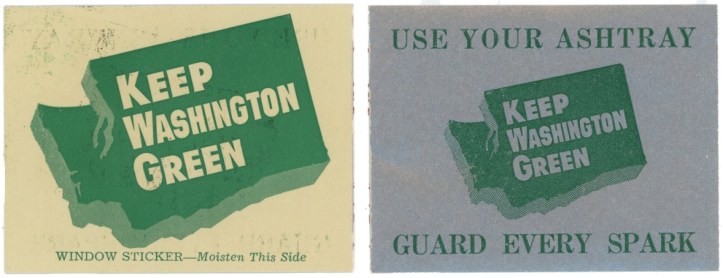
The message became even more instructive on two-sided window decals that KWG began distributing in the early 1950s, promoting the cause on the front side and reminding passengers to use their ashtrays on the back.
Keep Washington Green (Unofficial) License Plates
The movement might have missed its chance to appear on license plates in 1949, but developments in the early 1950s provided a path to unofficially achieve that prominence.
As the Korean War heated up, metal shortages became rampant as supply controls were put in place by the U.S. Government. By 1951, this began constraining the supply of Washington’s license plates.
Washington’s 1950 license plate issue had been designed for four years of use, with metal validation tabs indicating renewal each year. These aluminum plates were issued in pairs, and any vehicle registered since 1950 carried the same front and back license plates until 1954, when all vehicles in the state were to receive new plates.
New registrations, on the other hand, began receiving dated 1951 license plates issued as singles, instead of pairs, because of the limited metal supply. With empty license plate spaces on the front of more and more cars, Keep Washington Green saw an opportunity. “The front bumper of all new or relicensed cars will look bare until the metal shortage is over. Why not get Keep Washington Green on that space?” asked a letter sent out to KWG supporters.
In January 1952, the organization began marketing the Keep Washington Green topper design from 1947 as a modified front license plate made of masonite. A generic “KEEP WASHINGTON GREEN” message was also offered, on metal (steel, presumably) that was somehow sourced despite ongoing shortages.
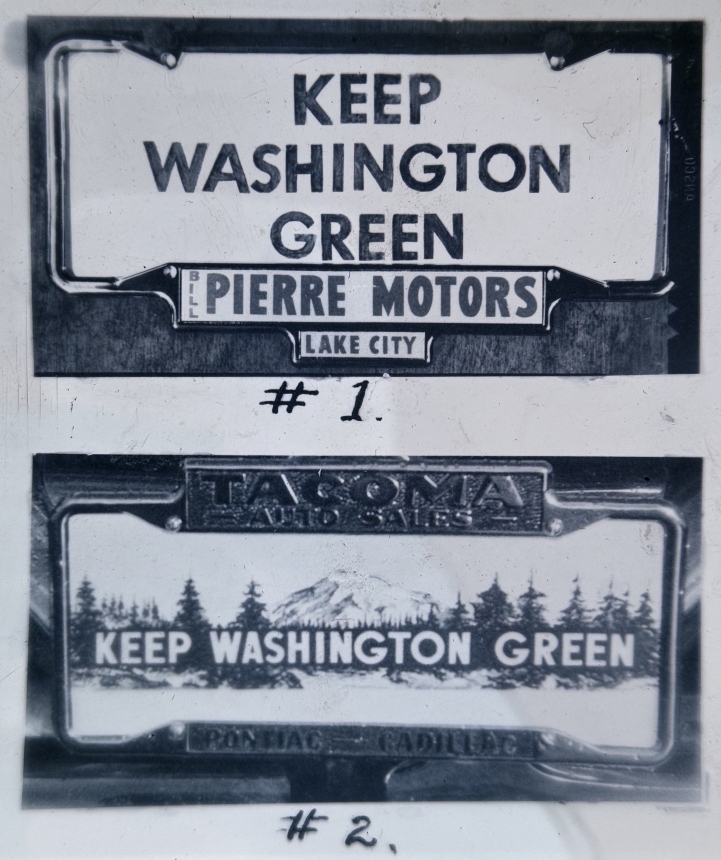
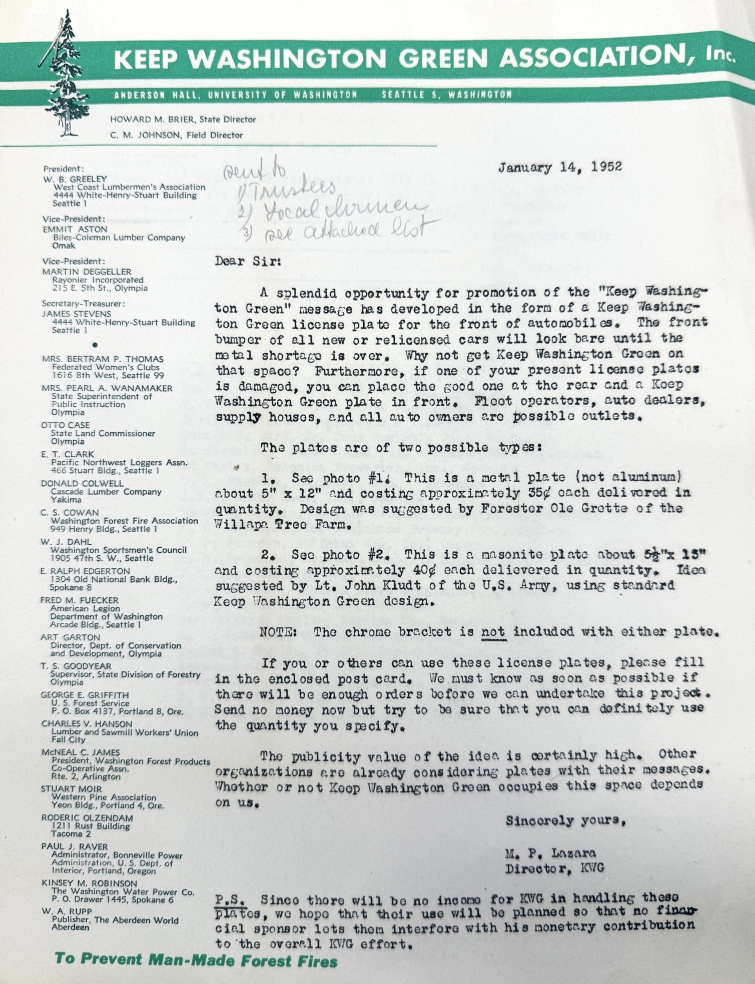
These two plates were marketed to supporters through a letter campaign that included a photo of the designs and preprinted postcard order forms.
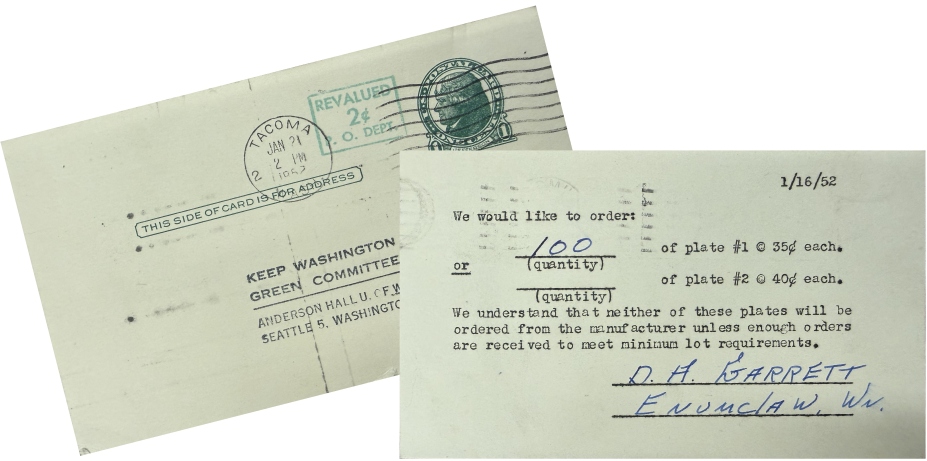
Given a dearth of modern survivors, these were likely not big sellers. Order forms even included a line that the customer acknowledged that none would be produced at all if minimum order levels were not met – it’s possible none were even manufactured (please contact me with any evidence they were!).
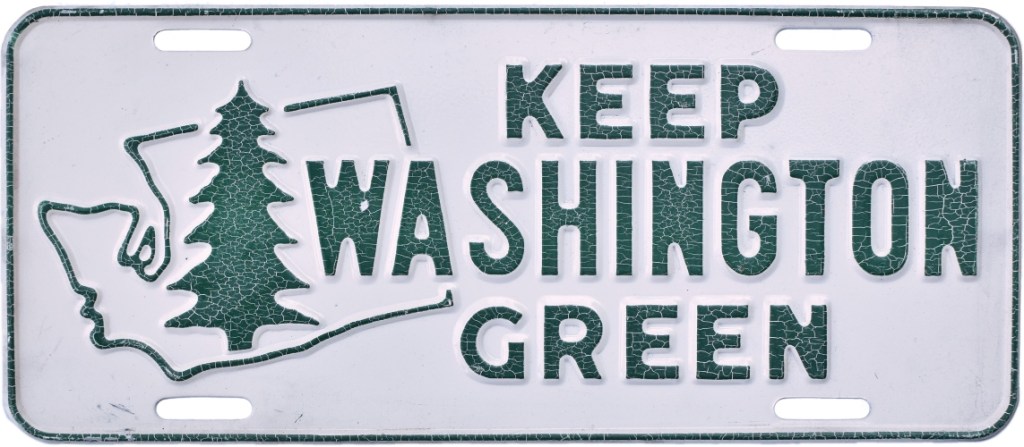
The Keep Washington Green license plate
The front booster license plate market took off in earnest a couple of years later, when Washington officially, and controversially, dispensed with the requirement for front license plates and shipped out the entire 1954 general license plate issue as singles. Every car in the state received a new license plate and number for 1954, but only for the rear. Many organizations saw a great business opportunity to sell booster license plates to fill all of those empty front bumpers.
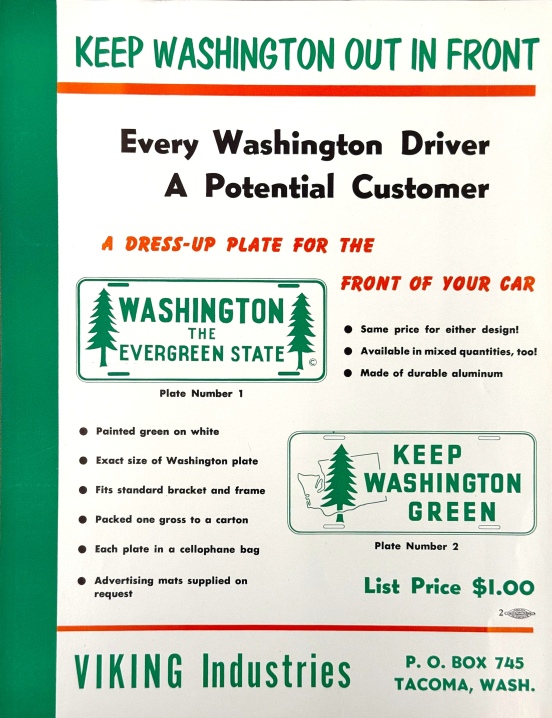
One company that leapt at that opportunity was Tacoma’s Viking Industries, which had developed a popular and well-made “WASHINGTON THE EVERGREEN STATE” plate that it had been advertising across the state since early 1954.
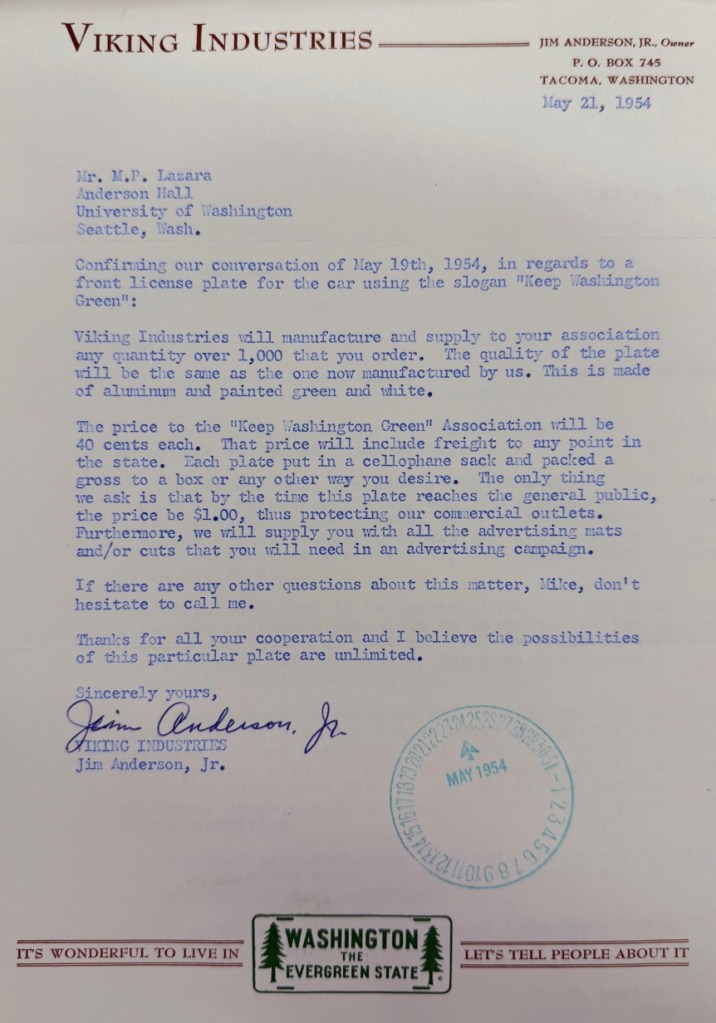
According to surviving correspondence, it appears that on May 15, 1954, the head of Viking, Jim Anderson, Jr., called Mike Lazara, director of Keep Washington Green, with a proposal to manufacture and sell a Keep Washington Green license plate. The following day, Director Lazara mailed Anderson sample graphics and outlined the potential for a manufacturing and sales deal, pending agreement from the KWG executive board.
Things moved quickly. In less than a week, Viking Industries and Keep Washington Green had agreed on terms to manufacture the license plate that would become a lasting and beloved piece of Washington state automotive history.
The production terms with Viking Industries were outlined in a May 19 letter from KWG director Mike Lazara, and stated that Viking would provide the license plates to KWG at Viking’s cost of $0.40 per plate. KWG agreed not to resell the plates for less than $1.00 each. Viking Industries retained the right to sell the Keep Washington Green license plates through its own networks, for its own profit, but was explicitly prohibited from stating or implying that its direct sales of the plates benefited the Keep Washington Green association.
The first batch of 500 license plates were received by Keep Washington Green on June 22, and advertising campaigns immediately followed.
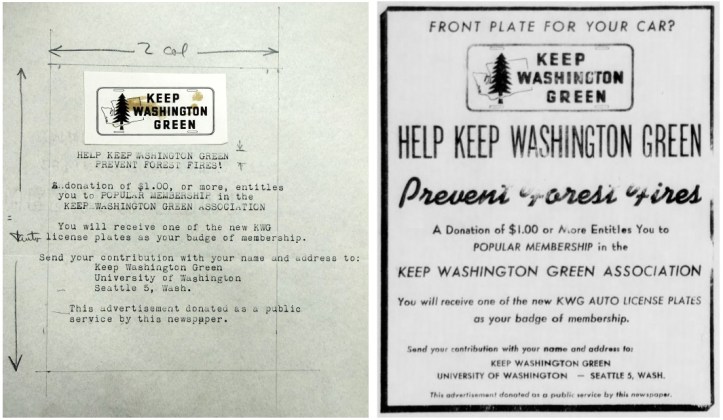
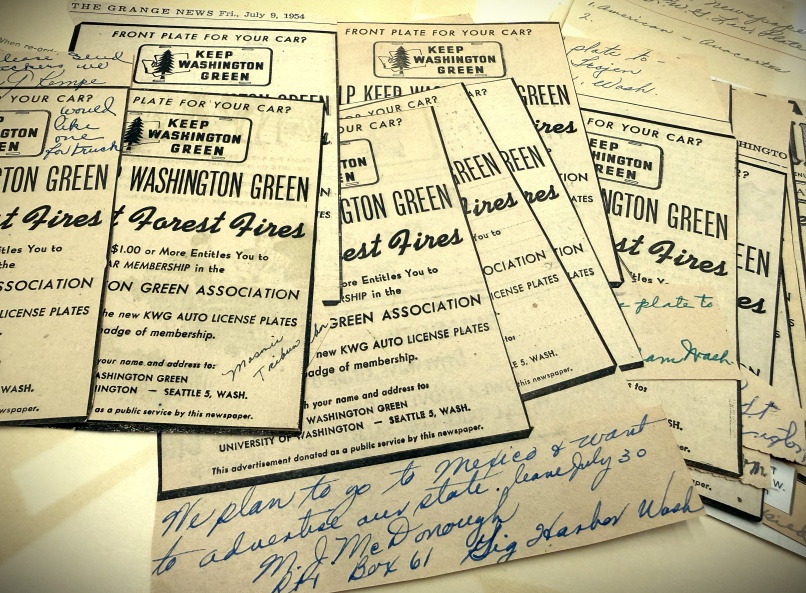
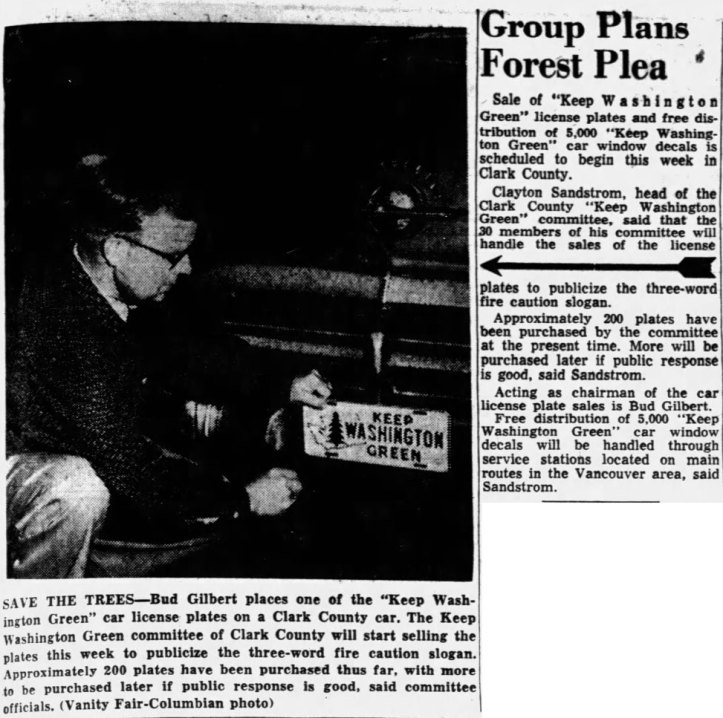
Supporting organizations, such as lumber companies, bought them in bulk. So did city governments and retailers. Community groups sold them, and newspaper ads were used as order forms by the general public, who would cut them out and remit them, with money, to the organization’s headquarters at UW.
The advertising graphics of the plates had some noticeable differences to the final, produced designs, with the promotional artwork showing the trunk of the tree continuing below the state outline and the “KEEP” offset instead of centered with the rest of the wording.
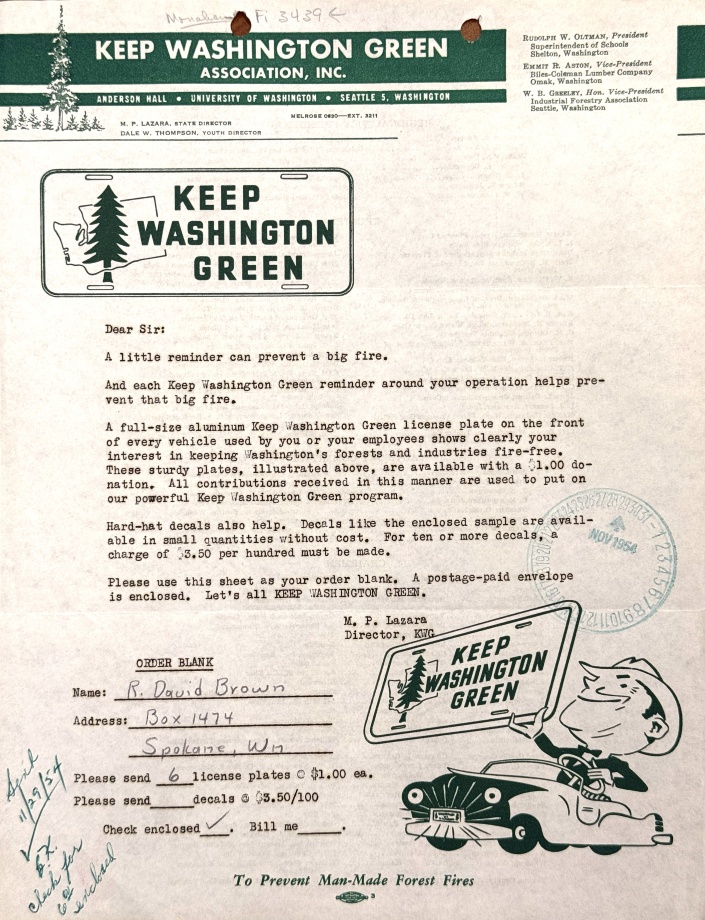
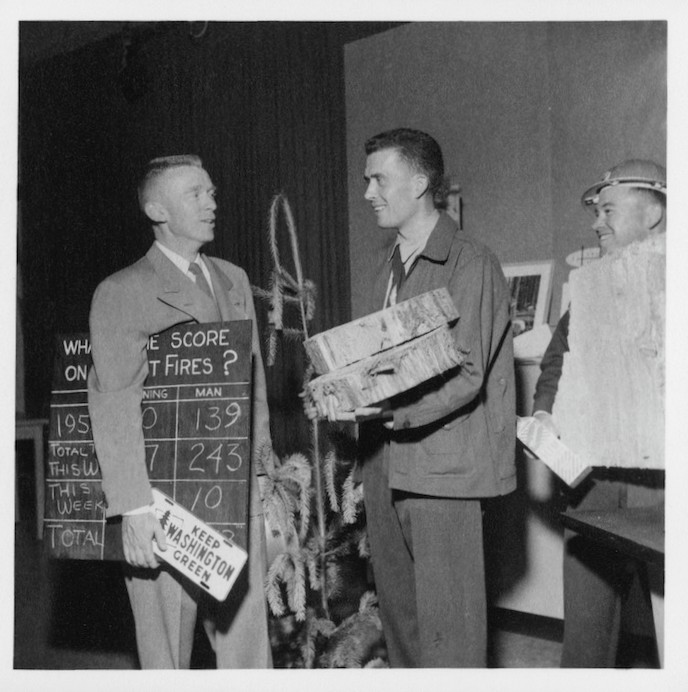
Archives of Keep Washington Green correspondence show the organization was quite generous in issuing complimentary plates to individuals or organizations, seeing more value in driving awareness than raising money.
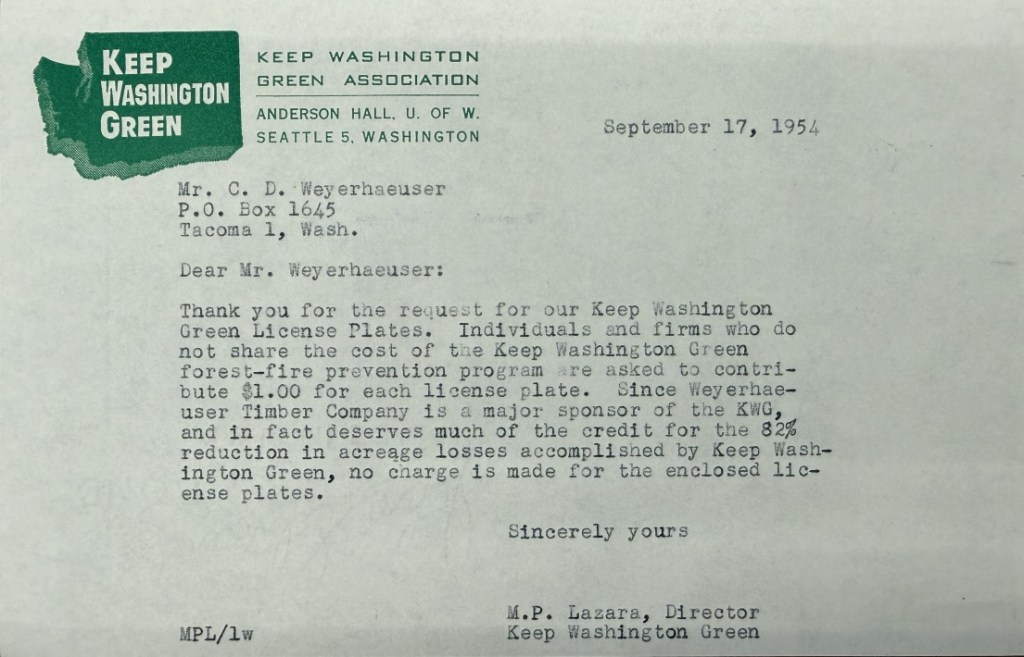
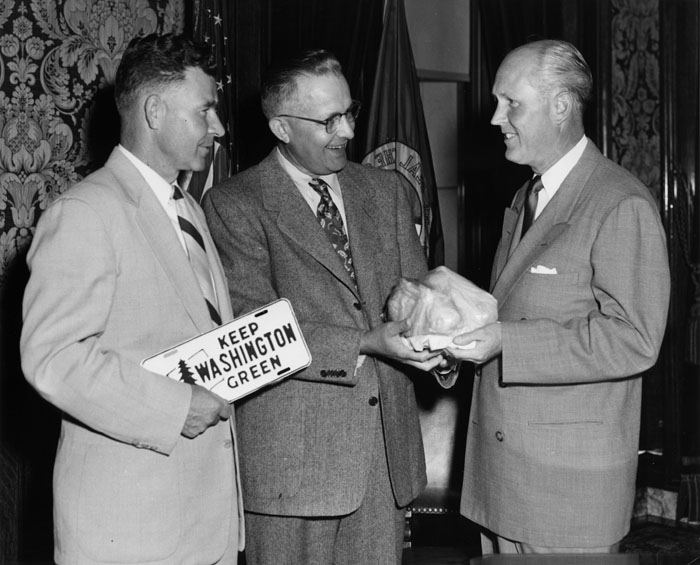
Independently from Keep Washington Green’s marketing and recruitment efforts, Viking Industries added the Keep Washington Green design to its license plate portfolio, selling through its own retail channels alongside its “Washington The Evergreen State” plate.
Government-owned vehicles, logging trucks, private cars – the plates appeared everywhere. They would have likely continued to be a major success…..except for updated state regulations.
At the end of 1954, the Department of Licenses backtracked on its controversial decision to issue 1954 license plates as singles and shipped every registered vehicle a new license plate for the front of the car. The days of empty front bumper spaces were over.
Over its six-month run, the Keep Washington Green license plates sold well, and survivors today are perhaps some of the most tangible reminders of the movement.
Later Years
With Washington state once again requiring front and back license plates, the front booster plate market was dead. License plate toppers were fading out as well – license plate dimensions were standardized in North America in 1956, and car designs took advantage of the uniform size by increasingly boxing the license plates into recessed wells, which brought styling innovations to the auto industry, but also made large attachments less feasible.
There is no indication that Keep Washington Green continued on with license plates or attachments after the midpoint of the 1950s. Car-based advertising continued in the form of window and bumper stickers, however.
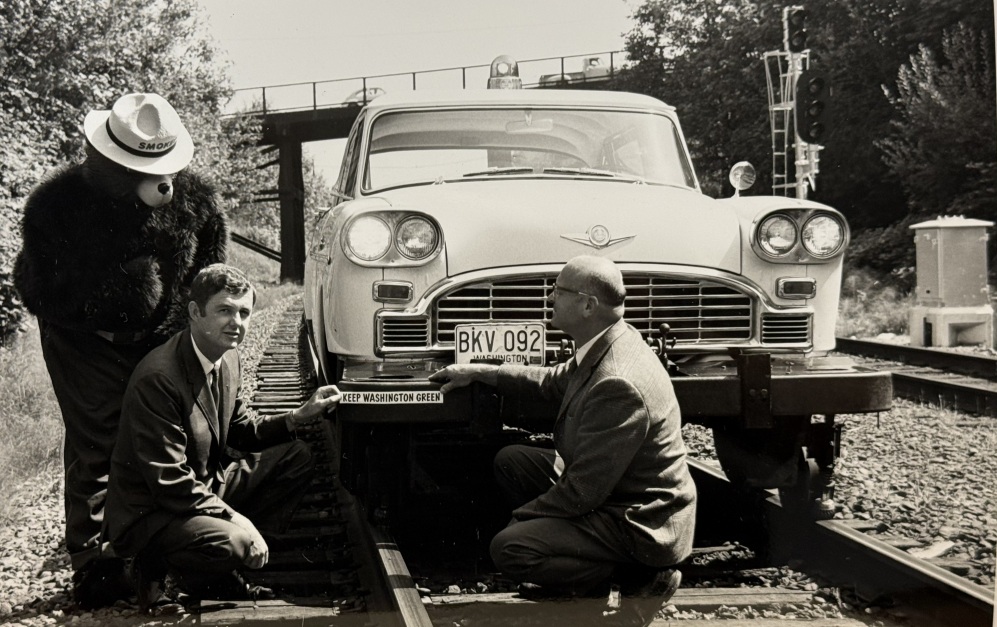
The movement continued to be quite active with road-based advertising, placing billboards and painted messages on roadways throughout the state. In 1951, at the same time the organization still harbored dreams of the slogan on the state’s official license plates, an idea had briefly been floated to place a giant, neon “Keep Washington Green” sign over the tunnel entrance of the (now I-90) floating bridge between Seattle and Mercer Island, but the cost was too high and association officials felt the money was better spent on smaller but more plentiful advertising around the state – another example of an icon that could have been.
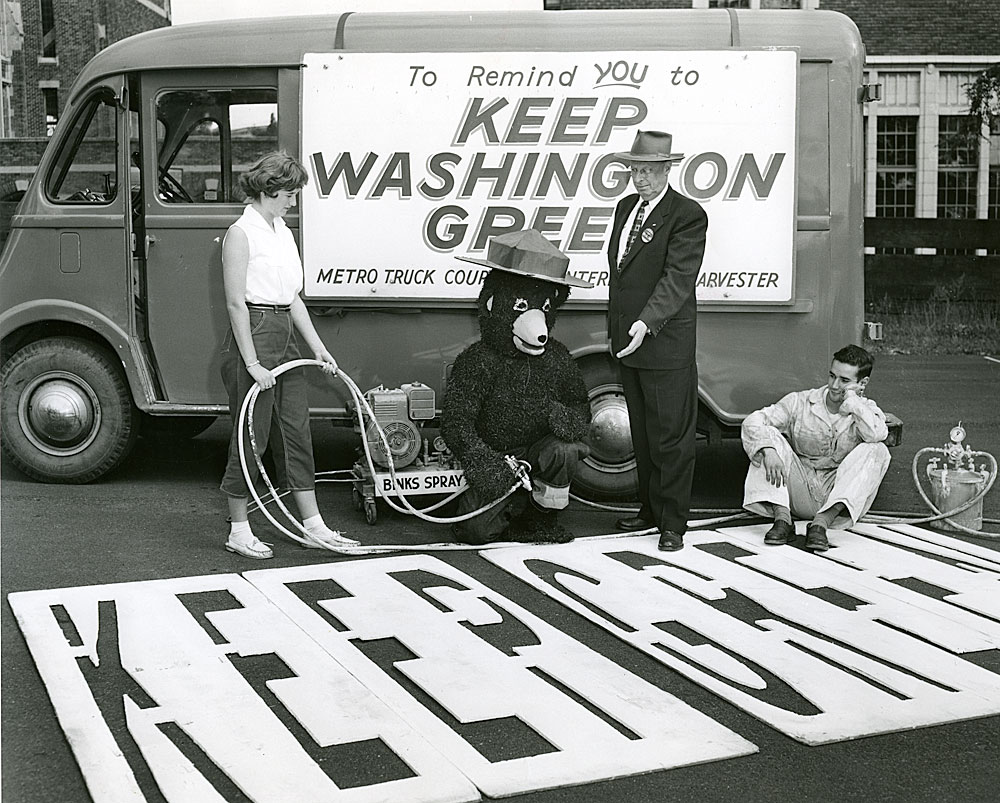
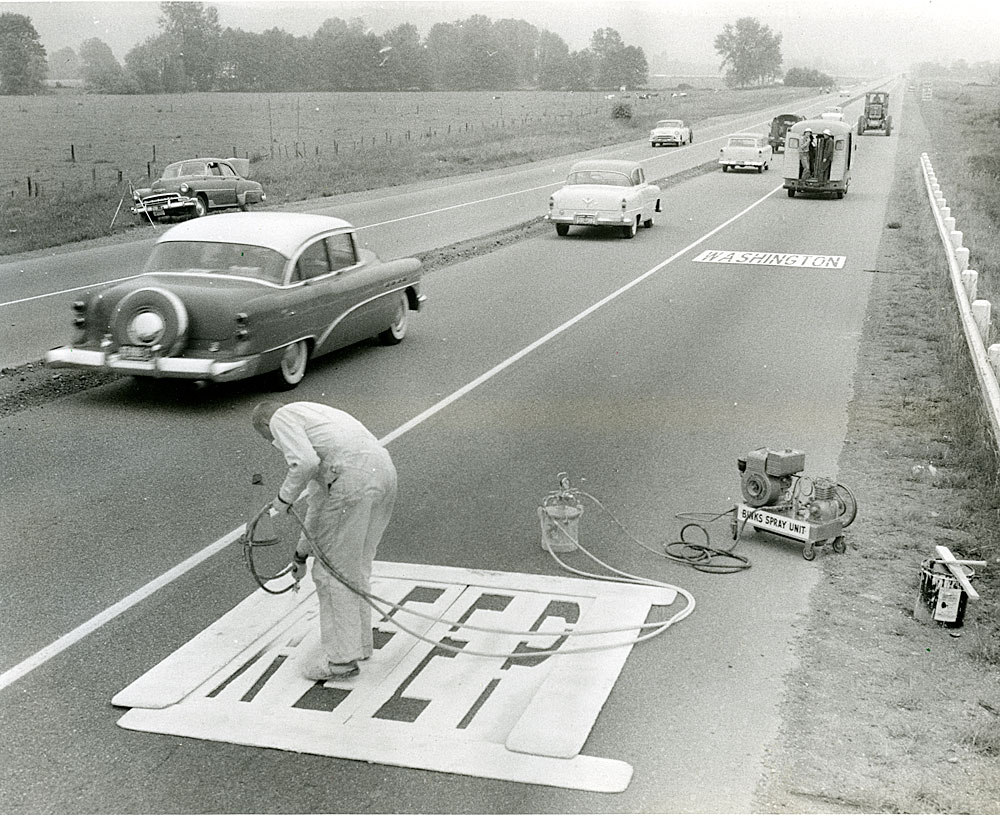
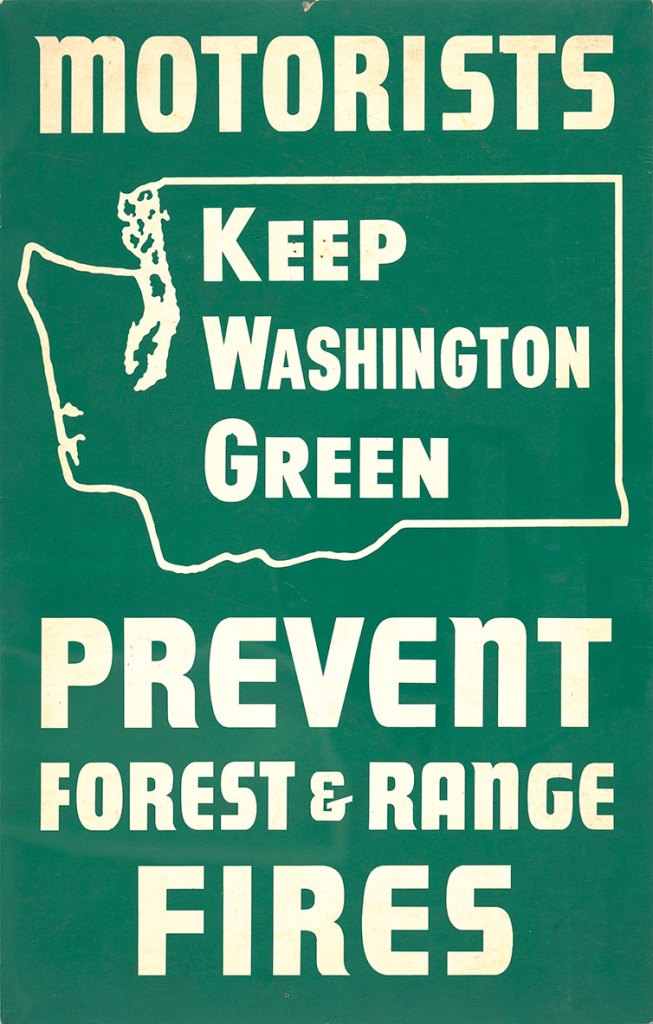
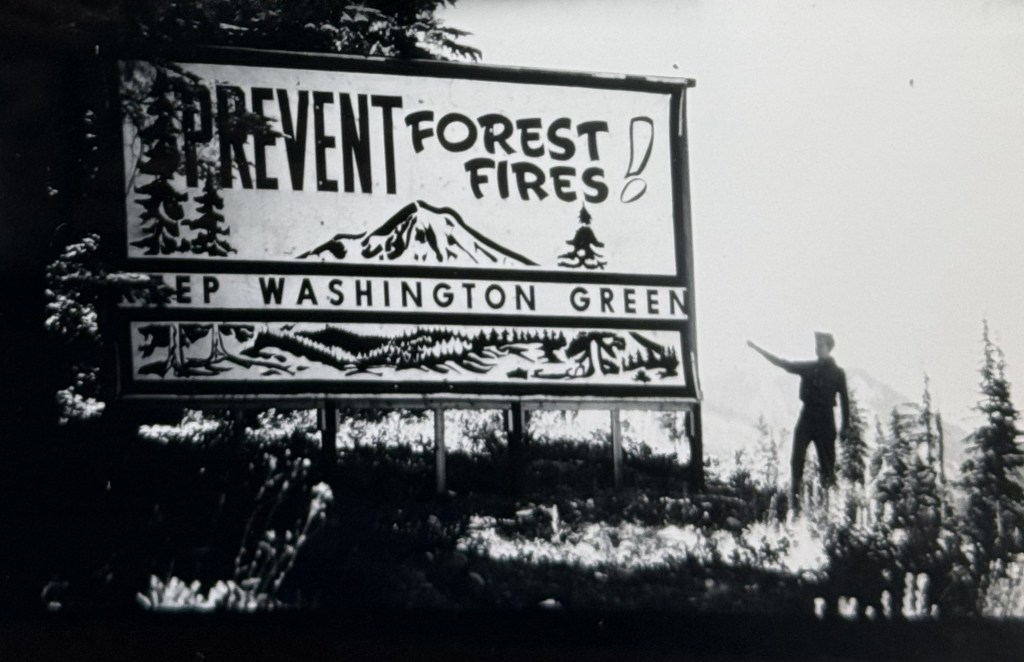
Forest fire danger never disappeared, but the state movement faded out toward the end of the twentieth century. Perhaps the message had been sufficiently received, or campaigns at the national level made state-level initiatives redundant.
Keep Washington Green dissolved in 1995, and similar organizations in most other states eventually faded away as well (the very active Keep Oregon Green is a notable exception).
Starting in 2026, Washingtonians have the option of promoting wildfire safety (sans the specific “Keep Washington Green” slogan) on official, state-issued license plates. The message is more important than ever, with Washington and Oregon both experiencing historically terrible fire years in the summer of 2026.
The Smokey Bear special design license plate officially launched on June 17, 2026, with proceeds funding the state Department of Natural Resources.
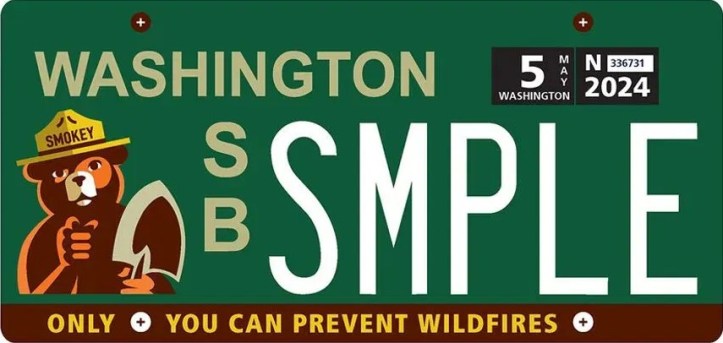
It might not say Keep Washington Green, but the devoted citizens that tried so hard to spread the message on the state’s license plates more than 75 years ago would likely be proud to see it.
Wanted! I am always looking to grow my license plate collection and am on the hunt for Keep Washington Green license plates, toppers, or attachments, Keep Washington Green bumper stickers or window stickers, or any additional information about these programs.
Other states, too! Keep Oregon Green license plate toppers or attachments, or any other state that had Keep Green license plate programs.
Please contact me here!


[…] the governor of Washington state launched the Keep Washington Green association in May 1940, he probably didn’t expect his movement to spread across the country. […]
LikeLike