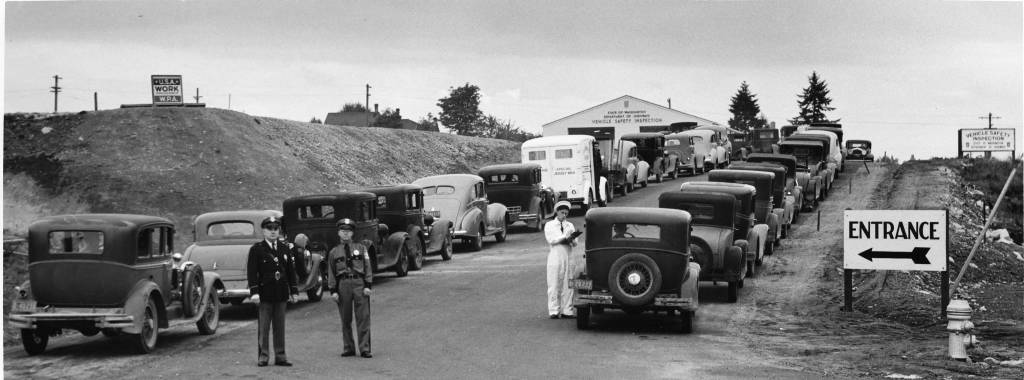
Cars lined up for testing at the state facility in Tacoma, October 9, 1939 (Tacoma Public Library)
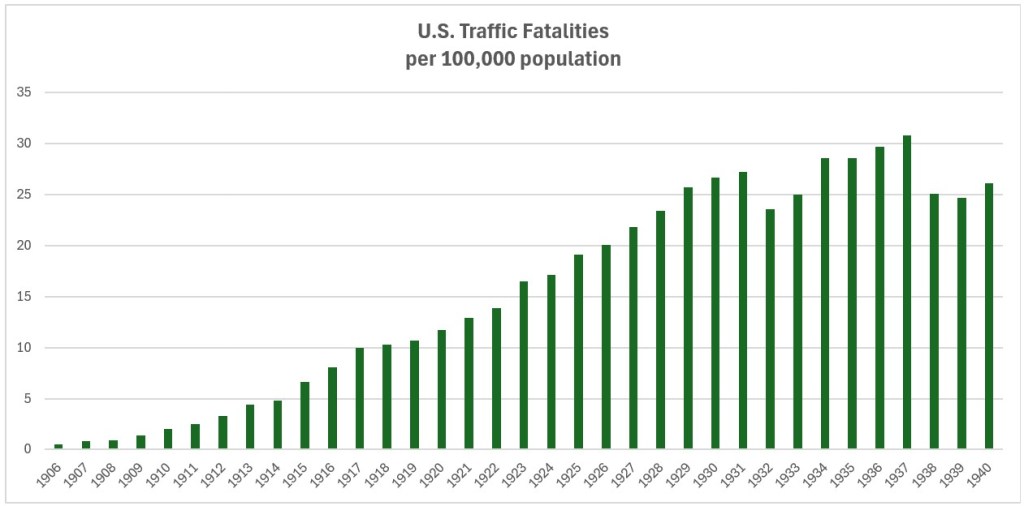
Publicizing the total of motoring injuries – almost a million last year, with 36,000 deaths – never gets to first base in jarring the motorist into a realization of the appalling risks of motoring. He does not translate dry statistics into a reality of blood and agony
Motor vehicle safety was top of mind across the country in the late 1930s. The automobile’s ubiquity in daily life, coupled with improved roads and more powerful cars resulting in more high-speed travel, brought along increased death and injury rates. Heightened public awareness drove safety campaigns all across the United States.
The biggest impact to residents of the Evergreen State came from the State of Washington’s safety inspection program, launched in 1938, which subjected every state-licensed vehicle to a series of annual tests.
The initiative required the construction of inspection garages all across the state, staffed by state officials using state-of-the-art equipment to assess the condition of a vehicle’s tires, headlights, windshield, lighting, brakes, and general state of upkeep. And it required vehicle owners to perform an annual trip into the local station to undergo all those tests.
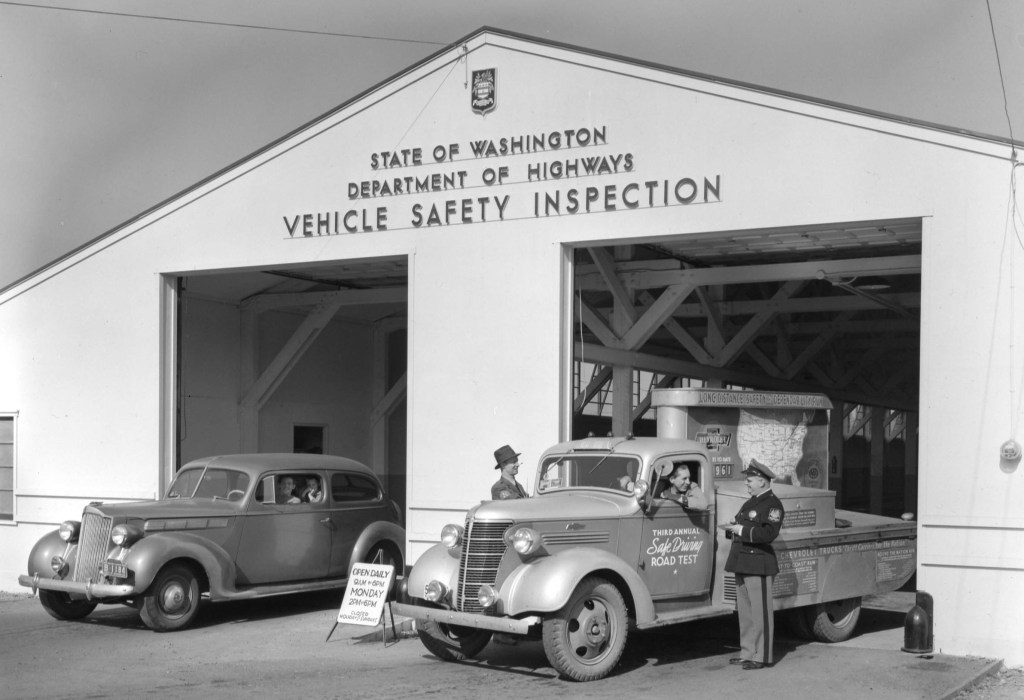
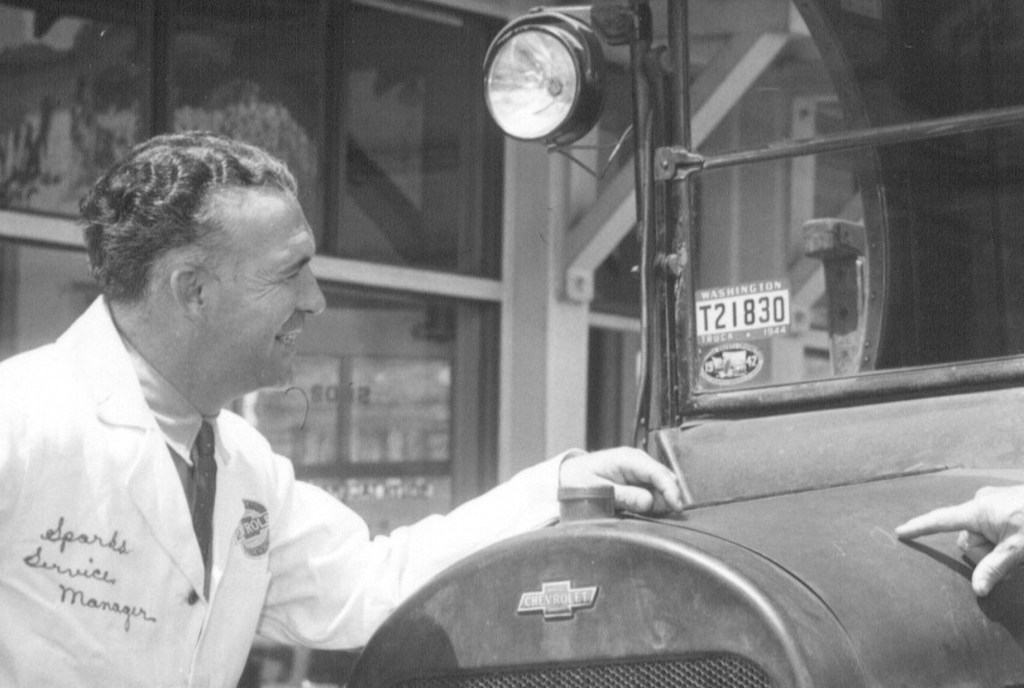
Chevrolet’s “Safe Driving” truck, driven by racecar driver Harry Hartz on a cross-country promotional tour, stopped into the Tacoma station for an inspection on October 13, 1939 (Tacoma Public Library)
Vehicle inspections were all the rage in the 1930s as cities and states across the U.S. implemented testing programs, and the go-to company for obtaining that equipment was the Weaver Manufacturing Company of Springfield, Illinois. It trademarked the “Safety Lane” name in 1932 and offered just about any kind of testing equipment or forms needed.
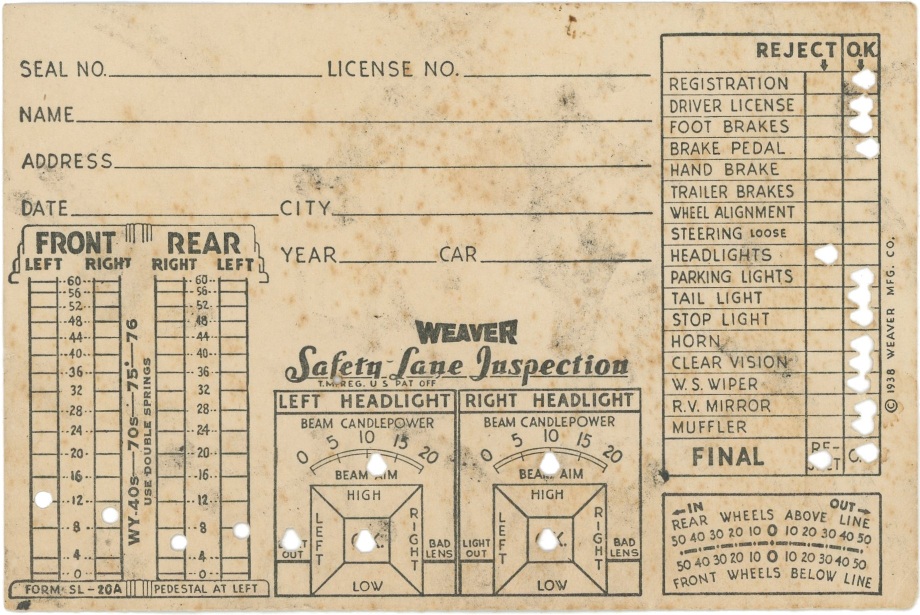
Weaver Safety Lane inspection card
Washington’s testing stations were equipped with Weaver Safety Lane equipment, and when the state mandate for testing died off at the end of the 1940s, car dealers and garages advertised their inspection services, noting they used the same Weaver equipment as the state.
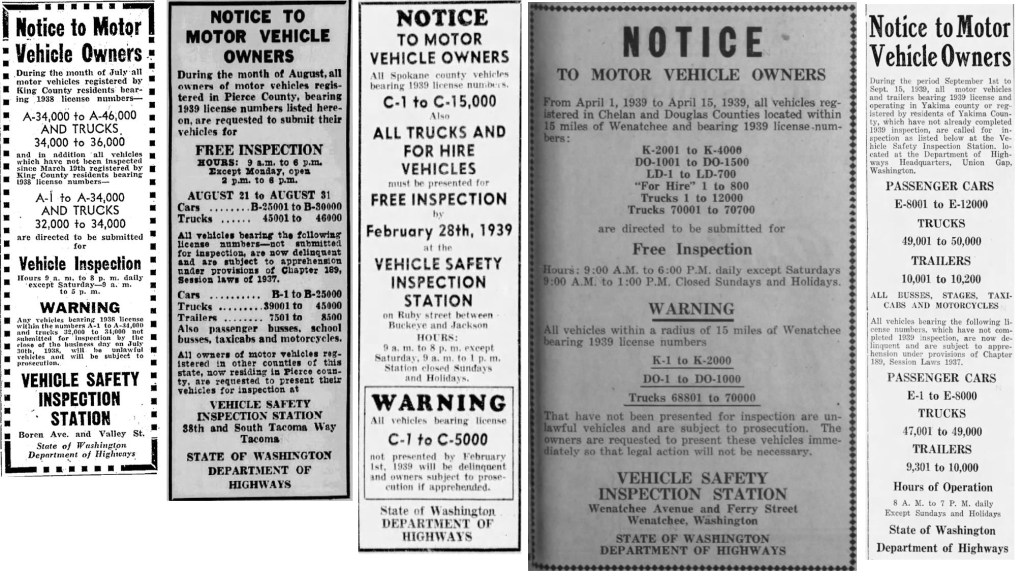
A vehicle’s license plate number determined when it was due for an inspection, with large blocks of numbers selected for specific timing windows. These blocks were publicly announced in local newspapers across the state, and reminder cards were mailed to registered vehicle owners.
A sampling of testing notices published in local newspapers throughout 1939
Washington Safety Inspection Windshield Stickers
To track which vehicles had undergone their required testing, inspection stickers were placed onto the lower passenger-side windshield, indicating a pass or fail. These stickers were familiar sights in the State of Washington, and often appear as indistinct blotches on windshields in period photos.
For the first few years of the program, inspection stickers were a simple octagon, with a bust of George Washington on the front. From a distance, they bear a close resemblance to the similarly-shaped National Park entrance permits used through the end of the 1930s.
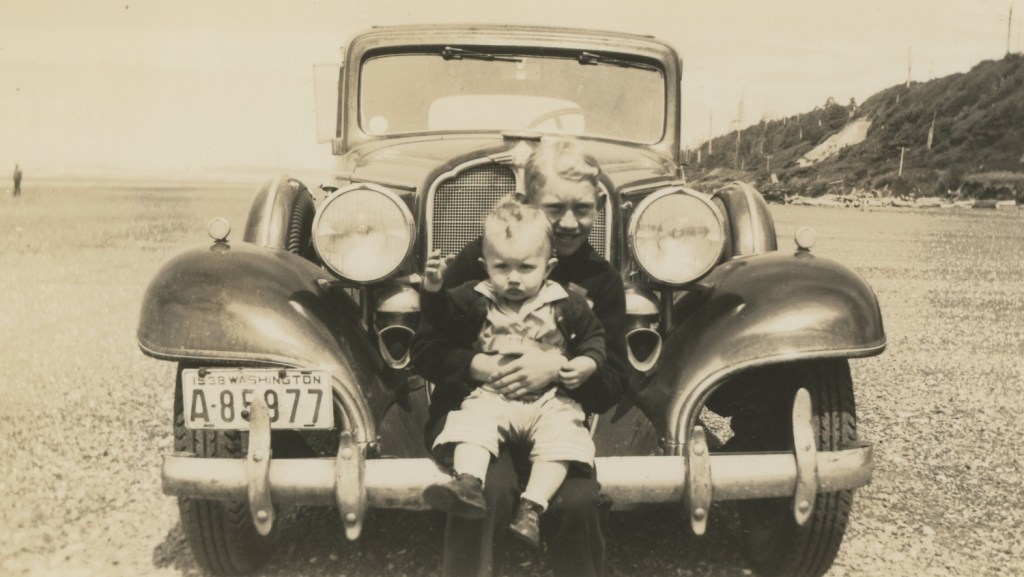
For 1938, a white sticker indicated a passing evaluation, and a red one indicated a failed review.
This 1938 photo of a King County-registered car at the beach shows what is likely a white 1938 state inspection sticker in the lower windshield on the passenger side (snapshot from my collection)
Inspections were not compulsory in 1938, but starting in 1939 were enforced by law. The public emphasis on safety also resulted in the new requirement for driver testing the same year.
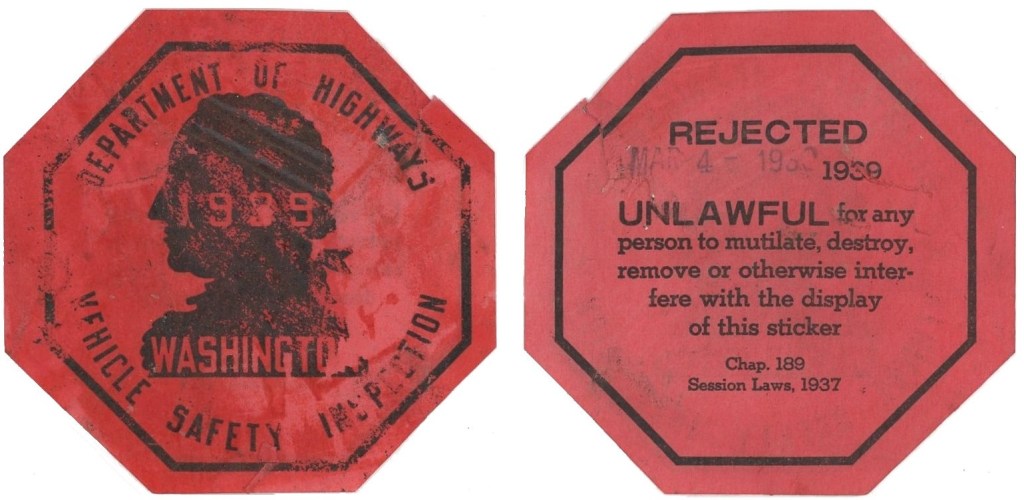
For 1939, an “O.K.” inspection outcome resulted in a gold-colored sticker affixed to the windshield. A failure brought a bright red one.
The scarlet decal of shame: 1939 rejected inspection sticker was for some reason saved by the vehicle owner after it was scraped off the windshield. Issued March 4, 1939 per the stamp
A red sticker granted the vehicle owner ten days to address the defective items on the vehicle and return for a follow-up inspection.
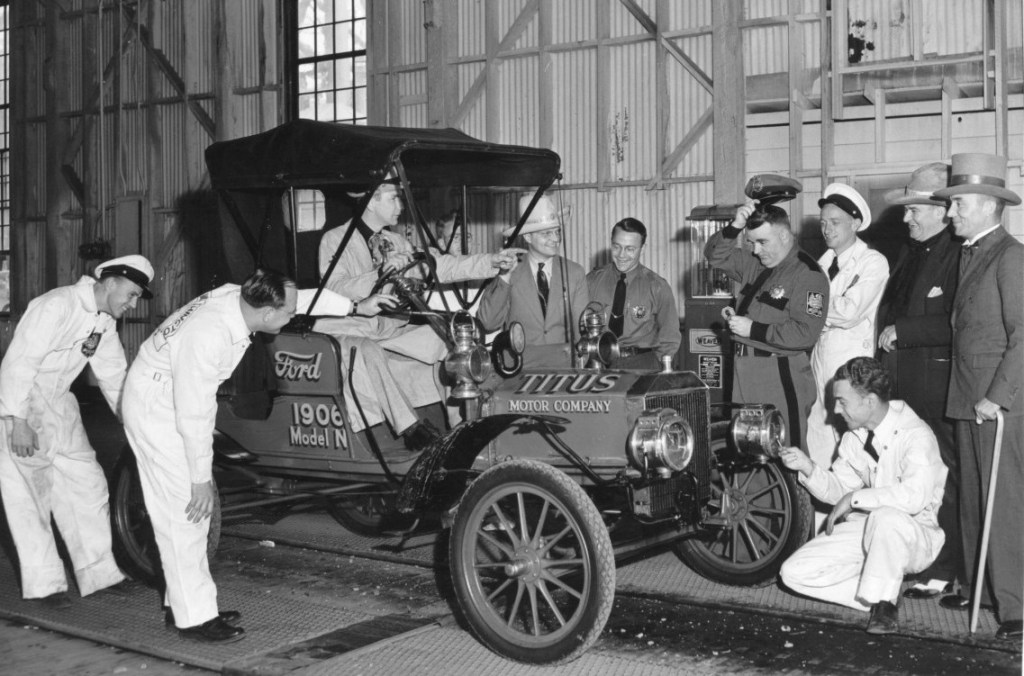
As a gag, on July 20, 1939, the Titus Motor Company (which evolved into the modern-day Titus-Will Ford) brought its 1906 Ford Model N for a test (Tacoma Public Library)
The inspector feigning confusion on where to place the testing sticker, given the lack of a windshield.
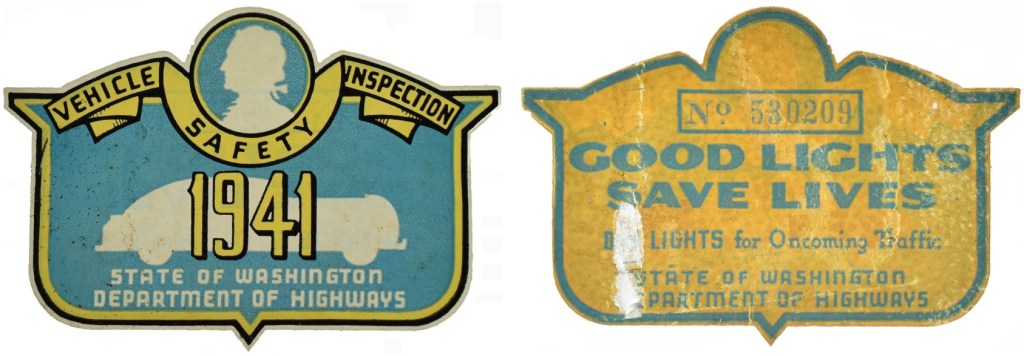
For 1941, the sticker format evolved from the simple octagonal shape used until that point into a larger, more bold and ornate design. A bright blue and yellow color, it featured the silhouette of a very period-unique car. A front-seat passenger, with the backside of the sticker at eye-level, would have a prominent reminder that GOOD LIGHTS SAVE LIVES and perhaps would remind the driver to “Dim lights for oncoming traffic.”
This 1941 safety inspection sticker survives attached to a scrap of the car’s windshield
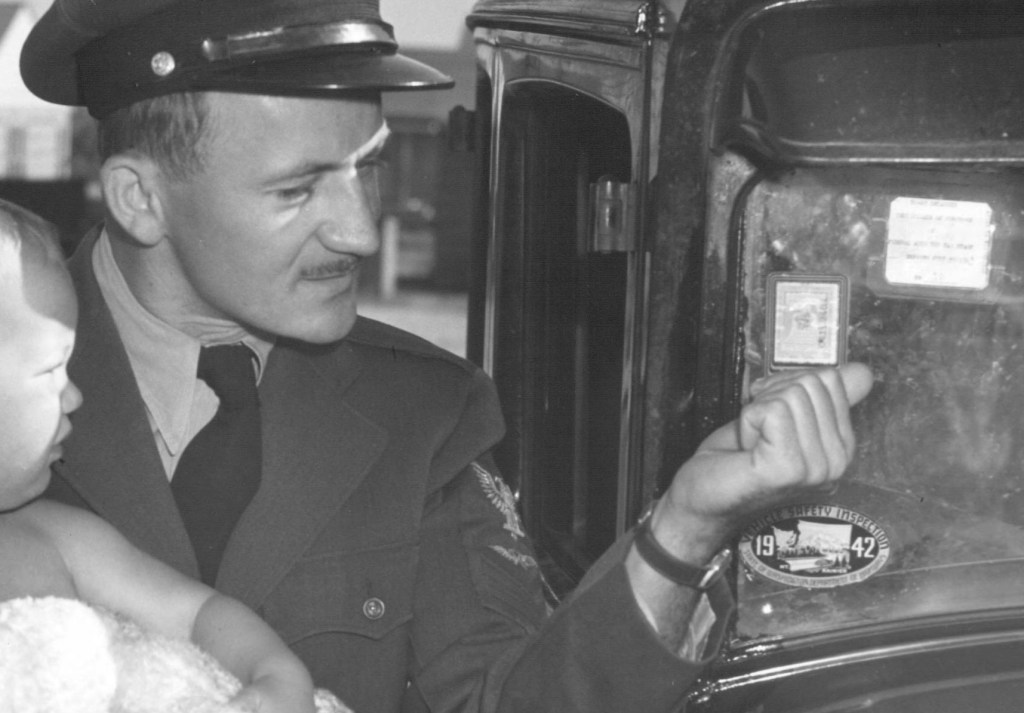
1942’s sticker continued the larger size, in an oval shape, with an outline of Washington State and a rendering of Mt. Rainier in the center.
1942 Washington Safety Inspection sticker, accompanied by a federal war revenue stamp (Tacoma Public Library)
Presumably, some form of safety message and serial number was displayed on the rear. It would likely be seared into the memory of anyone riding shotgun in a car for the next half-decade, because world events caused the 1942 decal to stick around for quite some time.
Interrupted by War
The U.S. entry into World War II disrupted most aspects of life on the homefront, including Washington’s vehicle inspection program.
In November 1942, the state announced a four-month hiatus of testing. The reasons were myriad: there were labor shortages of testers due to the military draft and demand for defense-related jobs; gas and tire rationing placed a higher burden on citizens making mandatory additional car trips to the testing stations; and cars were subjected to newly-imposed federal tire testing, creating a redundancy of multiple test regimes.
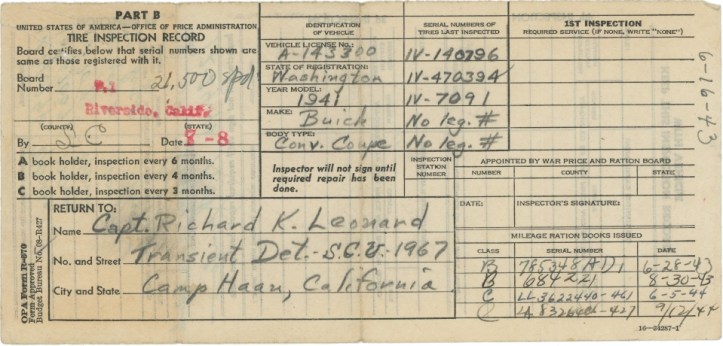
1943 federal tire inspection record for Seattleite Richard K. Leonard, then stationed at Camp Haan, California
The 1943 state legislature, accordingly, repealed the mandate for state-imposed vehicle inspections.
Consequently, 1942 inspection stickers lingered on windshields for many years, joined by a multitude of other state- and federally-issued stickers. A war-era windshield would typically also display gas ration cards, federal use tax stamps, and windshield decals to renew the license plates in years where metal shortages prevented issuance of new ones. So many windshield permits and licenses appeared on wartime windshields that state officials asked civil defense coordinators to place their stickers on the driver’s side window instead of the windshield.
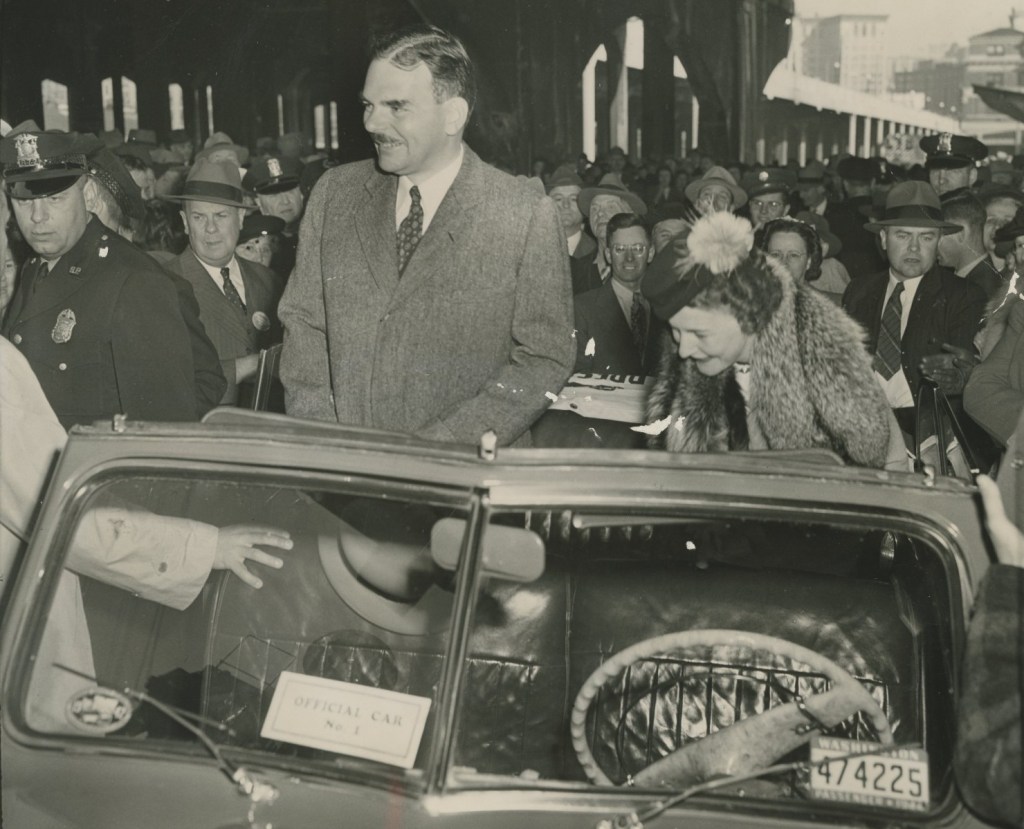
Governor Thomas Dewey, campaigning in Seattle on September 18, 1944. The car retained a 1942 inspection sticker from its final inspection, along with a 1944 state license decal on the driver’s side, which extended the validity of the 1942 license plates (press photo from my collection)
Washington state vehicles were generally frozen in 1942 for most of the war years: the 1942 inspection stickers remained on windshield, and the 1942 license plates stayed put until 1945, thanks to restrictions on the metal supply.
This truck, wearing a 1947 license plate in the uncropped photo, displayed a history lesson on its windshield, retaining its 1944 license decal that renewed its 1942 license plate, and a 1942 state inspection sticker (Tacoma Public Library)
Gradual Peacetime Resumption
With the end of World War II came a return to old practices. In September 1945, inspection stations reopened across the state, but this time on a voluntary basis. Motorists could bring their vehicles in for evaluation at their own initiative, and authorities could also compel an inspection when a defect was noted or suspected.
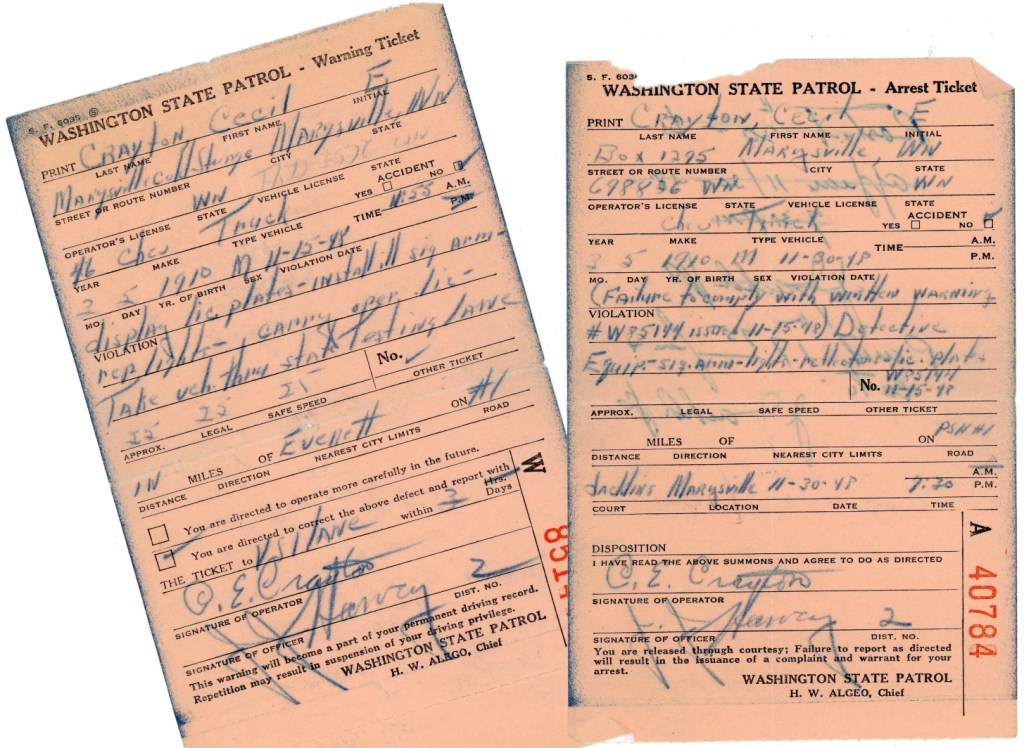
Report to the testing station! November 1948 was a tough month for Cecil Crayton of Marysville. On the 15th, he was stopped by a State Patrol officer and issued a warning ticket for his noncompliant truck (missing license plates, missing signal arm, a broken light, and also not carrying driver’s license). The officer instructed him to “Take veh thru state testing lane.” Fifteen days later, Cecil had left these issued unaddressed and was issued an arrest ticket
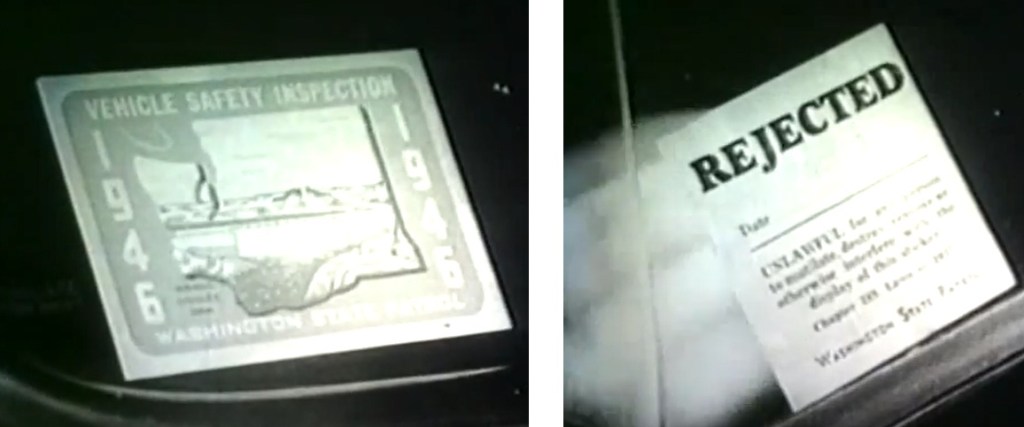
Three types of stickers were issued: “Approved,” “Rejected,” or “Condemned.”
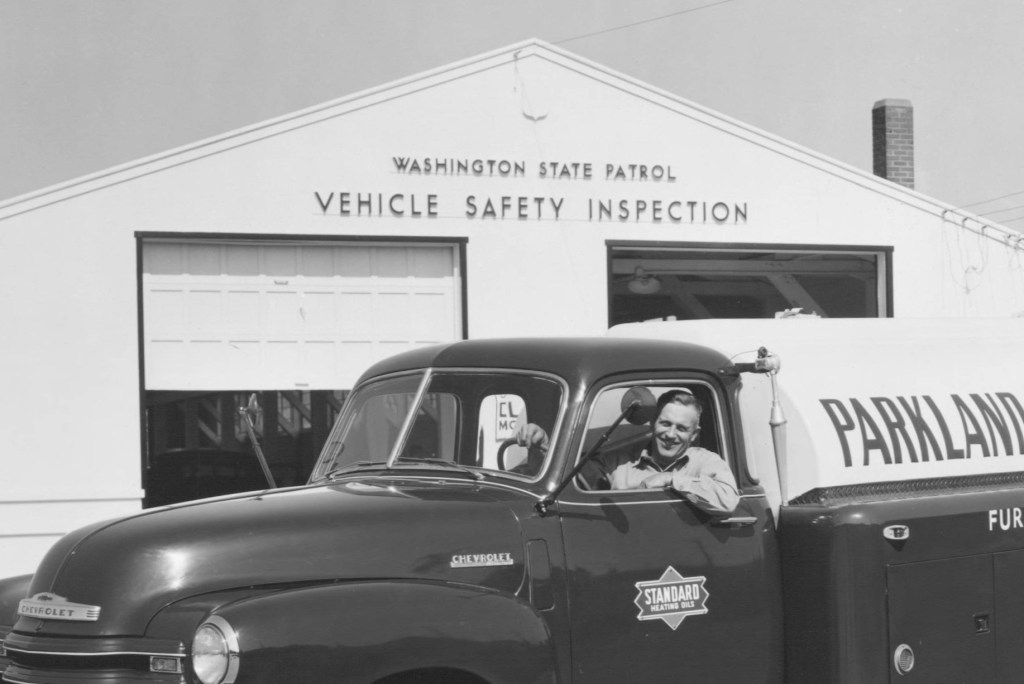
Another change from the pre-War years was the Washington State Patrol taking over testing responsibilities from the Department of Highways, based on updated legislation passed in early 1945. Inspection station signage and stickers noted this change in purview.
This 1947 photo shows the Washington State Patrol’s name replacing the departed Department of Highways (Tacoma Public Library)
Footage of an inspection station in 1946 is included in a Washington State History video:
1946 inspection stickers, as shown in a period Washington State Patrol film
Mandatory Inspections Return
The 1947 state legislature reimposed mandatory inspections, giving the Chief of the Washington State Patrol the authority to “establish periods of vehicle equipment inspection.”
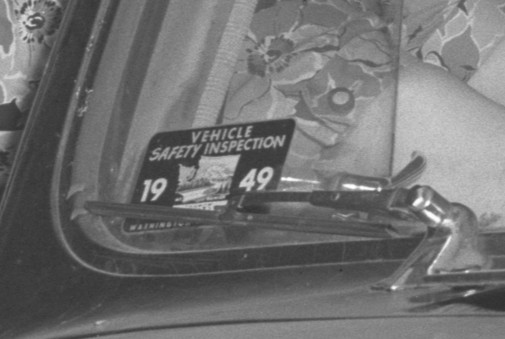
By midyear, inspections were again compulsory, with the license plate number blocks due for testing published in local newspapers. Mailing notices were not sent to vehicle owners due to budgetary constraints. The 1947 vehicle safety inspection windshield stickers were orange and blue, per period Newspaper descriptions (unless, of course, the vehicle failed the tests and received the dreaded red sticker).
The public can always be counted on to procrastinate, and the testing mandates doubled that tendency. Vehicles had been called for testing based on license plate number, with the lowest numbers due first in the early parts of each year. This had the unintended consequence of causing delays in the annual licensing process. It was already difficult for county auditors to coax the population into registering their cars before the last day of each year, but because most motorists also wanted to put off their testing duty as long as possible, officials found that more and more people waited until the last minute to process their vehicle renewal each December. The longer they waited, the higher the resulting license number, and the longer time until inspections were due.
Catching on to the trend, officials in the late 1940s began randomizing the sequence for testing a bit. In Clark County, the Columbian reported that the first license numbers subject to testing for 1949 were G-12000 to G-14000, intentionally pulled from the middle of the number range.
Faded Out
While much of the public continued to value mandatory inspections in the interest of public safety, the state legislature became less inclined to fund the endeavor. In 1949, funding was drastically reduced, and inspection stations began closing across the state.
The Spokane Chronicle reported on March 19 of that year that the State Patrol was to end the inspection program effective March 31. Acting State Patrol chief Roy F. Carlson told the paper that “the law requiring the inspection of vehicles was still on the books but the appropriation for carrying out its provisions during the next two years had been cut to $50,000 – enough for inspecting school buses only.” Two years earlier, state appropriations for the program had been $1,000,000.
The Chronicle had reported earlier, on March 1, that the legislature defunded the program for two reasons: first, some inspectors had been “obnoxious” in their methods, with complaints that full windshield replacements had been mandated based on small chips; and second, a Washington State Patrol finding that less than seven per cent of accidents were chiefly caused by vehicle defects. Other priorities, including salary increases for troopers and a widespread upgrade of patrol cars, ranked more highly.
As a result, permanent testing lanes in Spokane, Seattle, Tacoma, Wenatchee, Yakima, Vancouver, and Aberdeen were closed, and plans to open new lanes in Kennewick, Longview, and Everett were cancelled.
The State Patrol could still compel safety inspections for vehicles that were suspected to be defective or unsafe, but the yearly ritual of waiting in testing lines was over for the average car owner.
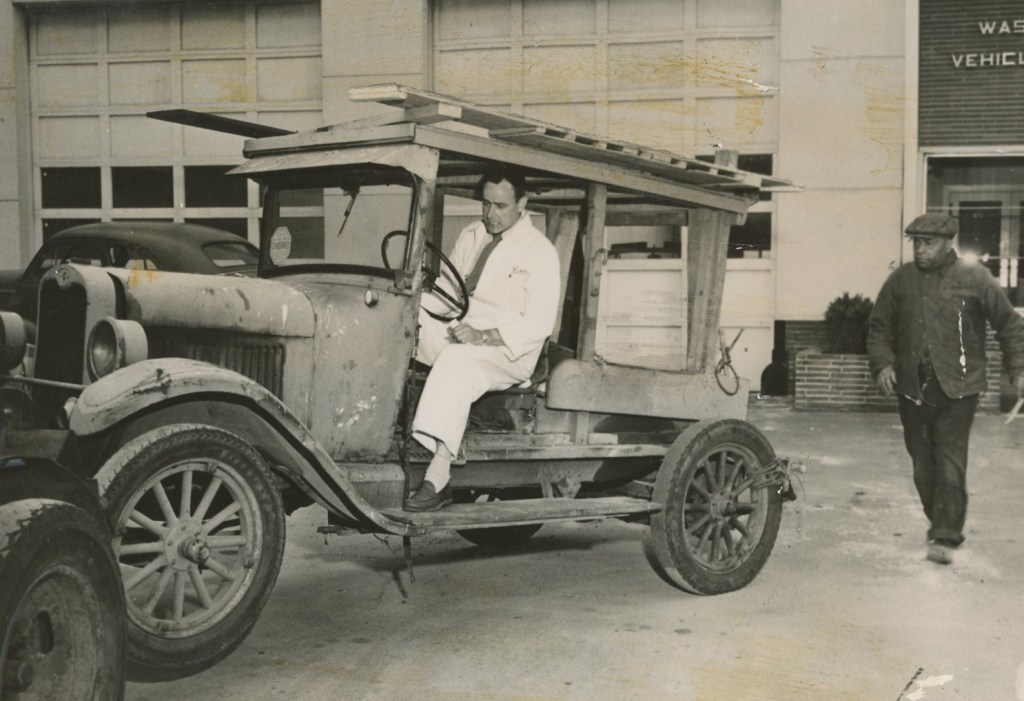
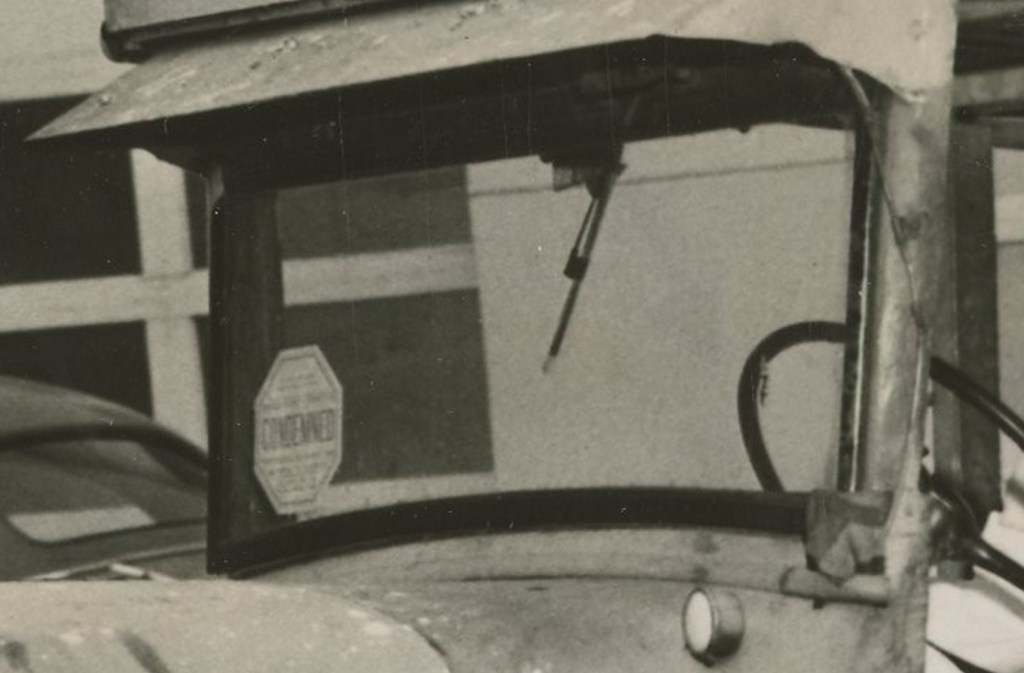
Condemned! This press photo from my collection, dated June 22, 1950, shows a derelict Seattle vehicle that received the worst possible test result. The accompanying text quotes the State Patrol testers saying it was “one of the worst we’ve seen.” It notes that “the inspection card, on which defects are marked by punches, had more holes in it than any other in the memory of Inspector Don Corey.”The oversized “condemned” sticker issued to the jalopy. Per policy, officials confiscated the license plates and registration certificate, to be returned only upon a satisfactory re-inspection, and ordered the vehicle towed directly to the owner’s residence.
Wanted!
I am always looking to add to my collection of Washington state vehicle licensing history, and to learn more about any of these items. Please contact me if you have surviving Washington State vehicle safety inspection stickers that could use a new home, or any interesting photos or records to share.
[…] didn’t make it onto the 1952 license plate decals, it did find its way onto the back of 1952 safety inspection stickers (there had been discussion of adding the Keep Washington Green slogan to State Patrol inspection […]


[…] didn’t make it onto the 1952 license plate decals, it did find its way onto the back of 1952 safety inspection stickers (there had been discussion of adding the Keep Washington Green slogan to State Patrol inspection […]
LikeLike