Below is an overview of Washington’s license plate history that I’ve compiled and illustrated with examples from my collection. Please do not reproduce without permission. I’d love hear from anyone who may have questions, comments, needs more information, or has some old plates that need a new home (please see my Items wanted).
Prestate era: 1905 to 1915
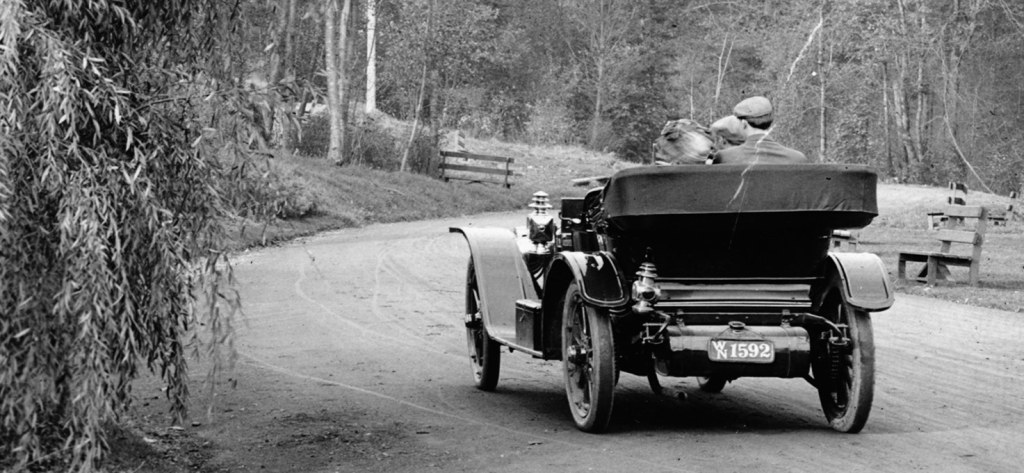
Things were primitive at the start. The horseless carriage was a novelty when it first appeared on public roads, and laws and regulations were not equipped to deal with them. As their population grew into the low hundreds in Washington state, calls for the automobile’s regulation made their way into legislative action.
Washington’s first laws regulating automobiles were effective June 7, 1905, and required that all motor vehicles be registered with the Secretary of State’s office, at which time the motorist would be assigned a registration number to be displayed on the rear of the vehicle, in “light arabic numerals at least four inches high on a dark background,” which were to be “preceded by the abbreviation ‘WN.'”
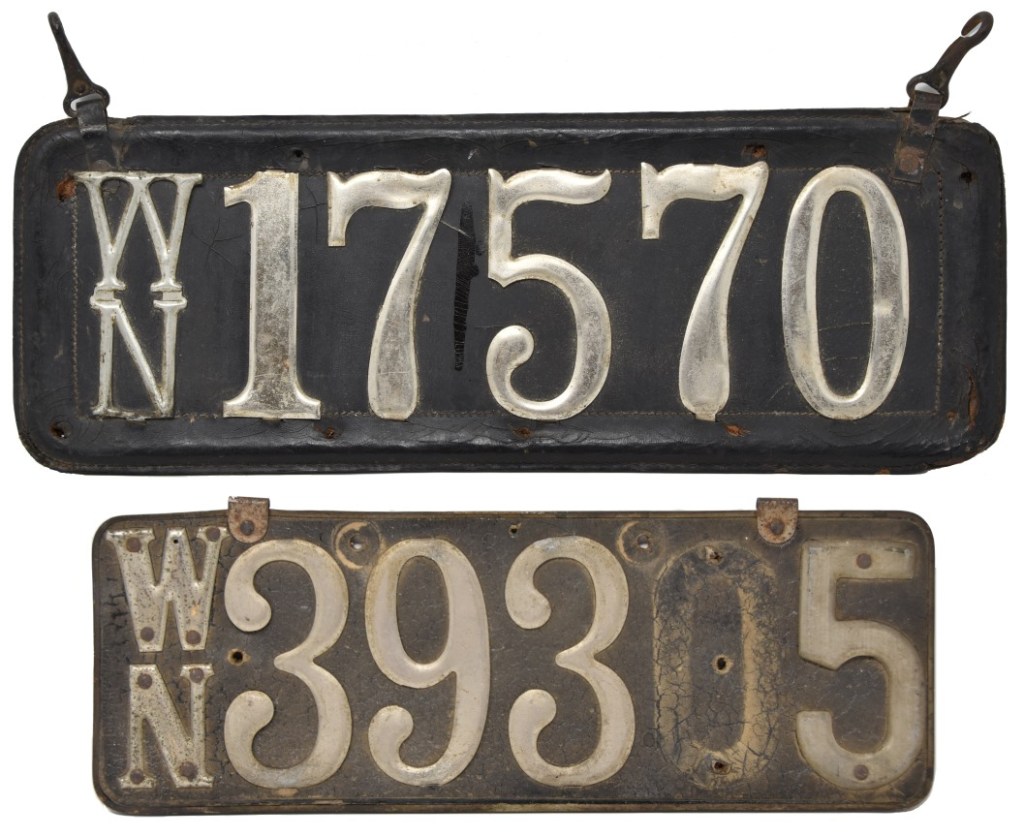
Only the number was furnished by the state; the owner was responsible for the method of displaying it. Common methods used metal house numbers mounted to leather or cardboard, but some licenses were custom-made out of metal, or sometimes merely painted directly on the vehicle. License plates from this era, before state-issued plates, are known as prestates (more on this era here).
For ten years, this was the extent of vehicle licensing in the state of Washington. All types of vehicles, regardless of class (car, motorcycle, truck, government-owned, for hire, etc.) received a simple number. As registrations lapsed over time, older dead numbers were recycled by the state. By the time this system ended in mid 1915, numbers were being assigned in the low 40000s.
1916: First State-Issued License Plates
The primitive method of owner-supplied license plates was outmatched by the massive explosion in vehicle registrations as the twentieth century entered its second decade. One especially vexing problem for law enforcement was ensuring a vehicle was properly registered and had paid the required fees: homemade license plates could be made with any made-up registration number, and while the $2 registration fee was due annually, there was no visual method of validating that payment.
By 1915, almost all U.S. states were supplying annually-dated, professionally-made license plates as a solution to these common problems. The state of Washington officially got into the business of issuing license plates when a new comprehensive motor vehicle law was passed in March 1915, effective June 10. Chapter 142 of the 1915 session laws outlined the processes for vehicle licensing, setting fees based on vehicle classes and assigning the secretary of state the duty to “furnish to each licensee of a motor vehicle two number plates containing the number to be displayed on such vehicle.”
On April 10, 1915, Charles E. Post & Company of Los Angeles beat out four other bidders and was awarded the contract to manufacture the 1916 license plates for a sum of $11,802. When the new law went into effect June 10, 1915, the handmade license plates on all vehicles in the state expired. Vehicle owners submitted licensing applications to their county auditor and received county-issued paper or cardboard temporary licenses pending their plates’ arrival from Olympia.
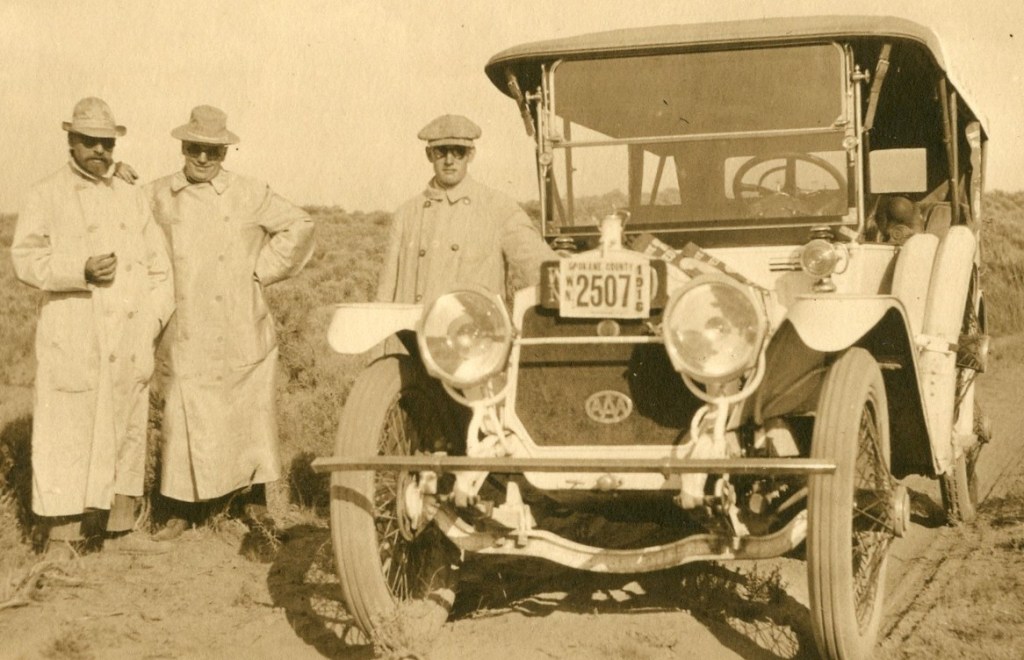
Plates were slow to arrive from the factory: only the first 400 licenses had been issued by June 15, and by July 15, only a total of 15,753 had been issued, with an estimated 20-25,000 still pending.
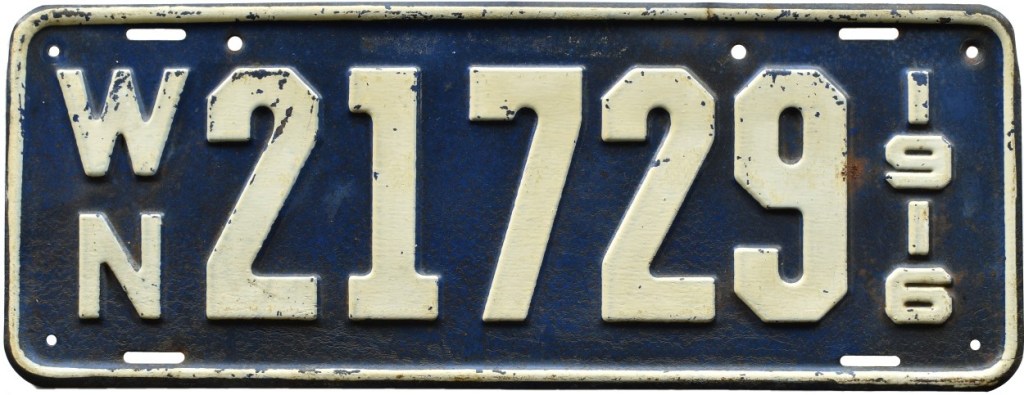
The 1916 issue was quite large (6 1/4″ tall and 16 1/2″ wide), and non-passenger types such as trucks or for hire vehicles had an additional 1 ¼” of height added, as the vehicle class was spelled out in large letters at the top. Under the terms of the auto law, the licensing period aligned to the state’s fiscal year (beginning of March to the end of February). The date displayed on the license plate indicated the expiration year (so the 1916 license plates expired February 29, 1916, and the 1917-dated issue was valid from March 1, 1916 to February 28, 1917). This system would continue until 1921.
“X” marks the plate: vehicle class codes added in 1917
Many changes were implemented in the state’s second year of issuing plates. After underbidding the Charles E Post company by a mere $19.75 (on a total bid of $9,352), the Seattle-based Pacific Coast Stamp Works was awarded the contract to produce the 1917 licenses, and would retain the state’s business for three years. The plate size was reduced and a letter code was introduced to designate the vehicle class, with “X” being issued to private passenger vehicles, “T” denoting trucks, etc. This system would remain in use through 1935.
The 1917 color scheme was an unusual choice for license plates. “Some nice old lady holding a state office has picked lavender,” was a snarky comment in the Lynden Tribune. Legibility was not a strong suit for white numbers on a lavender background (and is especially poor in old black-and-white photos). Paint quality was also a struggle for the Pacific Coast Stamp Works during its multi-year run as license plate supplier, with 1917 being the low point.
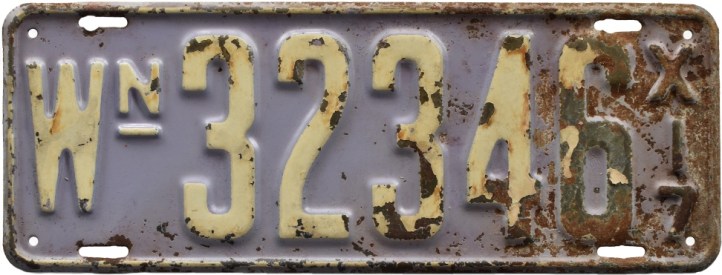
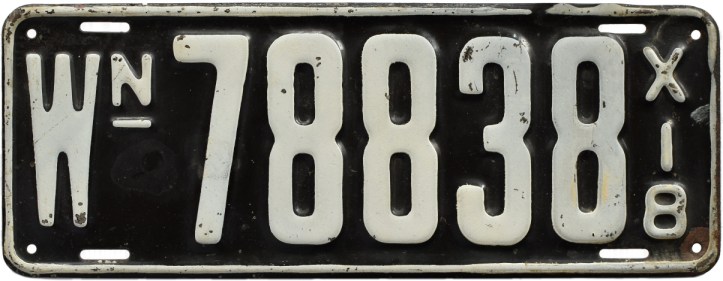
The format was largely unchanged for 1918, although a more legible white on black color scheme was used.
First attempts at renewal tabs
For 1919, the state began an experiment with multi-year plates, modeled after the practice California had used since 1916. The idea, which decades later would be commonly applied throughout the United States, was to save cost and materials by issuing a license plate that could be renewed each subsequent year with validation tabs.
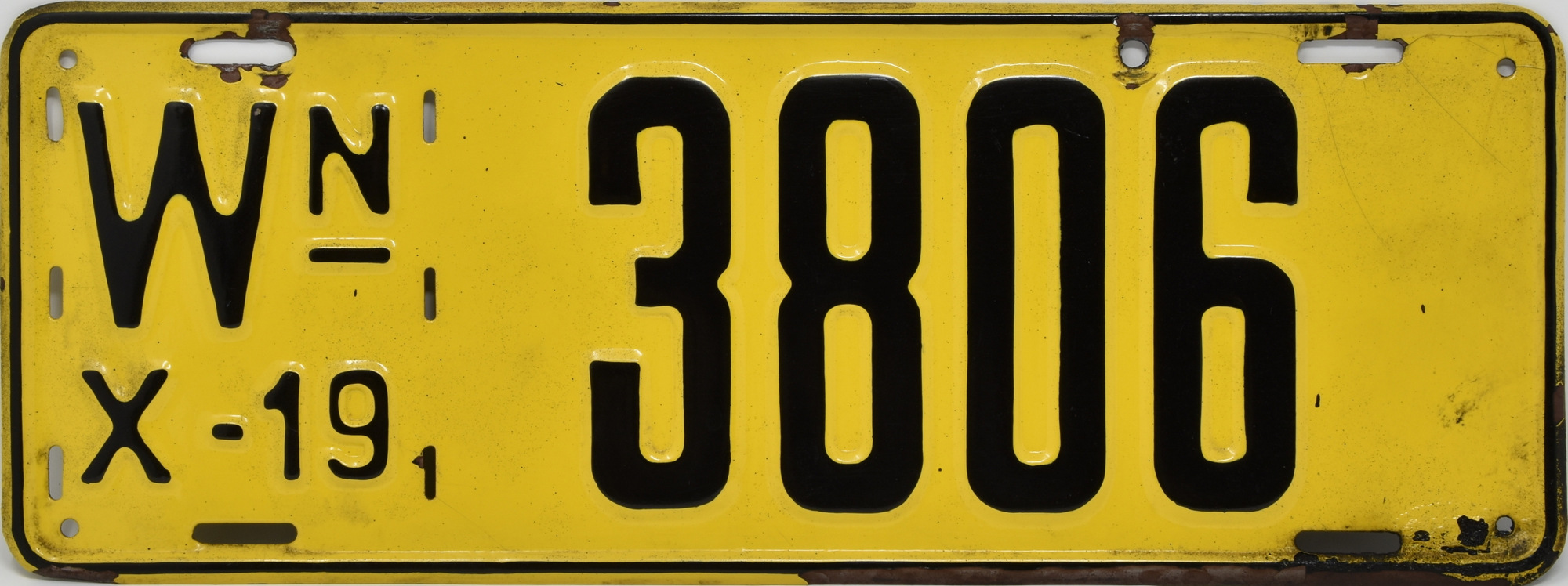
With this system in mind, the 1919 plates were manufactured with six slots surrounding the state name, date, and vehicle class, which would facilitate the attachment of a tab to renew the plates in future years. This cost-savings effort was doomed to failure from the start, and the plates had already proved unpopular before the end of the 1919 licensing year, with a particularly ornery Seattle Times editorial deriding the 1919 plates as a “cheap yellow form of construction that has aroused the resentment of every automobile owner who displays it.”
The legislature passed a new auto license law with an updated fee structure on March 1, 1919. 1919 licenses had expired the day before, on February 28, so with the late change in the law, a one-month grace period was granted for 1919 licenses, making them valid through March 31 without a 1920 renewal.
The new law triggered a substantial increase in the annual cost to register a motor vehicle. The old rate structure in place since 1915, based on horsepower (for cars) or load capacity (trucks) was replaced by a new, much higher one based on vehicle weight. For private passenger cars, the old rates ranged from $3.00 to $7.50 annually, depending on the vehicle’s horsepower rating. The new rates started at $10.00 for a private automobile weighing up to 1500 pounds, and then added $0.60 for each additional hundred pounds. For the very-common Ford Model T, this more than tripled the annual registration from $3 to $10 per year (about $50 to $160 in today’s money), and larger cars regularly ran more than $15 annually.
This fee structure would remain in place through 1931, with the interim period seeing intense debate between politicians, the public, and automobile interests on the fairest fee structure. Plenty of motorists found creative ways to cheat the state by licensing their vehicles elsewhere, or forging their own license plates, often in comically bad ways.
Three varieties of license plates were used for the 1920 licensing year. The first and most common was 1919 plates renewed with a white porcelain validation tab, made by the California Metals and Enamel Company. The tabs were issued with the vehicle class code and serial numbers matching the base plate.
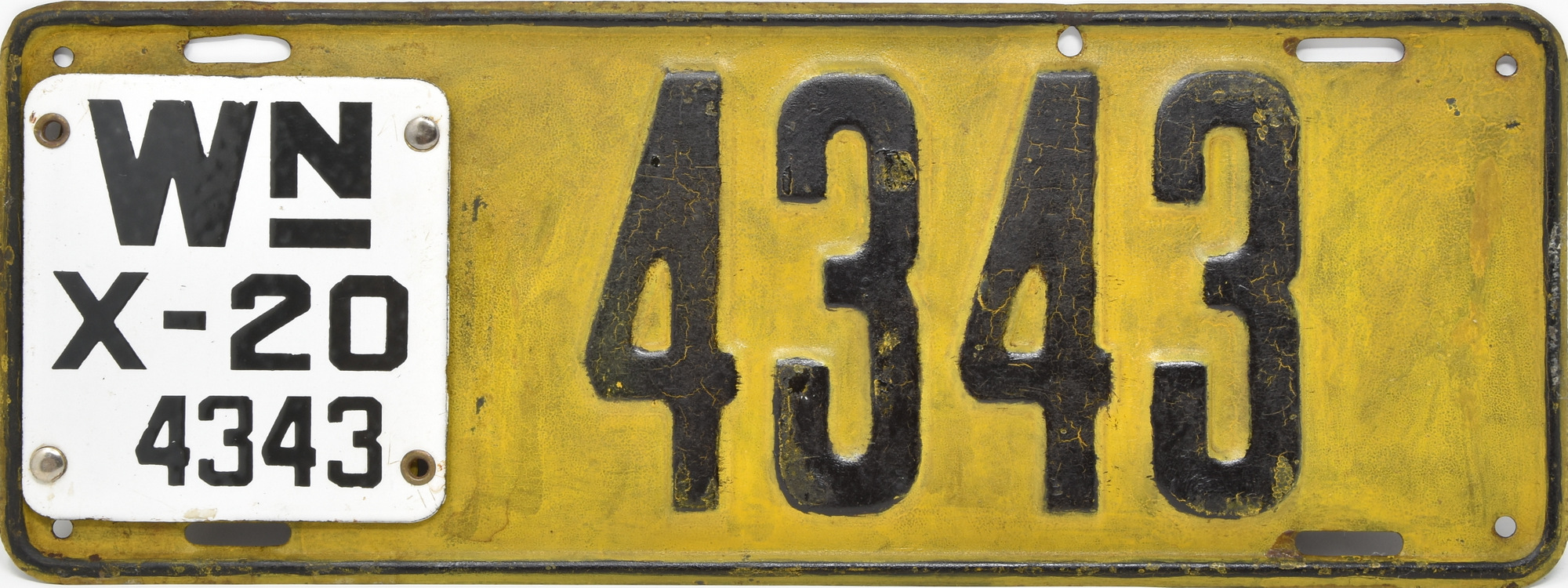
New registrants, who didn’t have 1919 plates to renew, received full porcelain plates, with a tri-color format to match the look of a yellow plate with a white renewal tab.
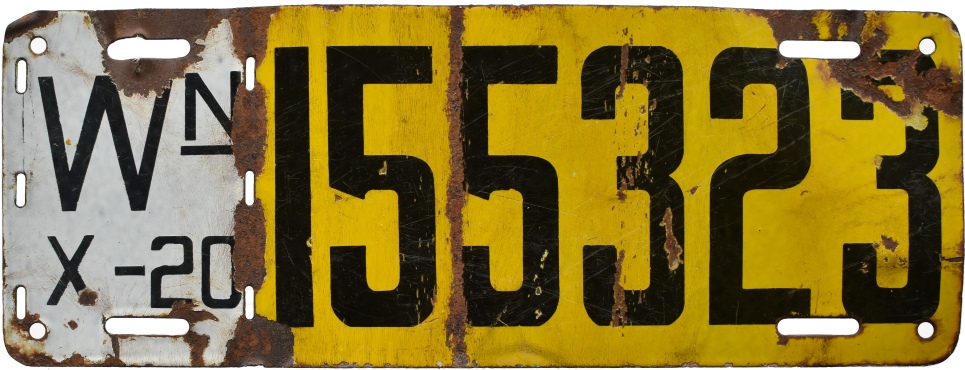
Toward the end of the licensing year, as stock of the porcelain plates ran out, full metal plates were produced, again with matching color formats.

The tab system died after only one year in use. Cost savings were minimal, and offset by production waste and administrative burdens. All of the renewal tabs had to be manufactured prior to the start of the licensing year, which meant producing matching sets of tabs for every single license number issued in 1919, since there was no way to identify which licenses wouldn’t be renewed due to sale of the vehicle, moving out of state, etc. As explained in the Seattle Times, “In the working out of the law, it was reported to the appropriations committee, the state is losing about $25,000 during a biennial period. Many cars are resold, change ownership, taken out of the state or are traded in. To guard against the demand for old numbers, license plates must be provided for which there is no call. It was pointed out that the old plan of issuing number plates whenever a license application was made did not require purchasing more plates than could actually be sold.”
Adding insult to injury, 12,000 of the tabs were lost when the ship Amazon capsized off Dash Point.
1921: the year with two plates
With the idea of multi-year plates abandoned, 1921 saw a new design that was smaller than previous years. Manufacturing was awarded to the Western Display Company of Minneapolis.

The state’s odd validity period (with March 1 marking the start each new licensing year and license plates dated with the year in which they expired) finally died in 1921. House Bill 70 passed on January 27, 1921, and, as summarized in the Tacoma Daily Ledger, provided “that auto license numbers issued in December shall be good for the following year. Representative Hubbell explained that this is one of several bills to make auto laws confirm with laws of adjacent states.”
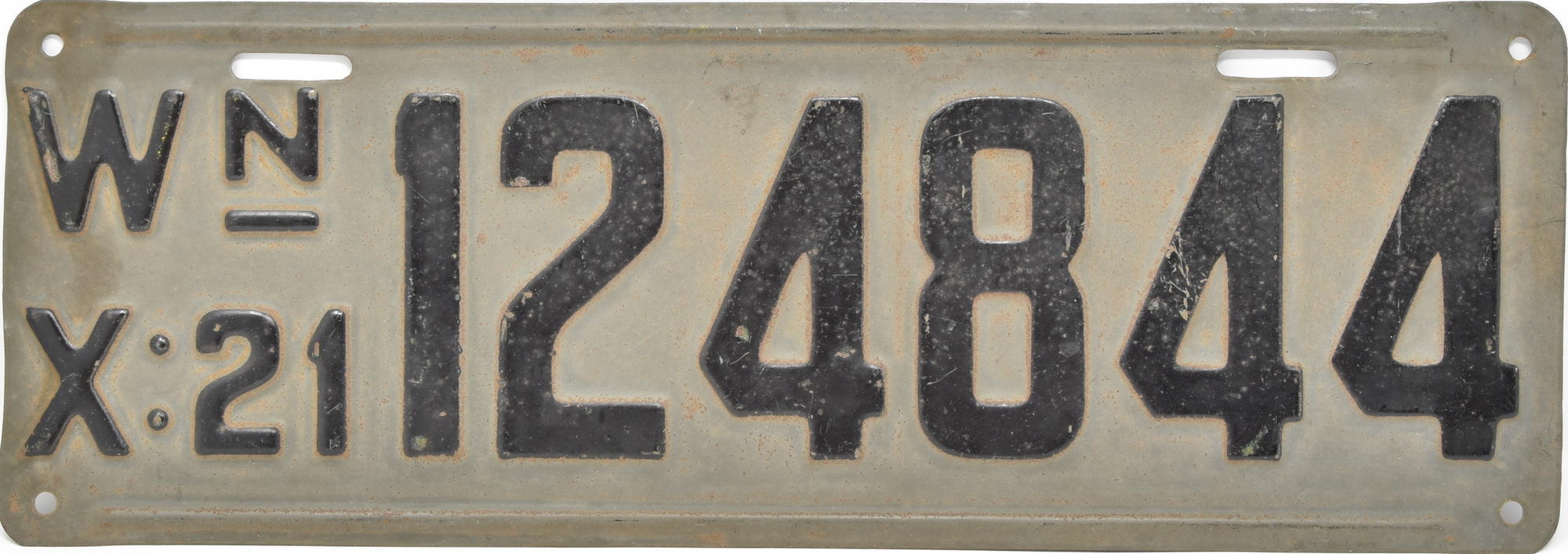
With the law implementing a more commonsense calendar year period of validity, a second plate was needed for the last ten months of 1921, as the original green plates had expired on February 28, 1921. A second 1921-dated plate was issued for the remainder of the year, expiring December 31, 1921. These were sourced from the Irwin Hodson company of Portland, Oregon, and had small design variations that prevented owners from painting over their first 1921 plates: the second type used a colon instead of a dash between the vehicle class letter and the year (X:21 vs X-21), and used more angular number dies.
1922: first full calendar year
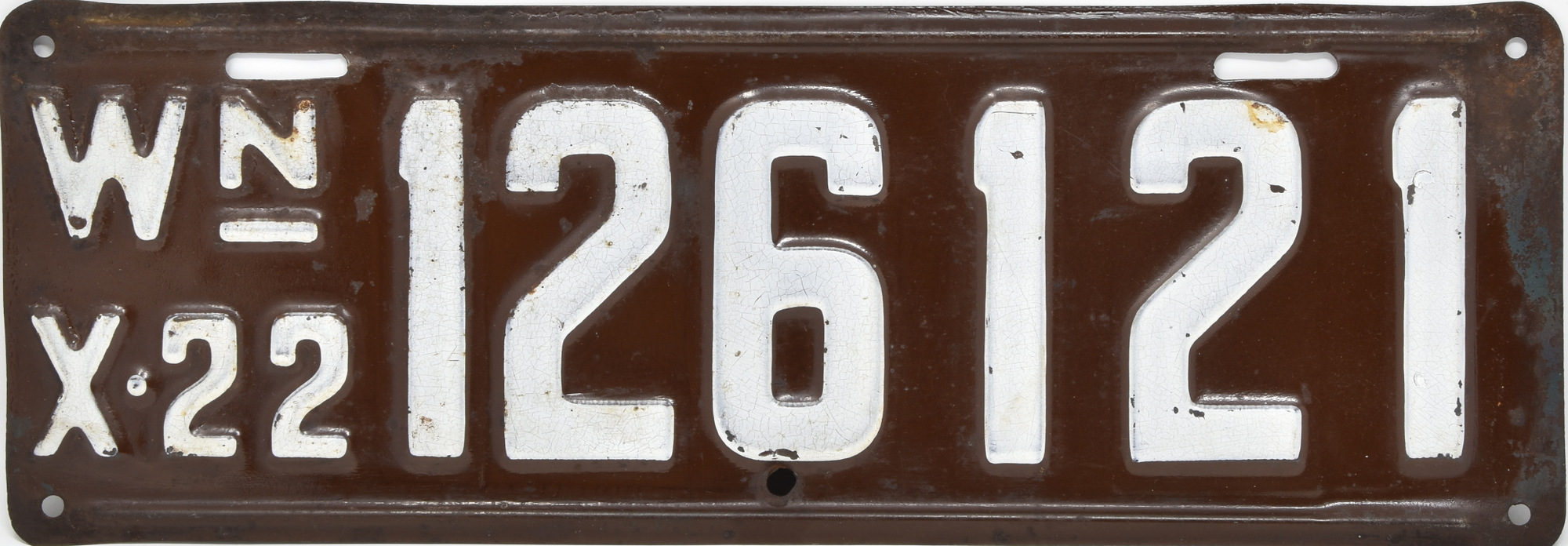
The first full calendar year licenses (valid from January 1 to December 31, 1922) were white on brown, and once again made by the Irwin Hodson company in the same format as the gray 1921s.
1923: prison production begins
Proposals to use the state prison system for manufacturing license plates, a practice used in many other states, had been floated at various times since the license law was passed in 1915. In March 1922, the license plate shop was established at the Washington State Penitentiary in Walla Walla. The 1923 plates were the first to be produced at the prison, which continues to make Washington’s license plates today.
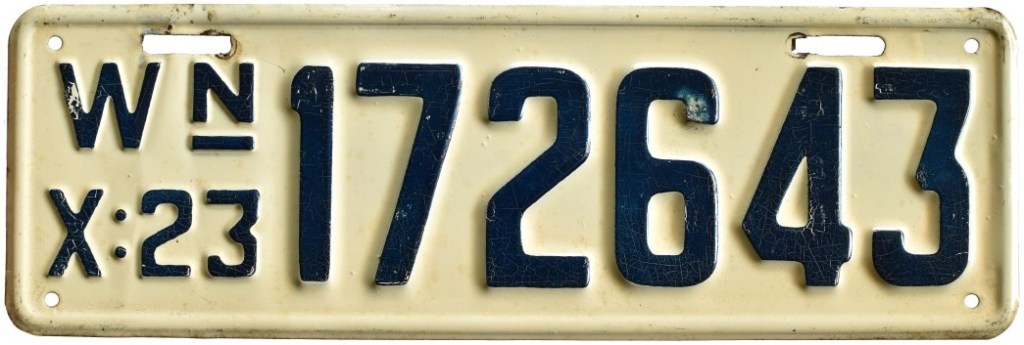
The design changed very little over the next two years. The 1923 color scheme of dark blue numbers on a white background was inverted in 1924, with white numbers on a dark blue background. With age, the blue paint tends to fade to black.
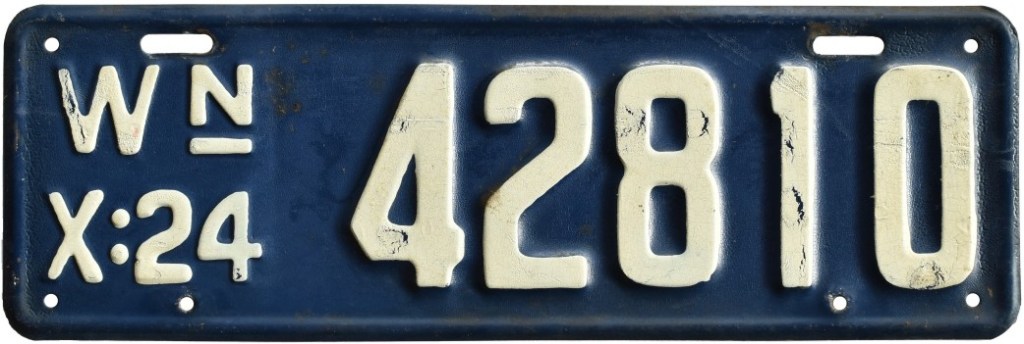
In 1925, the colors reverted back to the 1923 format. State planners intentionally used the same colors year over year in order to save money and avoid wasted paint, inverting them between the background and embossed characters annually.

1926: State pride wins out
The simple “WN” designation had been unpopular for a long time.
Back in 1922, an irate “Mrs. W.B.” wrote to the Seattle Times: “I am good and peeved because on a trip taken by my husband and me this last summer, back through the South to Kentucky, Ohio, Michigan and back—I am peeved because no one the other side of the Idaho line knew what ‘Wn.’ stood for on our car license plate. People even made wagers in Thermopolis, Wyoming, as to whether we were from Canada or Wisconsin. I wanted people to know our state, and I do not remember in the East of any one knowing what ‘Wn.’ stood for. At the very least, 500 people inquired as to where ‘Wn.’ was located. That’s not very good advertising, as everyone writing to this state abbreviates the state as ‘Wash.’ Why two abbreviations?”
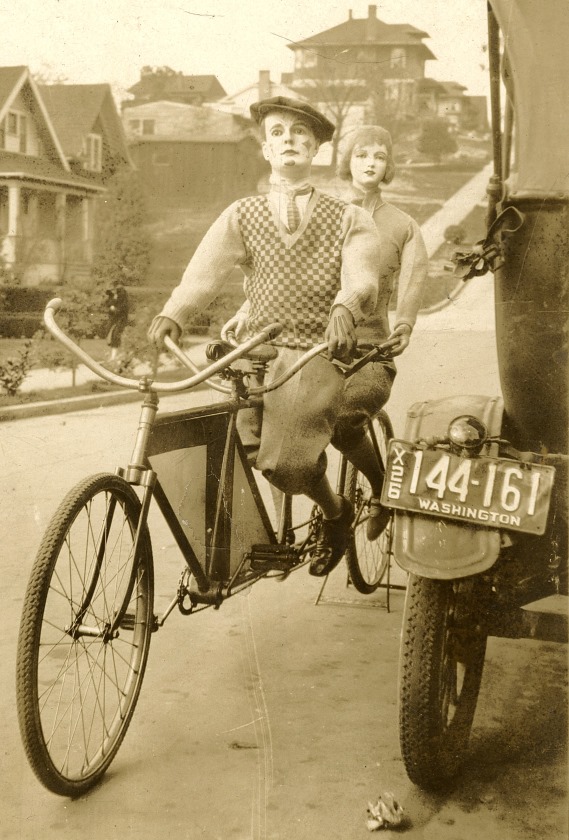
Mrs. W.B. was on to something with her desire to better promote the state and avoid confusion. Similar sentiments were widely shared throughout the 1920s, a period when automobile travel was more far-flung and when states were beginning to see license plates as marketing tools. So, in the interest of promoting the state, “Washington” was finally spelled out in full starting in 1926, and nobody was “good and peeved” until almost 40 years later, when the 1963 design would generate even more controversy.
With the addition of the full state name, plates became larger, while still maintaining the letter-coding system to denote vehicle class, and a hyphen was added to registration numbers to enhance legibility.
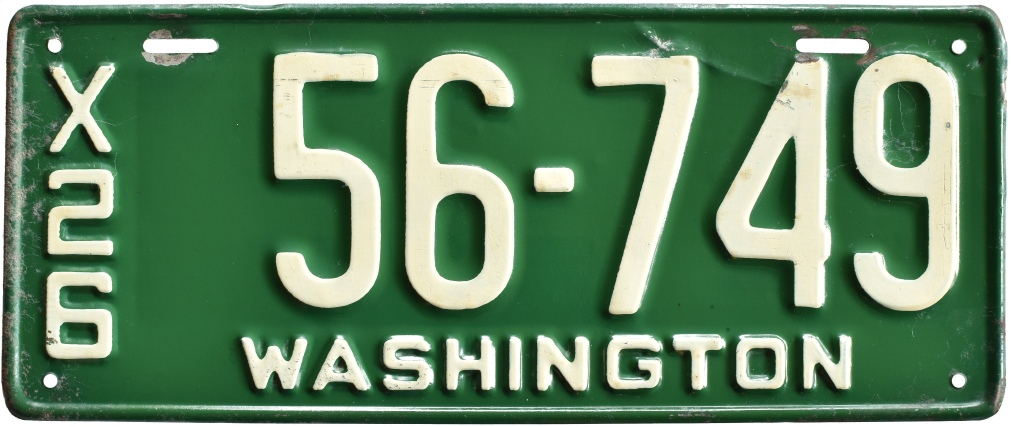
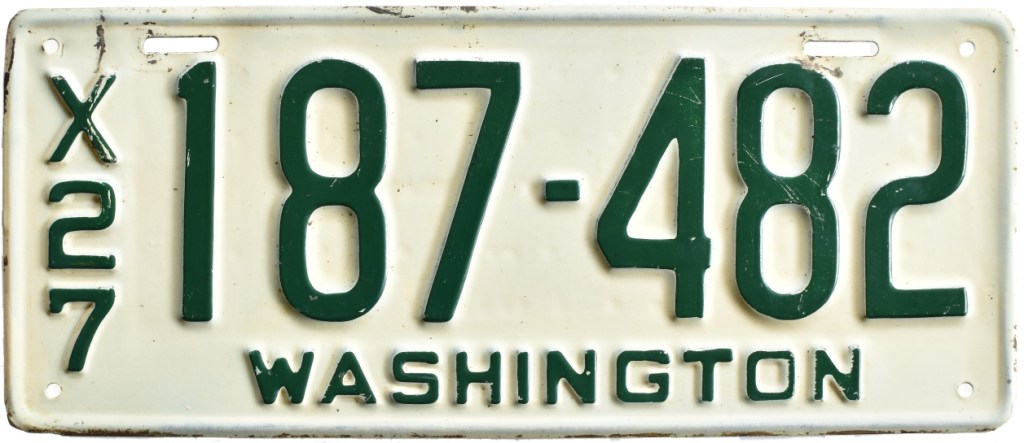
The same format continued in 1927, with the color scheme reversed. While the WASHINGTON designation would last, this specific format with the year vertically at left would only be in place for these two years.
1928 to 1934: A Stable Format
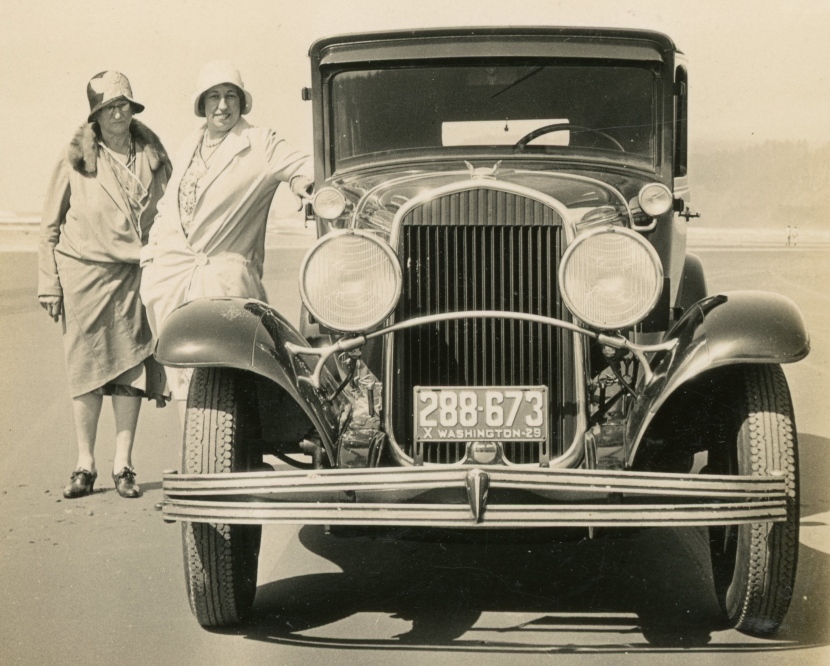
The design evolved again for 1928, with the vehicle class designator and date both moved to the same line as the state name. New, larger number dies debuted as well. This format persisted with few changes through 1934.
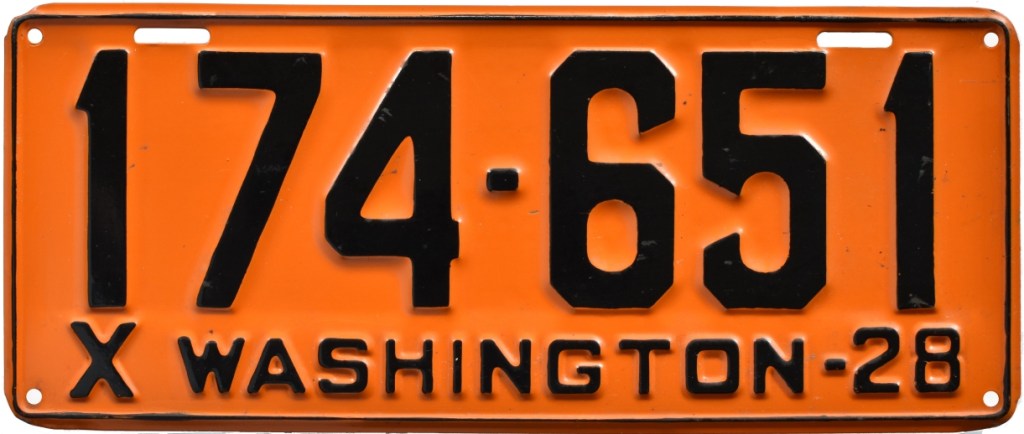
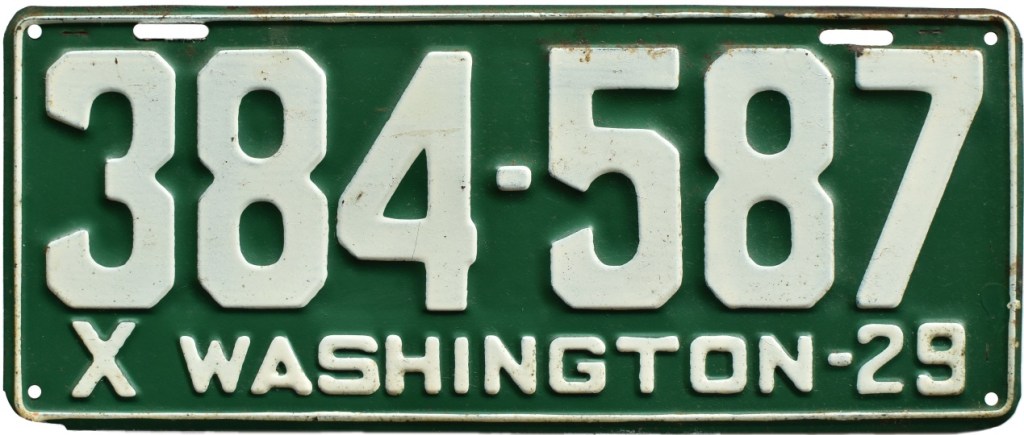
While 1928 used a bold, Halloween-appropriate black and orange color combination, 1929 saw the return to the standard white and green format. Small changes in the date and state name locations were made every year to easily identify vehicles using a prior year’s plate (and to make it easier for scofflaws to paint old plates to match the current year’s color scheme).
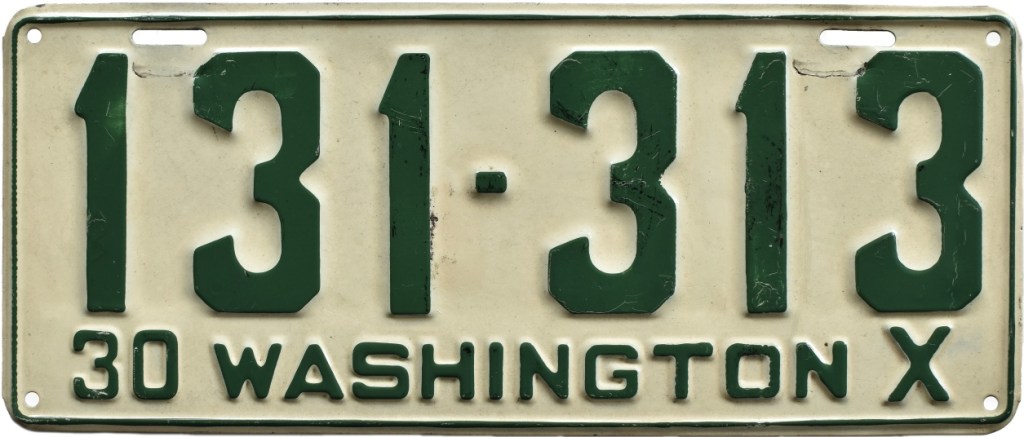
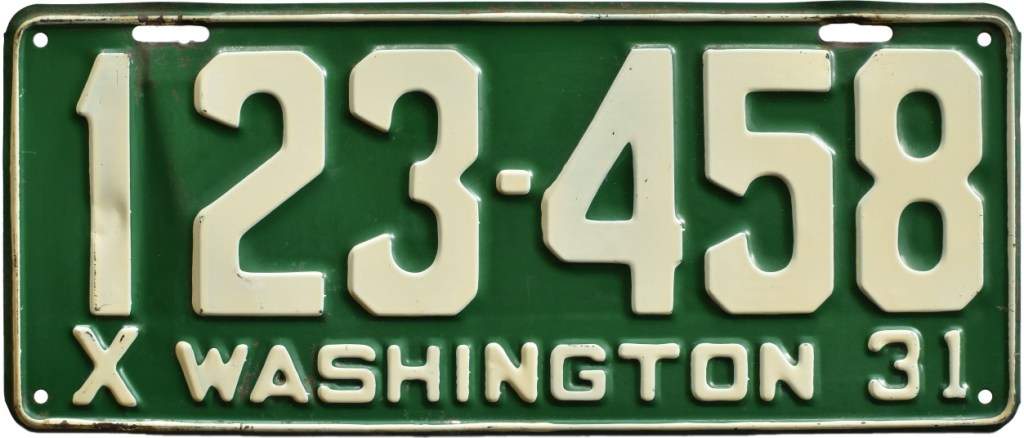
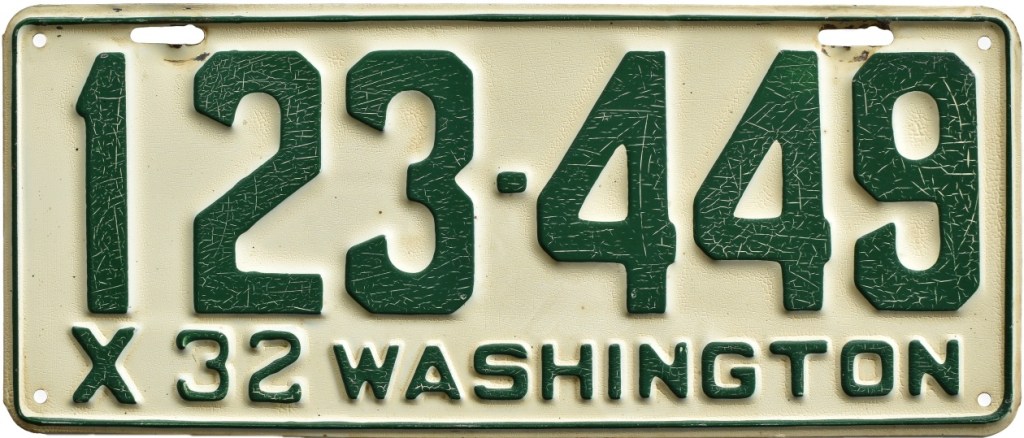
Washington’s exceptionally high vehicle registration fee structure was dramatically simplified for 1932, replacing the weight-based rates in place since 1920 with a flat $3.00 fee, with an offsetting increase in the gas tax.
Vehicle titles were required by the State of Washington for the first time, which proved vehicle ownership. Motorists were asked to apply for titles in the second half of 1933, and they became mandatory before obtaining a 1934 license.
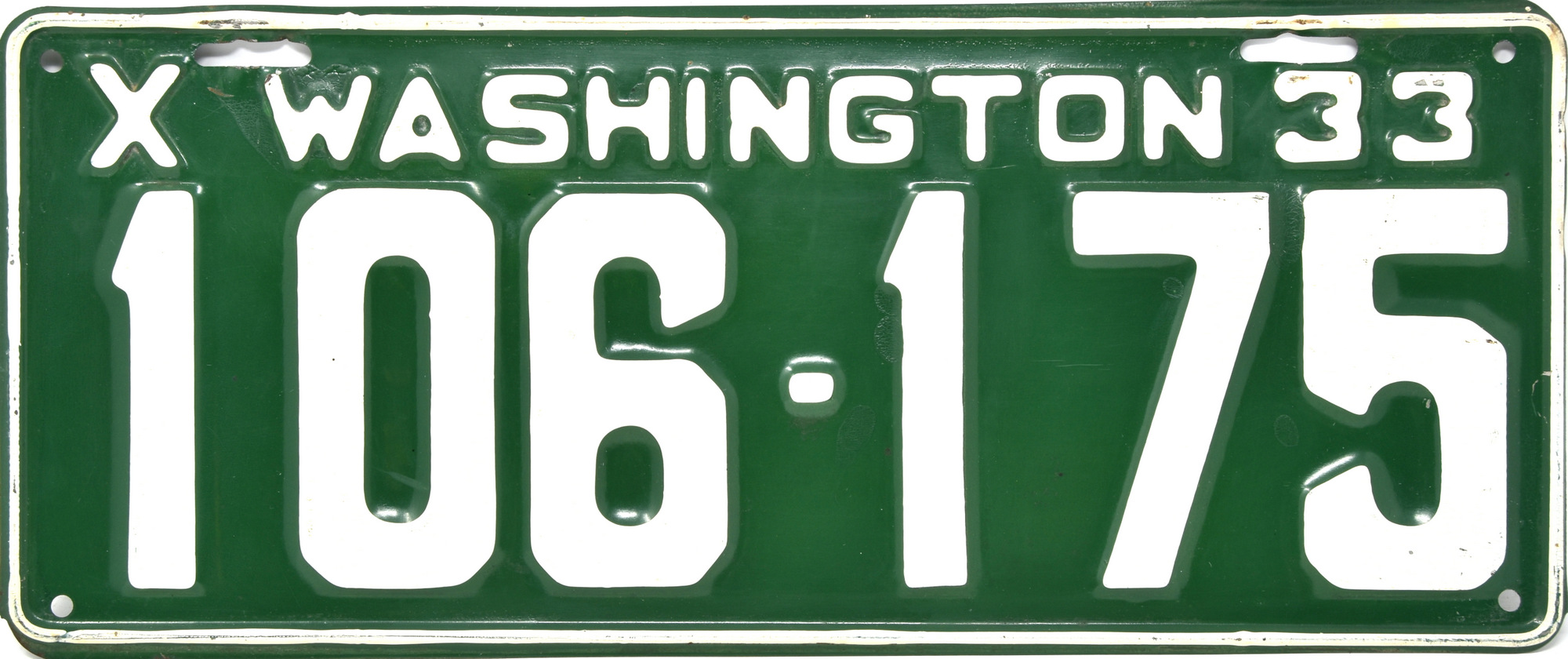
For the 1934 issue, in what was essentially a “soft launch” of the county-coding system introduced in 1935, the state allocated batches of passenger license plates to each county auditor, who were responsible for stocking inventory and distributing them to licensees. This eliminated the longstanding method where motorists would fill out a license application for the new year, file it with the county auditor, receive a temporary license from the county, and wait for the license plates to arrive from Olympia.
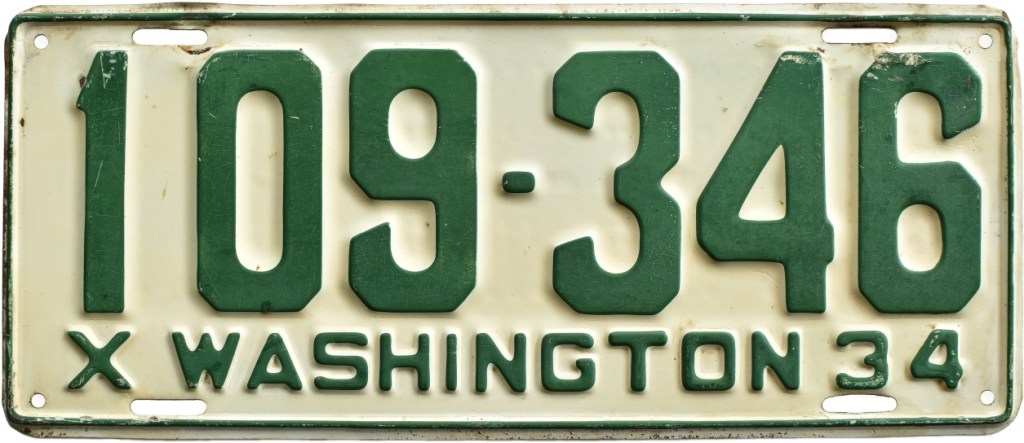
As a result, it is possible to discern the county of issue from 1934 passenger license plates based on where the number falls in the blocks issued to each county, but they are not officially or obviously county-coded. That practice would start the following year.
1935: County Coding begins
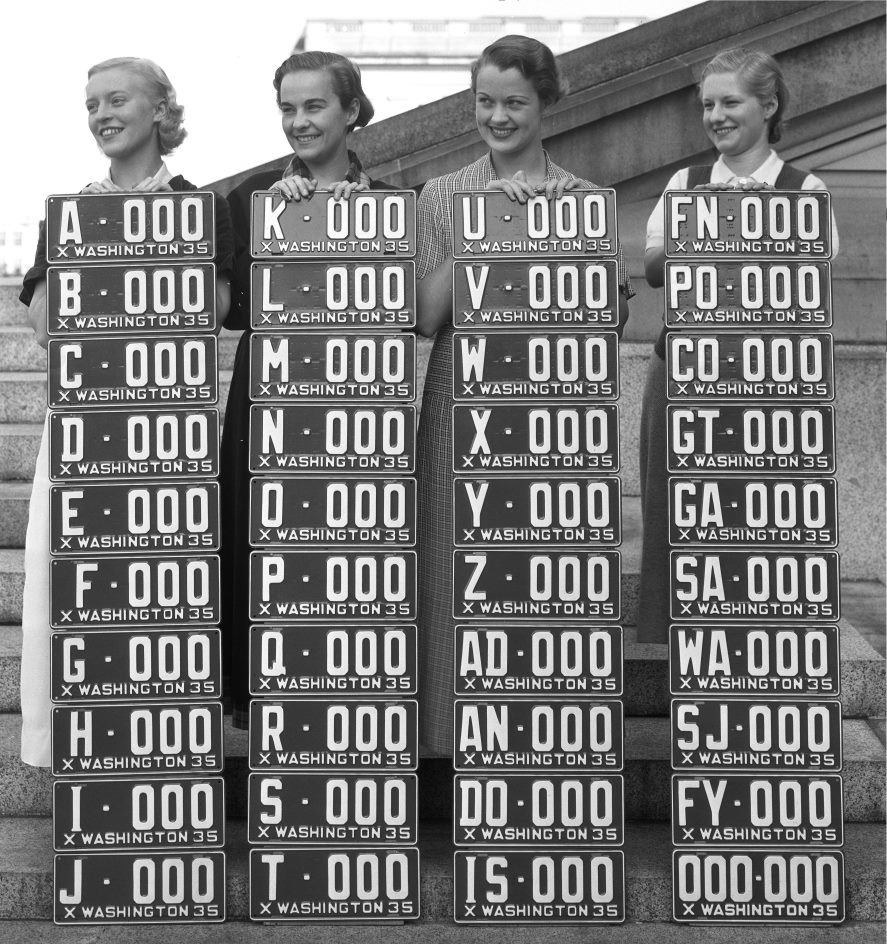
As registration volumes continued to increase, the process of issuing license plates centrally from Olympia became costly and inefficient, and in 1935 Washington followed the practice of many other states and implemented a county code system. License plates would be shipped to each county auditor, with the registration numbers now comprised of a one- or two-letter prefix indicating the county of issuance.
County codes were assigned according to each county’s registered vehicle population, in descending order. The Big Three counties (King, Pierce, Spokane) received letters A, B, and C, respectively, with the alphabet progressing through the rest. Washington has 39 counties, so after Z was assigned to the 26th smallest (Klickitat), the remaining 13 received two-letter abbreviations derived from their names (e.g. AN for Asotin, SJ for San Juan). These letter codes would remain unchanged through 1957 (full list of Washington’s license plate county codes here). At first, county coding only applied only to passenger vehicles, but in 1942 it was extended to truck and trailer license plates (continuing through 1957 as well). No other vehicle class was ever issued by county in Washington state.
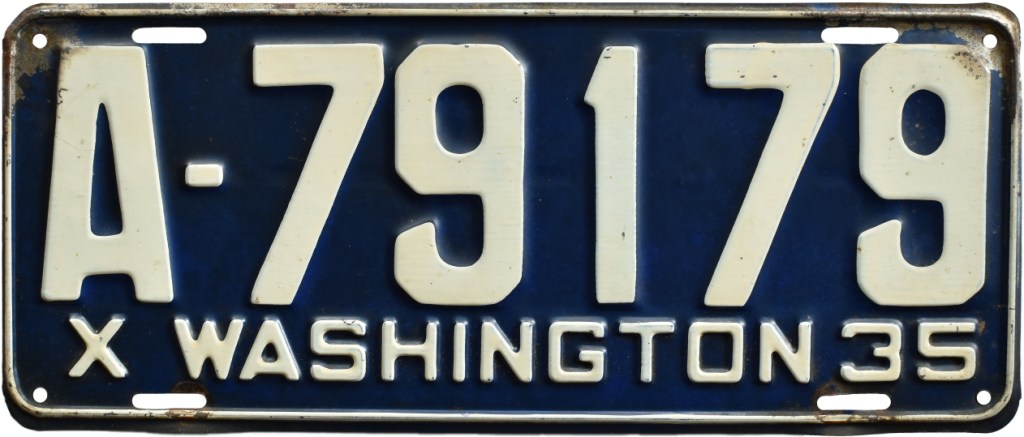
In King County, lack of space resulted in the exclusion of the letter code after number A-99999 was reached, with the next in sequence being 100-000, sans county designator. Foregoing the “A” prefix for high-numbered King County license plates was a feasible workaround, as it was the only county with a passenger vehicle population greater than one hundred thousand (the next-largest, Pierce and Spokane, each only had about one third of King’s registration volume). These “uncoded” King County issues only existed for 1935 and 1936, until a redesign in 1937 created sufficient spacing for higher numbers.
Vehicle Class Letter Codes Disappear
Since 1917, a letter code system had been used to classify vehicle type (“X” for passenger, “T” for truck, etc.). For the 1936 issue, this system was finally abandoned. Passenger plates lost their small “X” designator, and non-passenger vehicles had their class type spelled out in full before the registration number.
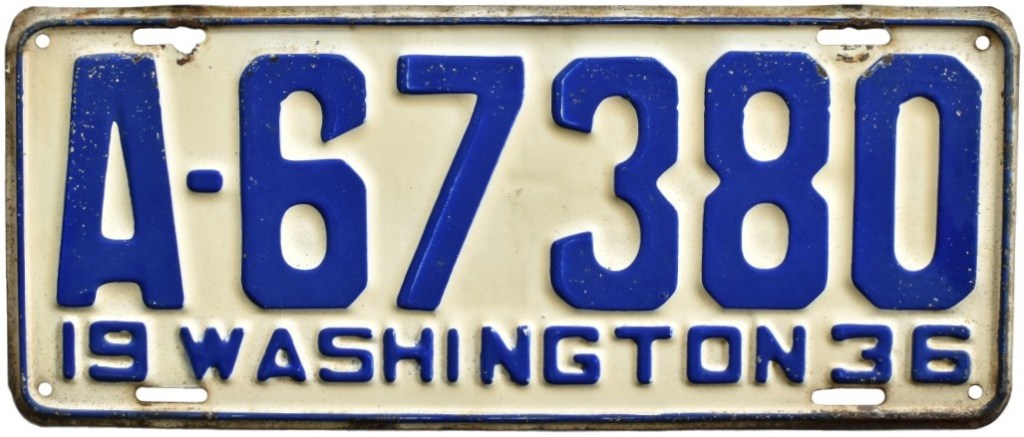
1936 was the only year a split date was used with a centered state name.
A minor format change in 1937 debuted what would be a lasting design legacy for Washington license plates.
For the first time, the state name was shifted to the top left, with the license year following. Under the state’s practice of modifying the license plate layouts each year to make scofflaws easier to spot, this was not a permanent change, but it was the first instance of what would eventually turn into a tradition: with the relatively brief exception of the Centennial Celebration issue (1987-1998), Washington license plates have otherwise had the state name displayed in the top left since 1968, where it continues to appear today.
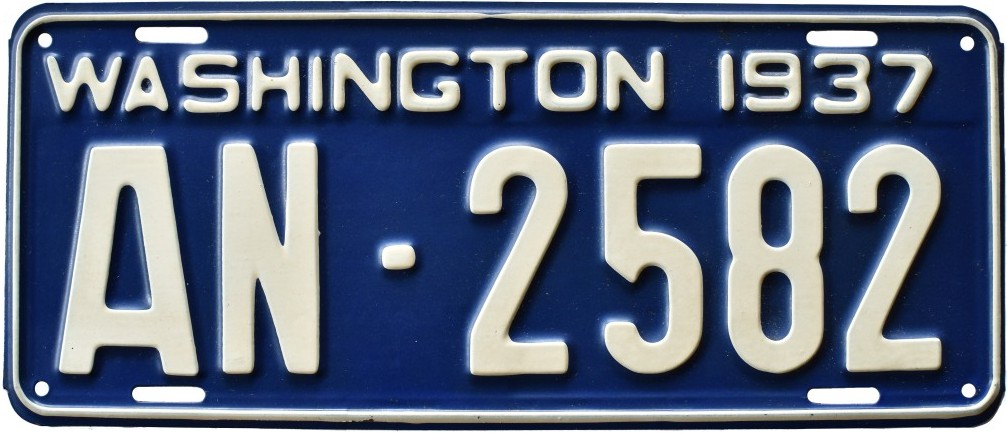
The 1937 issue also saw the first use of narrower number dies that would accommodate a county code prefix letter with a six-digit registration number.
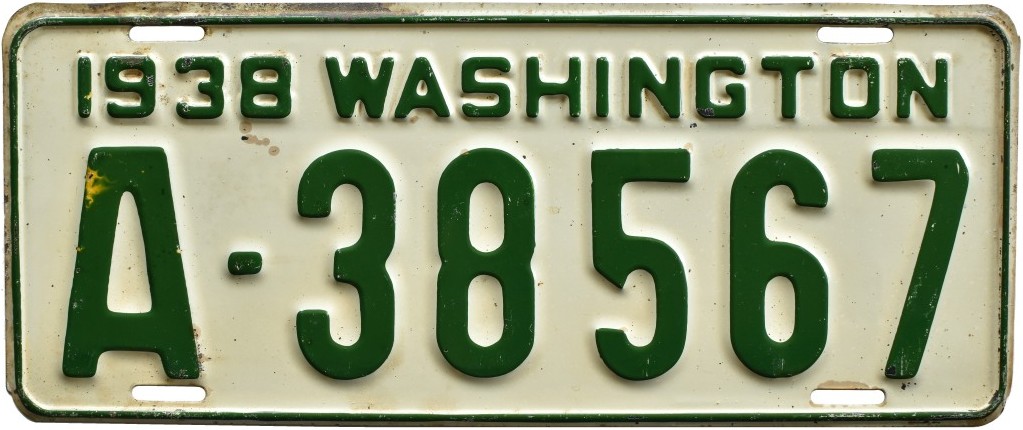
After alternating between white and blue colors for three years, 1938 brought green back to Washington’s license plates, where it would appear on every general issue for the next half century.
1939: Golden Jubilee
Washington’s 50 years of statehood was marked by its first (and only, until 1987) use of a slogan. As part of statewide campaign to celebrate and advertise Washington at its milestone anniversary, the 1939 license plate design was a notable departure from the standard formats. The state’s Golden Jubilee was commemorated by the dates of statehood (1889-1939), the use of gold paint (for the “golden” anniversary), and the one-time designation of the “State of Washington.”
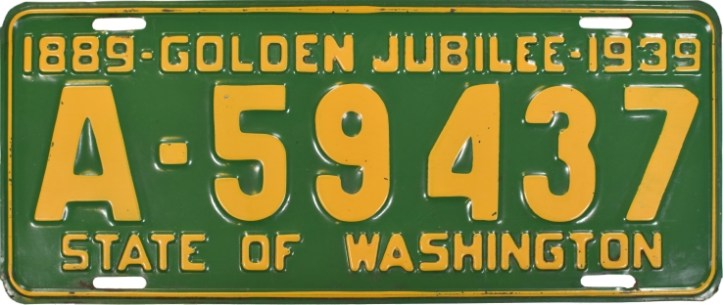
Today the Golden Jubilee license plates are generally considered a beloved icon, but reception was mixed in its own era.
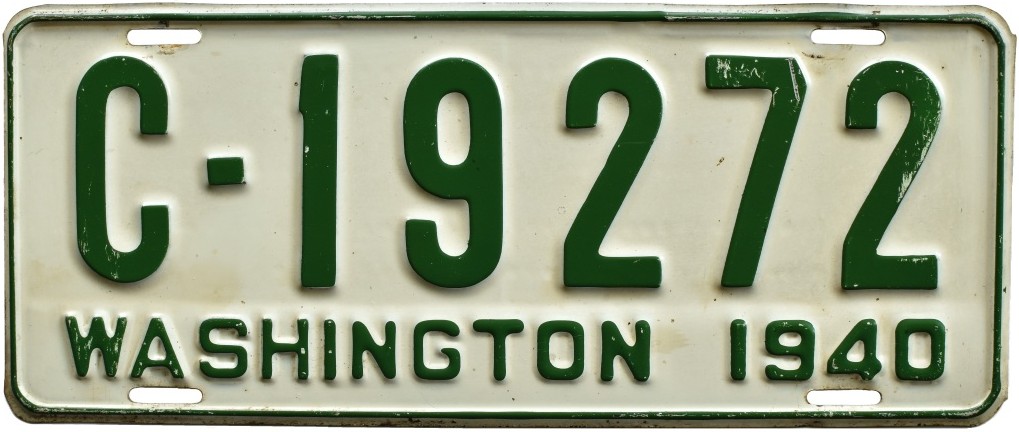
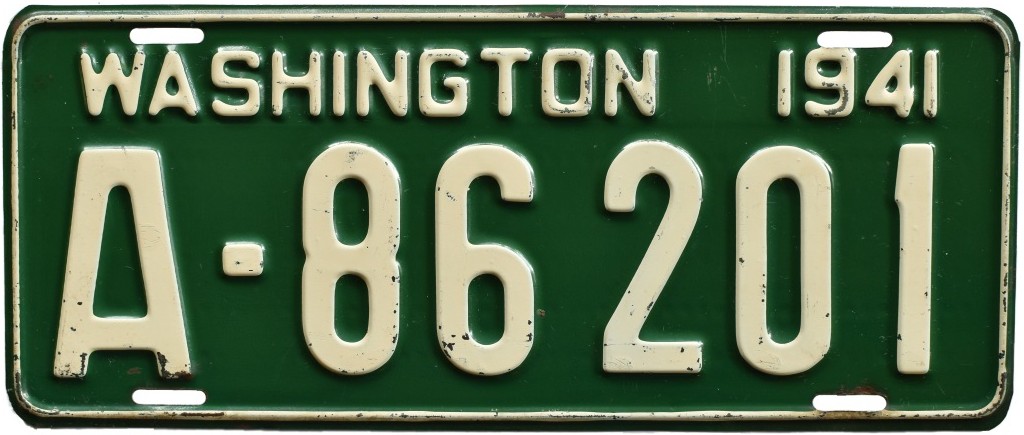
After the jubilation of 50 years of statehood subsided, the 1940 issue kicked off more than a decade of fairly standardized designs. Green and white once again became the dominant colors, with the only other major changes being a yearly switch in the location of the state name and year from bottom to top and back. 1941 would be the last year an embossed, painted border was used on annual passenger plates.
World War II: no metal for plates
The 1942 license plates had already been produced and were starting to appear on Washington roads (thanks to early renewers) when the bombing of Pearl Harbor brought the United States into World War II.
The most notable aspect of the 1942 plates was that they were used far longer than intended: three years. With metal restricted for use in the war effort, none would be available for license plates.
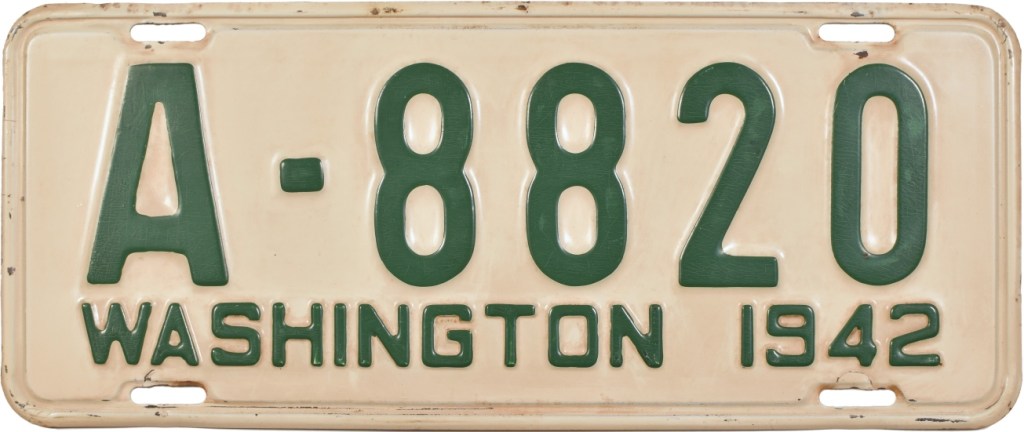
Less than two weeks after the Pearl Harbor bombing, it was clear that the United States’ entry into the war would impact the license plate supply. As early as December 18, 1941, Washington state officials were publicly speculating that the 1942 license plates currently being distributed to motorists would be in use at least through 1943, although at that point it was still unclear what system would be used to ensure vehicles continued to be validly registered.
By July 1942, there was already public messaging that windshield stickers would be used to extend the validity of the 1942 license plates, an approach that Washington and many other states would adopt during the war years.
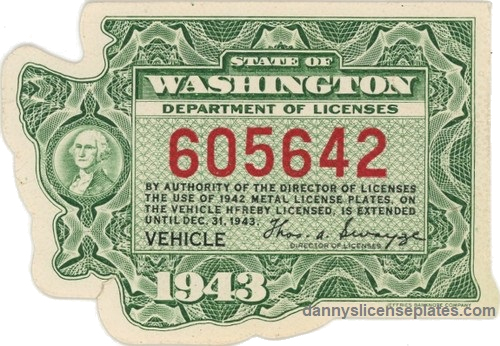
Washington state officials, like their counterparts in Oregon, turned to the Jeffries Bank Note Company of Los Angeles to design a decal for motorists to affix to their windshields. These would serve as official validation that the 1943 registration fees had been paid, extending the validity of the 1942 license plates. The Tacoma Times noted that the Jeffries Bank Note company was also contracted to print all of China’s paper money. Jeffries outsourced the printing of the decals to the North Pacific Bank Note Company of Tacoma.
As 1943 ended with the war effort still in full gear, windshield stickers were again issued for 1944, although of a much simpler design provided by a company in Chicago. The 1942 license plates were still to be displayed, for a third year.
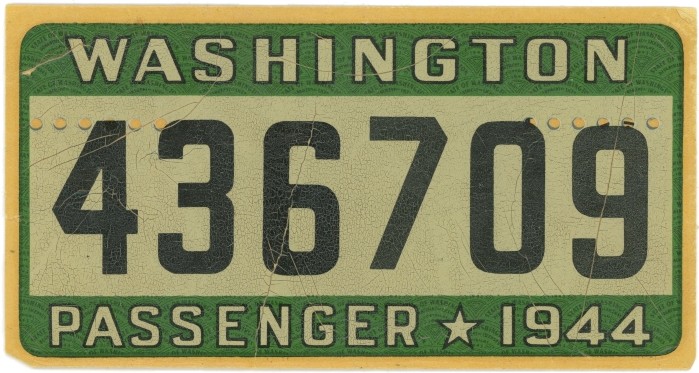
For 1944, the metal supply had opened sufficiently to manufacture some license plates (in singles, not pairs) for new registrations. Given the complete cessation of civilian automobile production, this mainly comprised people moving into Washington from other states. The state also allowed anyone whose 1942 license plates had been heavily damaged to acquire a 1944 plate as a replacement.
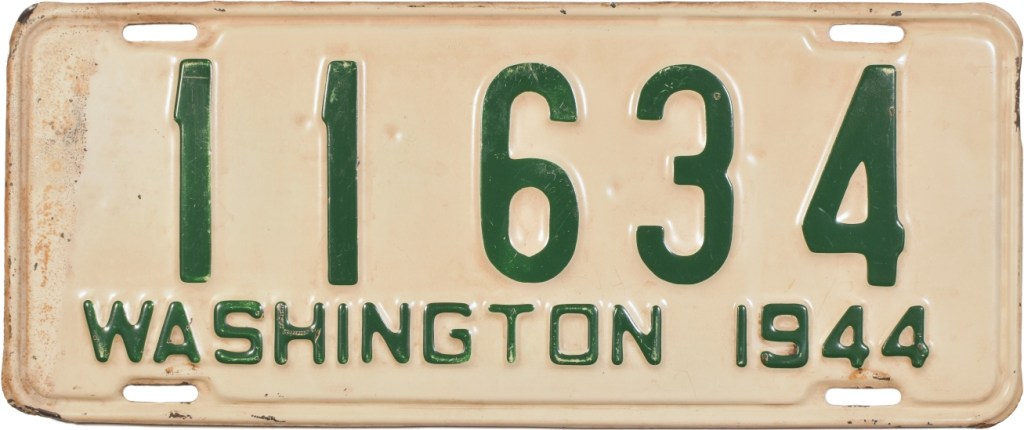
Dated 1944 license plates are thus relatively scarce, being issued to a fairly small population. These were all-numeric, lacking county code prefixes, which allowed the Department of Licenses to issue them throughout the state as needed instead of stocking quantities with each county auditor. Some non-passenger vehicle classes, for example trailers and dealers, received stamped 1944-dated license plates as well.
Standard license plate issuance resumed for 1945, with the 1942 plates finally coming off bumpers after three years in use. While the 1945 issue was a return to the old practice of issuing license plates annually to all vehicles, these were produces as singles, not pairs, due to the lingering problems of sourcing metal.
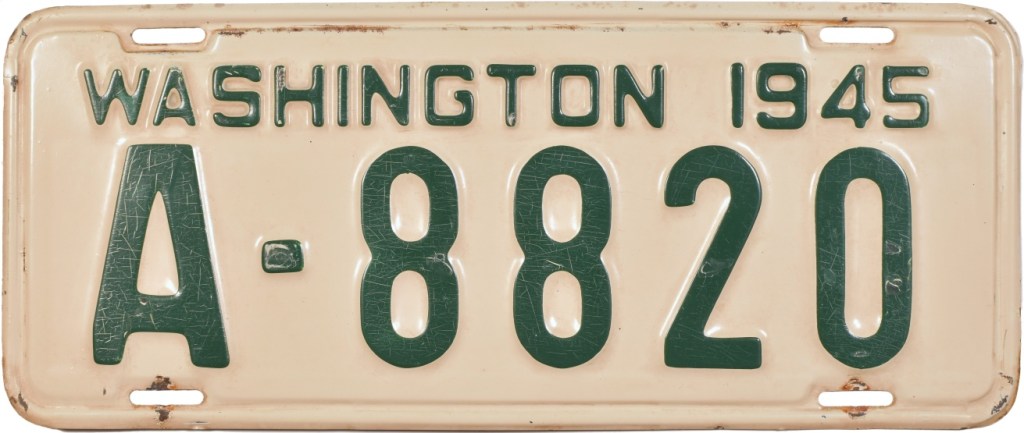
Similar to the whipsaw changes in supply chains, supply and demand, and inflation that the world experienced after COVID shutdowns in the 2020s, the years immediately following World War II were complicated for the global metal supply. Due to sourcing obstacles, windshield stickers made a return in 1946, with all passenger vehicles retaining their 1945 plates for an extra year.
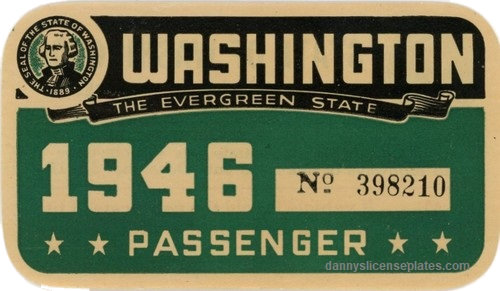
Dated 1946 plates were issued to non-passenger vehicle classes, such as trailers and trucks.
Aluminum License Plates
With a glut of aluminum available after the war, its use for license plates was common, for the first time, across the United States. Washington’s 1947 plates marked the state’s first use of aluminum instead of steel, and it was not an ideal execution. Paint was difficult to successfully apply to aluminum, and like a great many states that used the material in the late 1940s, Washington left the background as bare metal, painting only the embossed characters.

Immediately after 1947 plates began appearing on the road, numerous complaints poured in about the bright reflection they generated.
“At night headlights reflecting on the plate practically obliterate the numerals, the unpainted aluminum having the same characteristics as a mirror held to catch the sun’s rays,” complained the Spokane Safety Commissioner after the plates had been on the road only two weeks. Additionally, paint adhesion was poor, frequently resulting in bare numbers.
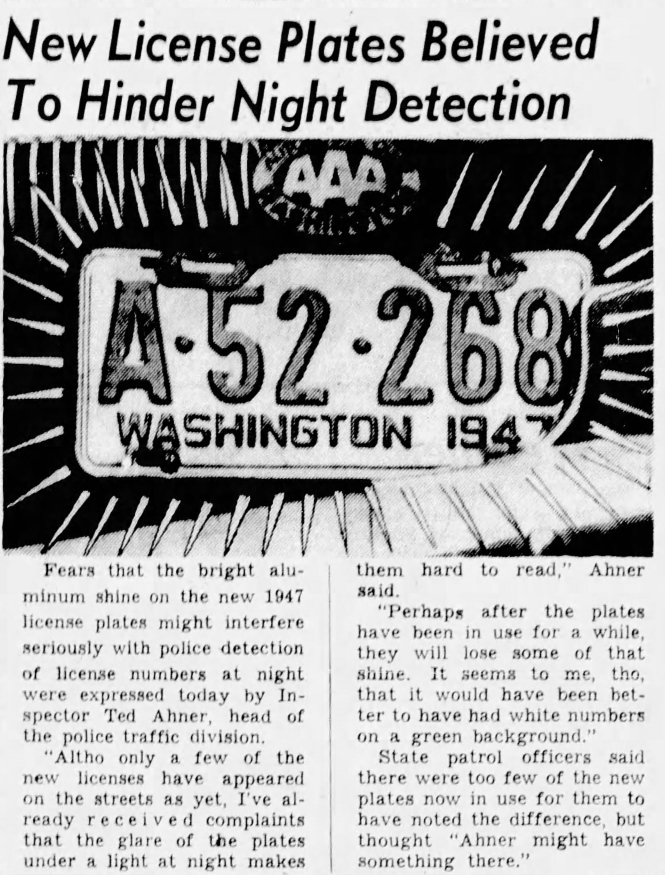
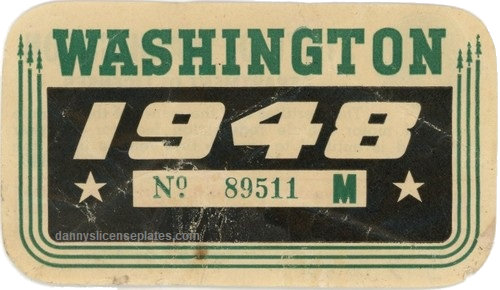
In spite of these complaints, the plates stayed on the road for two years, with windshield stickers again used to revalidate plates for 1948. After two years on the road, many of the 1947 plates had lost a good portion of their green paint. Dated 1948 plates were made only for a few non-passenger vehicle classes, such as trailers and dealers.
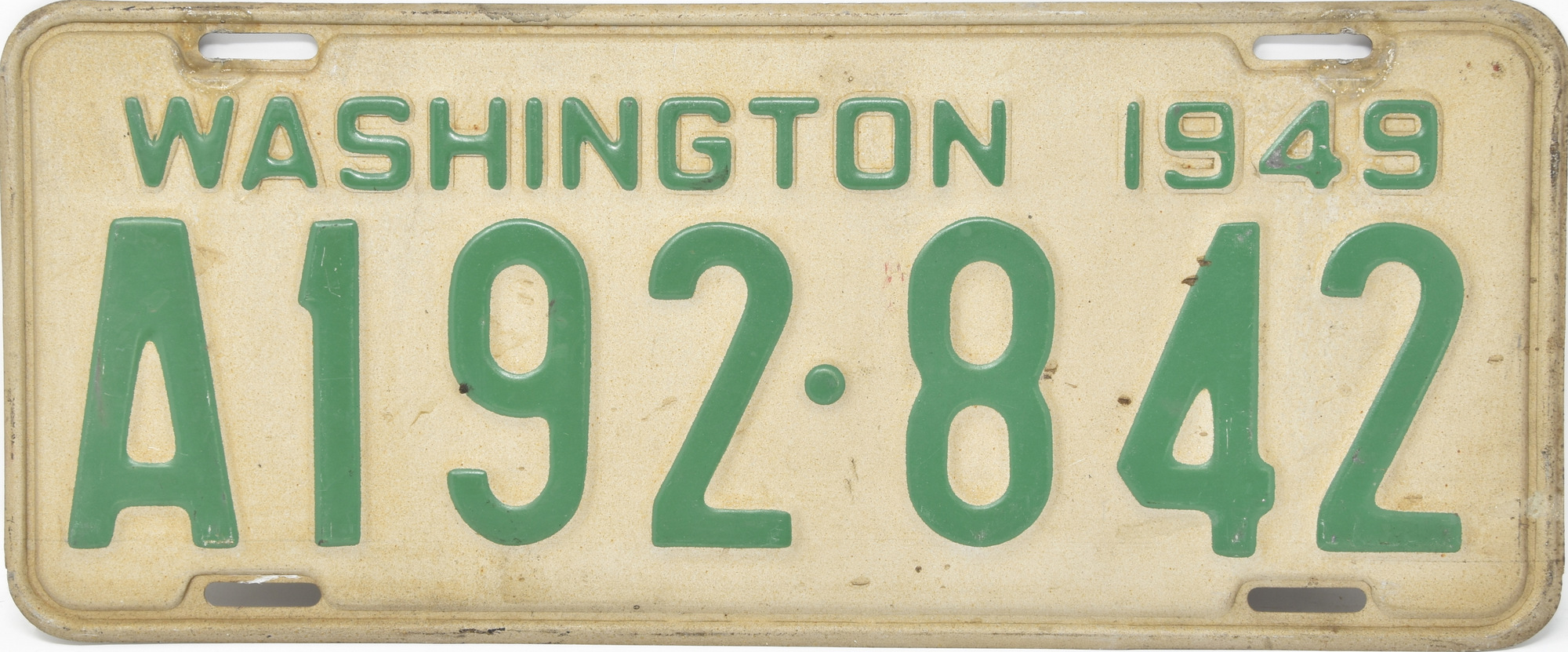
Unpainted aluminum plates were used again for the 1949 issue, but this time were sandblasted with steel grit to dull the background and eliminate the bright reflection caused by the shiny metal background at night. The result was characterized by a Seattle Times columnist as “dull, drab, dreary-looking.”
1950s: Transitioning to the future
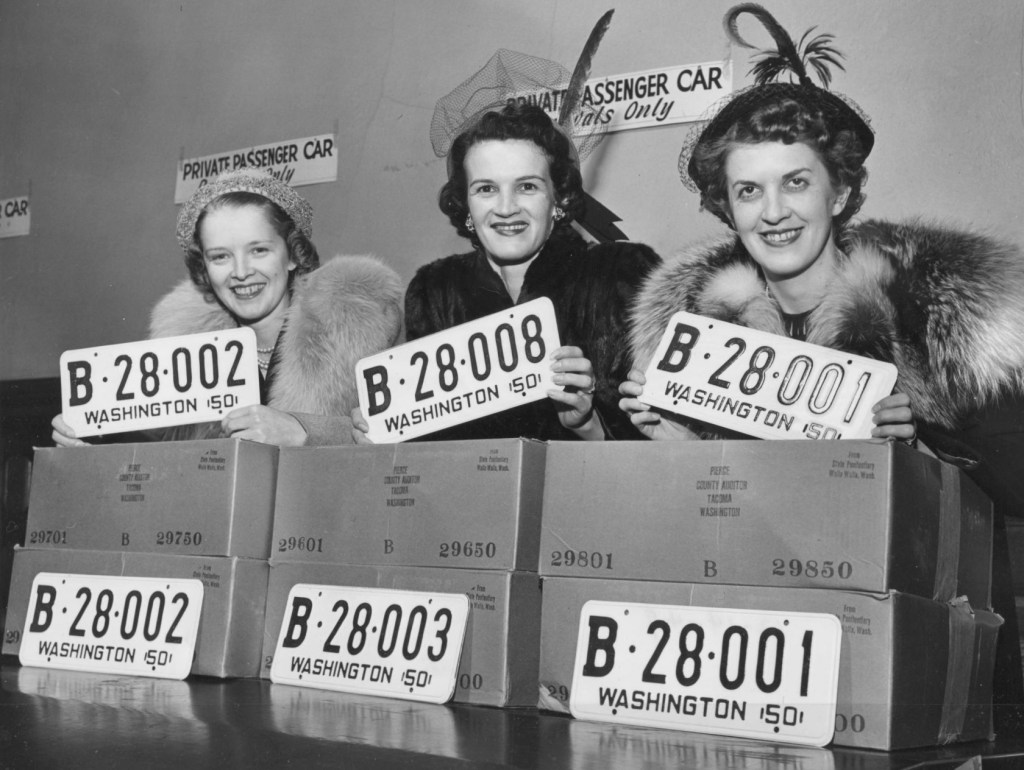
With the 1950 issue, the state resurrected the practice of multi-year baseplates renewed by tabs, which had been unsuccessfully attempted with the 1919/1920 issue three decades earlier. Issuing brand-new, date-stamped license plates every single year was increasingly less sustainable with higher metal costs and larger vehicle populations, and most states were gravitating toward renewal tabs and stickers.
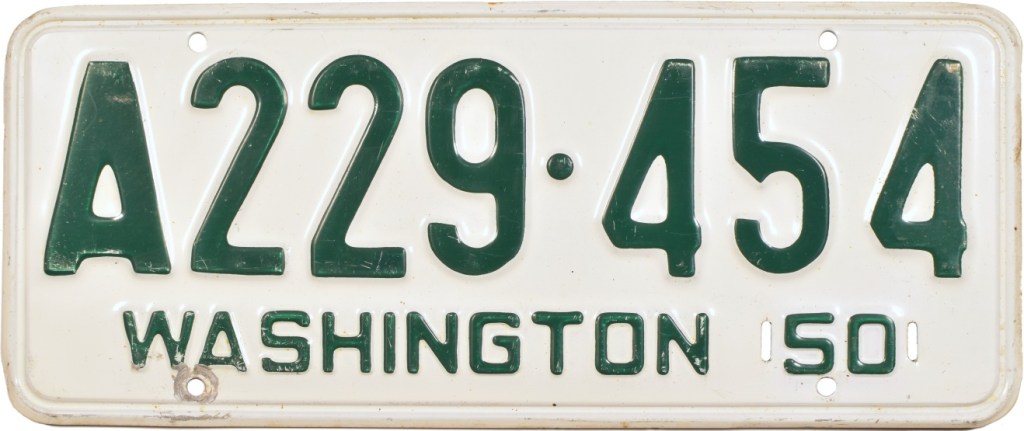
The plates were designed with slots flanking the date, which would be used to apply metal date tabs in future years. These were the first fully-painted aluminum license plates used in Washington, and they were plagued by weak paint on the numbers. Even when new, the state director of licenses deemed them “shoddy, badly painted, and are not strong enough.”
Metal shortages became an issue again in 1951. Existing registrations were issued pairs of ’51 tabs to renew the 1950 plates, but as supplies ran out, dated 1951 plates were issued for new registrations, first in aluminum, and later in steel.
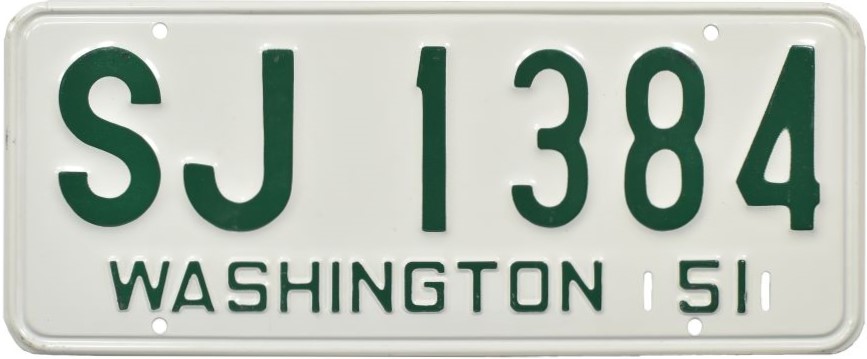
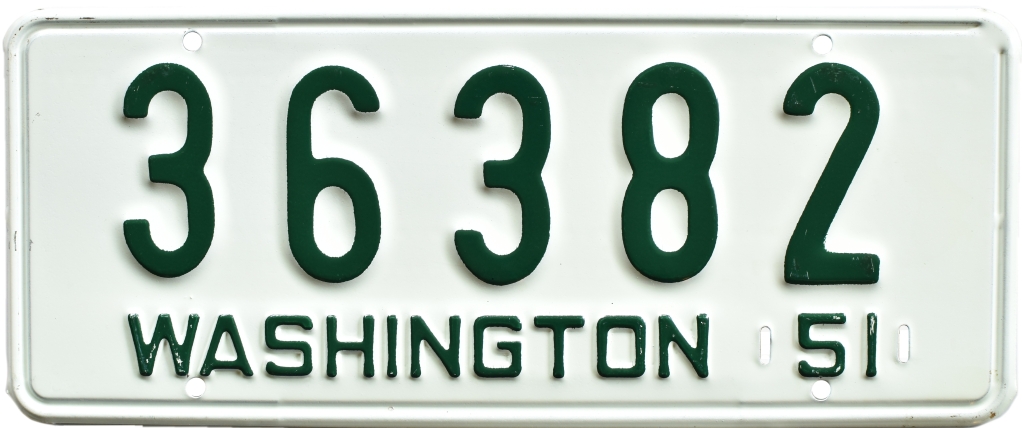
As supply constraints prevented adequate stocks to be issued to each county, a non-county-coded plate was produced that could be shipped to counties as needed. For a period, there were no license plates available at all, and only a windshield sticker was issued to new applicants.
Because of ongoing metal shortages, the state would again turn to windshield stickers for the 1952 licensing year, the final time they would be used in Washington. This time, they were issued in pairs: one for the windshield and one for the rear.
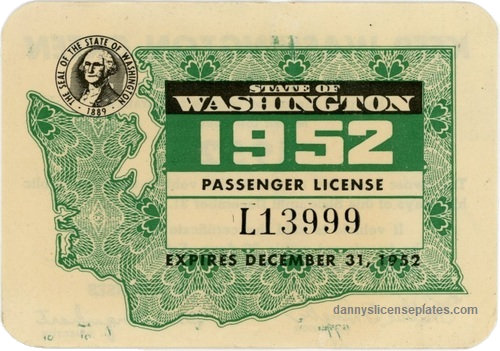
No dated 1952 plates were issued to passenger vehicles, only certain non-passenger types such as trailers, dealers, and motorcycles.
1953 saw the 1950 and 1951-dated plates renewed with dated ’53 tabs, issued only to the rear license plate. By 1953, a typical car would have 1950-dated license plates, with a green 1953 tab on the rear, a leftover 1951 tab on the front, and leftover 1952 windshield stickers in the windows (or the remnants of unsuccessful attempts to scrape them off).
An uncommon 1953 variant arose due to the September 1953 fire at the state prison (see 1954 below). After the license plate mill was destroyed, any additional plates needed before the end of the calendar year had to be sourced from the alternate supplier in Oregon. These plates looked quite different from the regular issues: they were smaller (made from leftover blanks of 1952 Hawaii plates) and used the same blocky dies as Oregon plates.
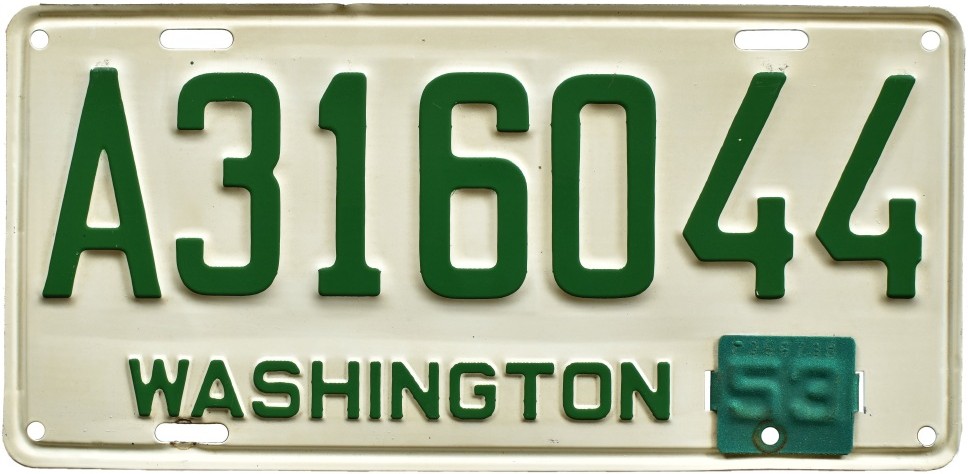
Only a handful of counties needed additional license plates produced to meet demand for the final few months of 1953, so these types are relatively scarce oddballs.
1954: So Many Changes
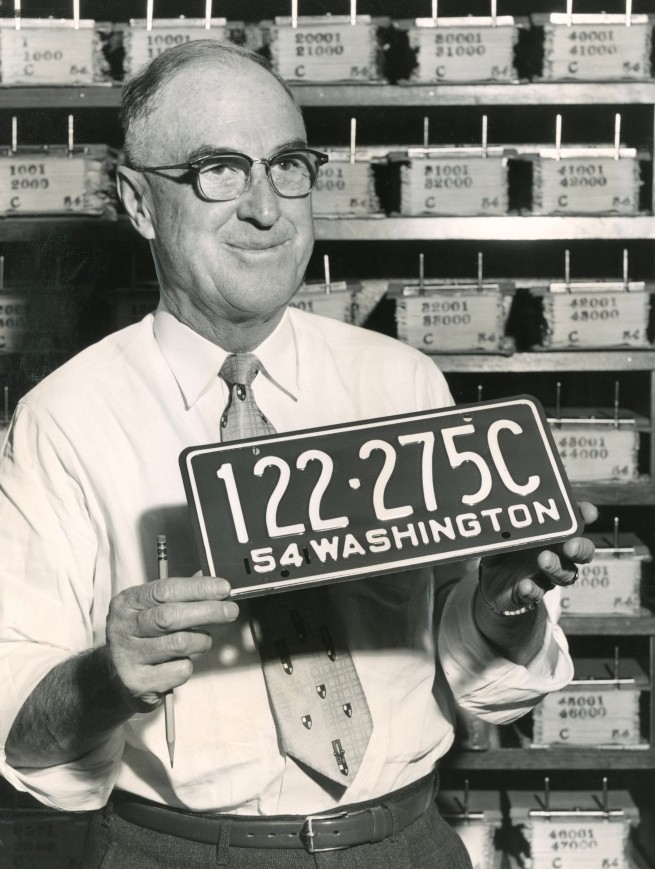
Big changes were in store for 1954, some planned and some not. The most notable planned change involved the county code designation, which was switched from a prefix to a suffix. The justification from the Department of Licenses, as quoted in The Olympian, was to aid in faster identification by law enforcement, the number being a more important component for tracking down a vehicle owner than the county designation.
For cost savings and mitigation of ongoing metal shortages, the original plan was to issue ’54 plates as singles, made of steel and in the same format as the 1950 plates, with a reversed color scheme. This decision would result in a number of complications and anomalies over the next year.
Consistent with the 1950 base, these were produced with slots flanking the date to facilitate renewal with metal tabs in future years. This base was intended to be used for four years.
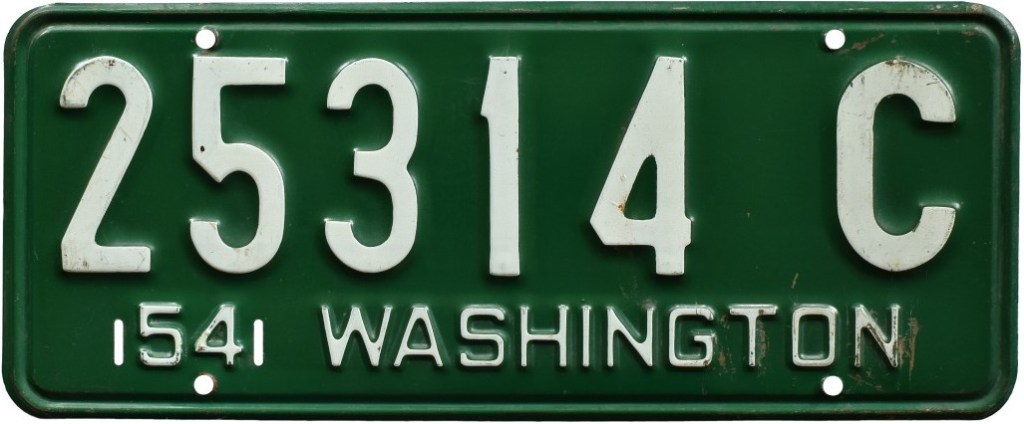
Production for these plates, which had been underway for most of 1953, had been just about completed when disaster struck on September 9. The plate mill at the Walla Walla Penitentiary caught fire and burned to the ground, destroying all of the plates that were on hand.
With in-state production impossible until the mill was rebuilt, the state launched a frantic search for an alternate supplier. On September 14, just five days after the fire, a contract was signed with the Screw Machine Products Company of Portland, Oregon, which at the time was also supplying license plates to Oregon, Alaska, Hawaii, and other jurisdictions. These Oregon-sourced plates differed from the pre-fire plates in size, metal (aluminum vs steel), and dies.

Some of the original plates had already been shipped to county auditors (mostly in Pierce, Spokane, and Columbia counties), and in these cases were issued to the public as planned. However, most of the original run of 1954 plates was destroyed in the fire, so the vast majority of 1954 plates issued to vehicles were sourced from Screw Machine. The prison license plate shop would not reopen until the production of the 1958 plates began.
An additional complication arose late in 1954. The decision to issue only a single plate for the rear of the vehicle had been controversial from the start, but trouble identifying a bank robber’s getaway car in Seattle was the tipping point for public outrage and law enforcement pushback, and at the end of 1954 the Department of Licensing acquiesced to demands for front license plates. This required an enormous effort to manufacture a second plate for every number and ship it to registrants across the state. A 1957 state audit deemed it a fiasco, costing taxpayers a quarter of a million dollars from inefficiencies and disorganization, with improper records resulting in thousands of plates being mailed to incorrect addresses and returned to state offices multiple times.
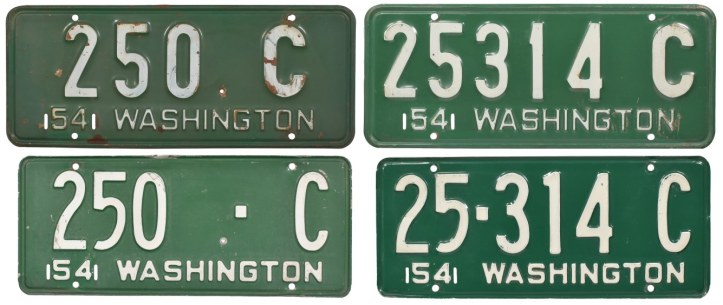
One common quirk of this situation is the inconsistencies in number layout, hyphenation, and spacing between the first batches of Oregon-made plates and the second batches of front plates. It is extremely common for pairs to have mismatched formatting as a result.
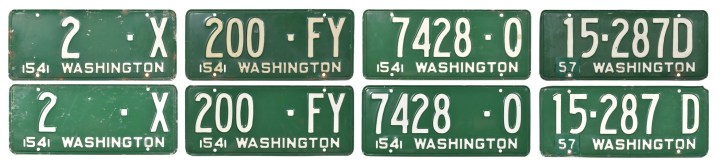
In the instances where the original prison-made plates had been issued, this also resulted in completely mismatched sets of plates, where one car would have had a steel, Washington-made plate on the rear and an aluminum, Oregon-made plate on the front.
1956: standardization
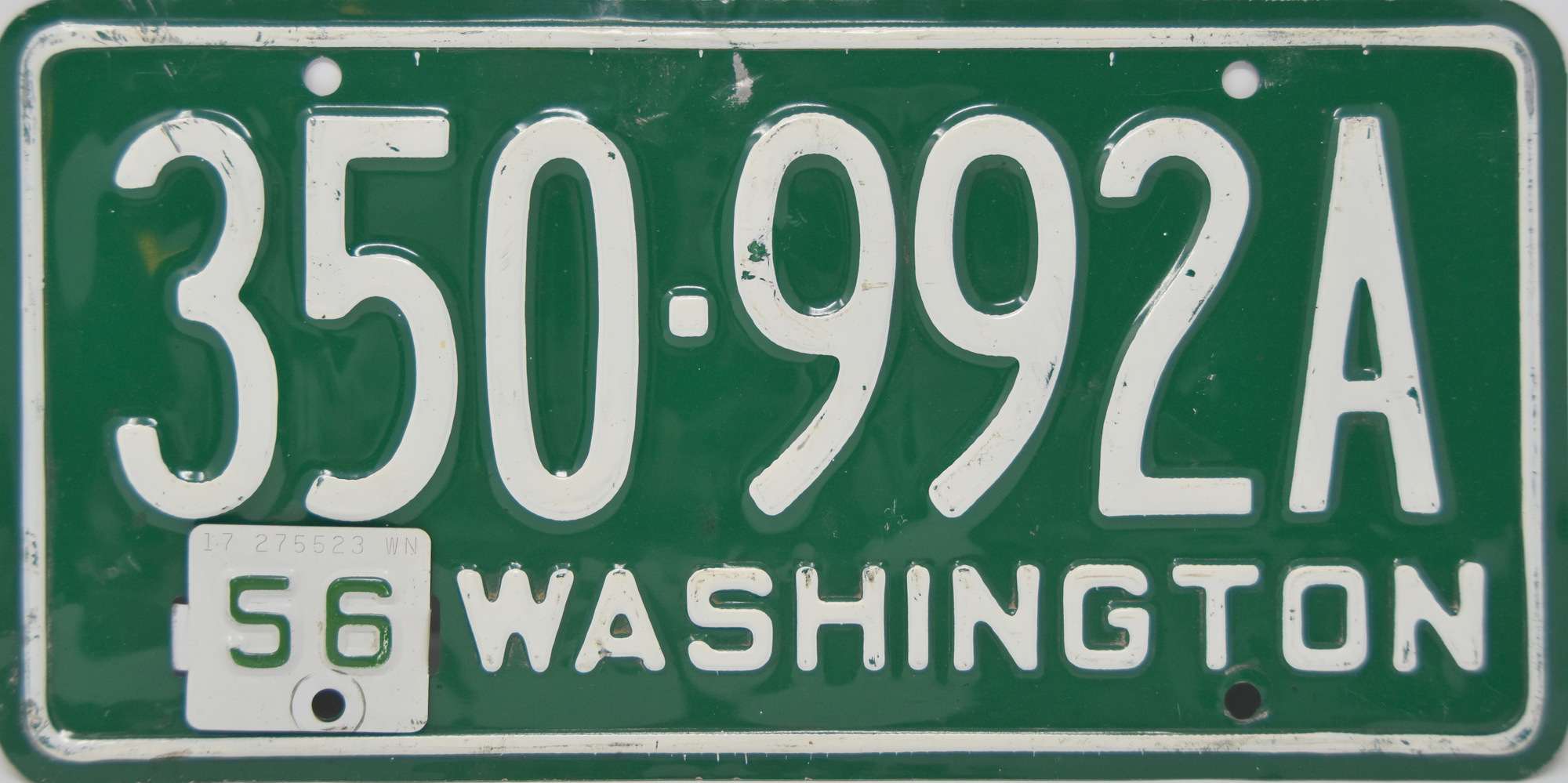
Starting in 1956, all license plates in the United States and Canada were standardized to a common size (6″ x 12,” the dimensions still in use today), based on an agreement reached between motor vehicle administrators.
Washington was still using the 1954 base with renewal tabs, so while existing registrations kept their original plates, all newly-issued plates for 1956 were in the new dimensions, with a design that mimicked the originals. In fact, even though these smaller plates were made for the 1956 expiration year, they were still stamped with a “54” date preceding the state name, to match the other plates on the road.
1958: the modern era begins
Washington’s current license plate system, with alphanumeric serials and annual renewals marked with adhesive stickers, originated with the 1958 issue.
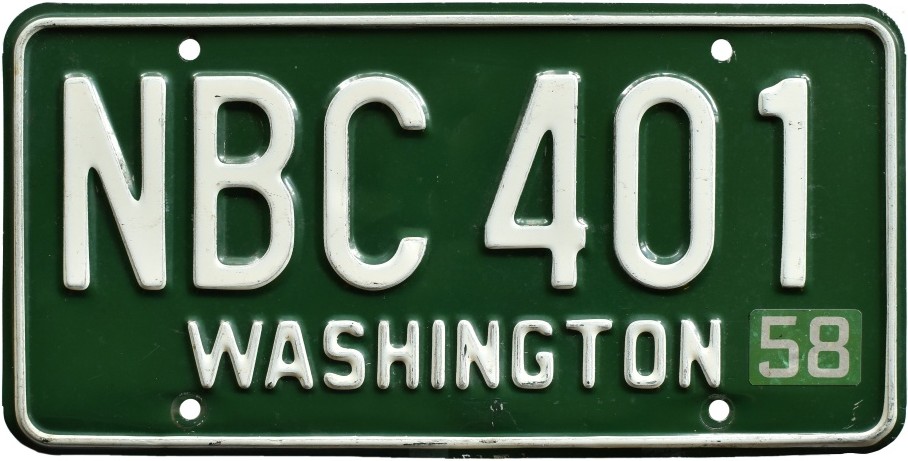
The modern era began with the introduction of the now-common alphanumeric ABC 123 format on multiyear baseplates renewed with adhesive stickers. California had introduced this system in 1956, which allowed easy identification and memorization, and offered millions of number combinations.
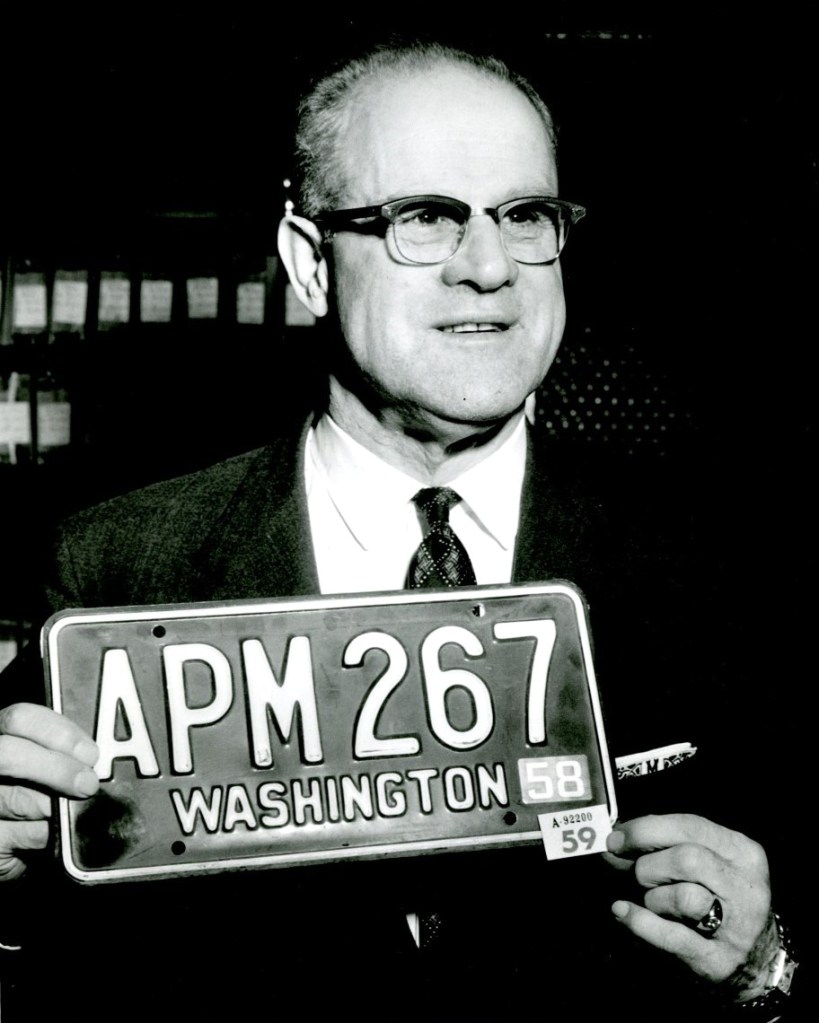
Production of these new license plates began in the newly-rebuilt factory at the Walla Walla Penitentiary in October 1957. The plates were shipped from the prison with a foil “58” sticker already glued on. Starting in 1959, the annual renewal process would be completed the same way as today: by peeling the back off a sticker and placing it over the prior year’s. The 1958 base plate was used, through renewal stickers, through 1962.
The county coding system in place since 1935 was adapted to fit the new alphanumeric format, with King County (previously “A”) assigned AAA through AZZ, Pierce County (previously “B”) assigned BAA through BZZ, etc. The new coding scheme would continue to be used through 1982, with modifications as larger counties ran out of their original allocations (complete listing of Washington county codes here).

1963: the WASH scandal
A new license plate issue was due for 1963, which replaced all plates then in use. It also generated the largest license plate controversy in Washington’s history.
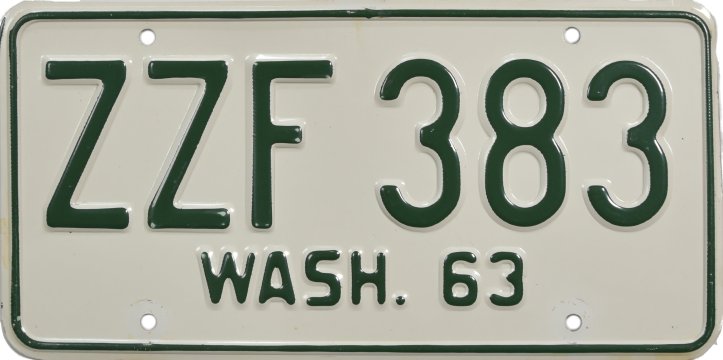
As a cost-savings measure, the original plan was for these to display the state name in full, followed by an embossed “63” to denote the first year of expiration, with adhesive year stickers used to renew for future years. By embossing the first year on the plate, the state claimed it would save $50,000 by not making 1963 stickers. However, an embossed “WASHINGTON 63” would not provide enough room for future years’ renewal stickers, which at some point were to include month tabs as part of a long-delayed plan to implement a staggered registration process. At the last minute the design was altered, “substituting the ugly abbreviation ‘Wash’ for the dignified full name of our state,” sniffed the Longview Daily News.
As soon as the WASH 63 plates made their appearance on the roads in December 1962, outrage and mockery filled newspapers pages across the state. An editorial in the Aberdeen World joked that “Wash 63 sounds like an emergency order in a laundry.”
Outcry over the “Wash” abbreviation was widespread enough that in 1965 the state legislature passed a law that stated: “Vehicle license number plates issued by the state of Washington commencing with the next general issuance of such plates shall be so designed as to designate the name of the state of Washington in full without abbreviation.”
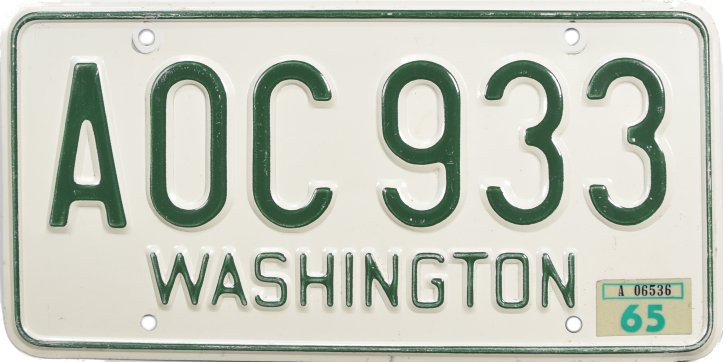
In response, starting in April 1965 the design was altered to spell WASHINGTON in full, with no embossed date. These plates were only issued to new registrations; the 1963 plates were not replaced and continued to be revalidated by year stickers. In fact, the 1963 plates, and all others issued thereafter, remained in use through 2000.

Reflectorization
State law drove another change in Washington’s plates in the 1960s. In 1967, the legislature passed a law stating that “All vehicle license number plates issued after January 1, 1968 […] shall be treated with reflectorized materials designed to increase the visibility and legibility of such plates at night.” This resulted in another new baseplate in 1968, which again did not replace any plates currently on the road, but became the standard issue for all new registrations. Numbering directly continued from where the previous issues ended.
This design would have a lasting impact on Washington’s license plates: to this day, the state name is displayed at the top left, in what has become an informal tradition.
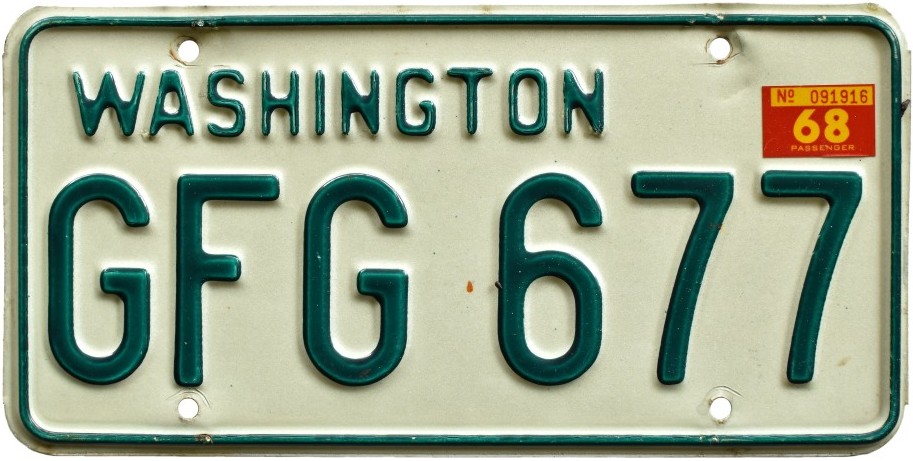
The 1968 base was issued until 1982, but had several minor design evolutions, the most notable being a change to smaller, crisper dies on the state name in 1978.
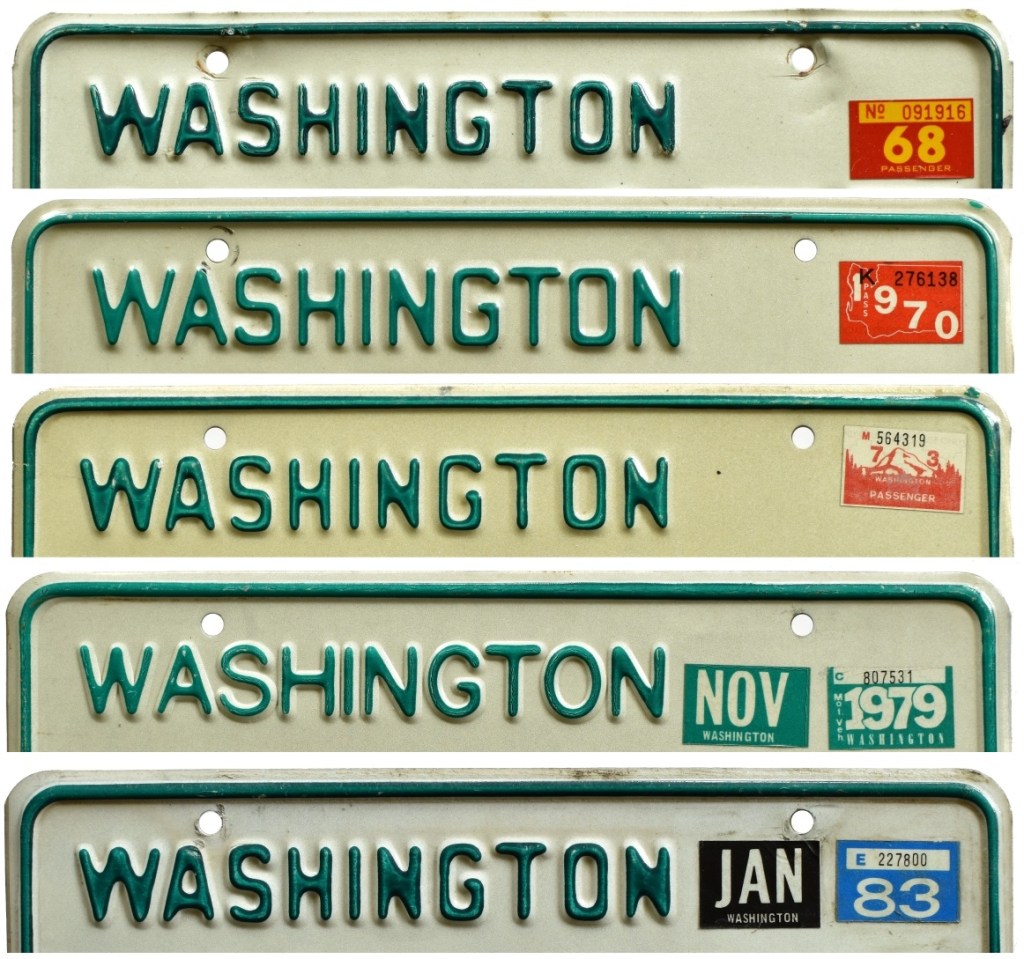
Another development was the introduction of a staggered registration system in 1977, which had been proposed through numerous (failed) legislative efforts over twenty years.
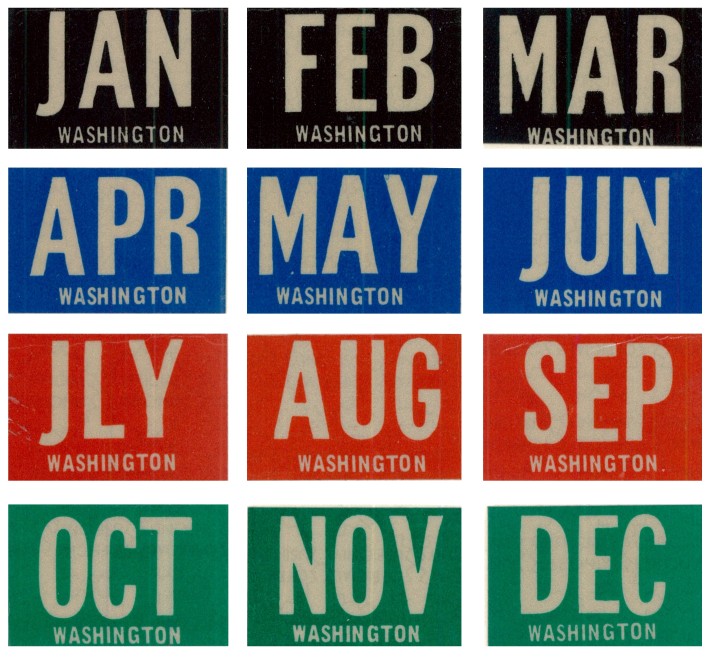
Prior to this, registrations all expired on December 31 of each year. With the adoption of staggered registrations, a month sticker was added, and for all new licenses, the original date of registration became the annual expiration date – the same system used today. Existing registrations were assigned a new month of expiration derived from a formula based off the license number.
The 1970s also kicked off another innovation is taken for granted today: license plates evolving from a mere registration device into a forum for personal expression. In late 1973, personalized plates were made available for the first time in Washington after a voter-passed referendum overrode the objections of Governor Dan Evans. For an extra fee, motorists could apply to for their own registration of two to six characters (updated in the mid-1980s to one to seven characters), subject to state approval.
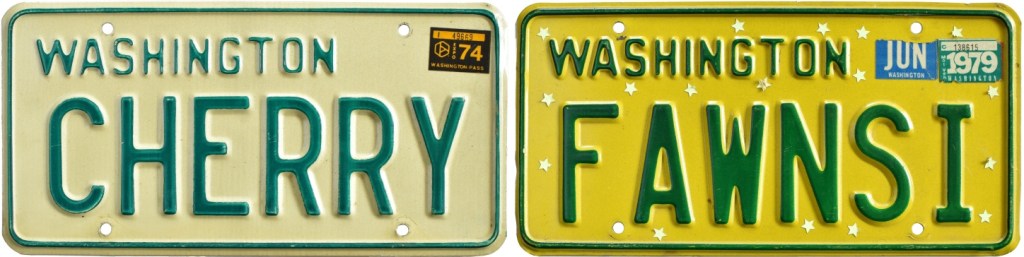
And, also for the first time, one could choose an optional design that differed from the standard issue. A special base with a bright yellow background could be chosen for personalized plates. Known informally as the “lemon” base for its colors, it would continue to be available as an alternative for personalized licenses until 1997.
By the start of the 1980s, the county coding system began to break down. King County registrations had become so large that the system could no longer be adapted to accommodate the necessary amount of letter combinations. The state finally abandoned the practice in 1982.
Not long after, Washington’s standard issue license plate was modernized, slightly, with the embossed state name replaced by a screened graphic.
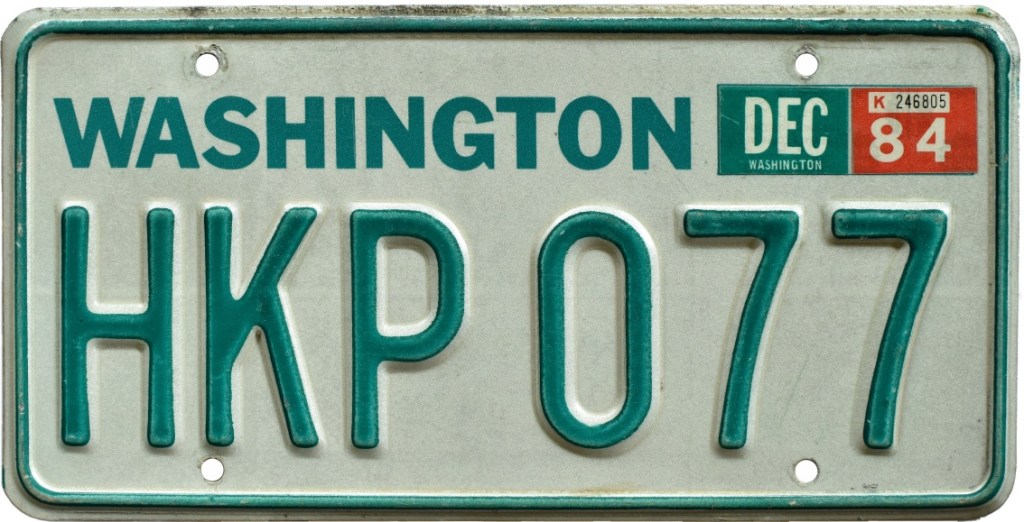
Narrower dies were adopted in 1985, also introducing a hyphen in the registration number. The smaller characters also allowed the use of seven-character personalized plates for the first time.

These would be the last non-graphic plates issued in Washington.
Centennial Celebration
In 1987, to commemorate Washington’s centennial in 1989, a new, fully-graphic design was introduced to great fanfare. The state created a design contest for the new plate, which was won by Eric Booth, a high school senior in Bellingham, who beat out more than 2,000 other submissions. This design became the new general issue for new registrations, and owners of existing vehicles could purchase the new plate for a small fee. Dominated by a rendering of Mt. Rainier, it has persisted for nearly four decades as the symbol of Washington state, and is still in use today, with minor evolutions.
Along with the new design came a brand-new numbering system, with passenger vehicle registrations starting at 000-AAA.
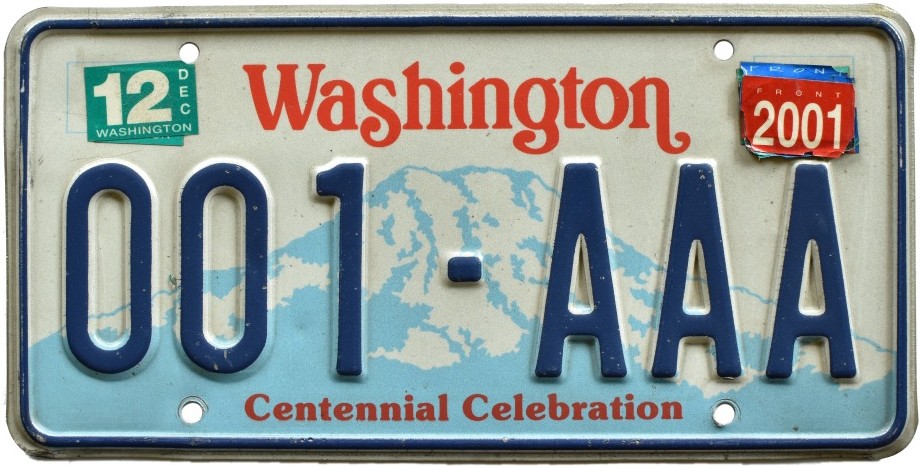
The “Centennial Celebration” slogan was in place two years before and after the 1989 centennial: in 1991, it was removed, but the design was otherwise unchanged. In 1997 the size of the hyphen was enlarged, starting with 000-HYB.

Optional Designs
During the 1990s, optional graphic design license plates exploded across the United States, with states like Florida pioneering striking graphics available for extra fees, benefiting causes like the environment or special organizations. Washington state dipped its toe into this practice slowly, offering a limited number of special licenses, all adhering to the standard Mt. Rainier design, with special graphics or logos.
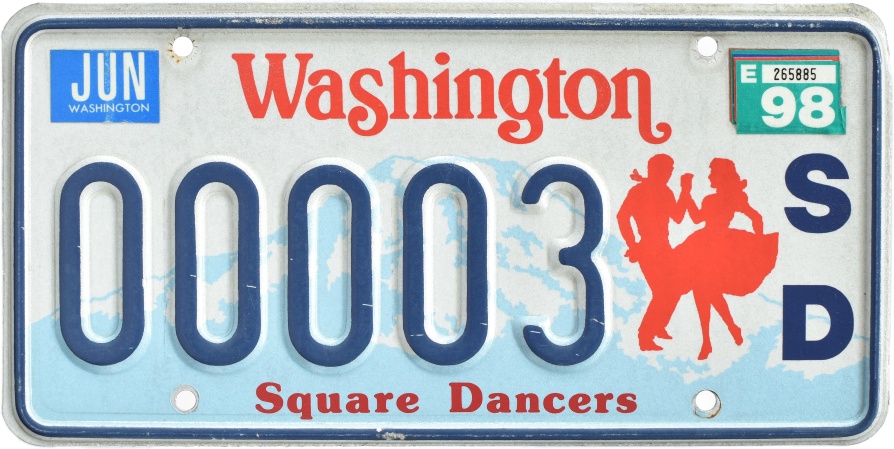
In 1993, the first special-interest optional design in Washington state debuted, and it was for an unassuming cause: Square Dancers. In a real marketing and lobbying success, devotees of Square and Round dancing, which had been named the official state dance, were able to influence legislation for a special license plate. Anyone could pay extra to register their car with one and proclaim their enthusiasm for the do-si-do. Never a high-volume seller, these are still available for registration more than 30 years later. For a few years after it debuted, it was the only special license plate in Washington.
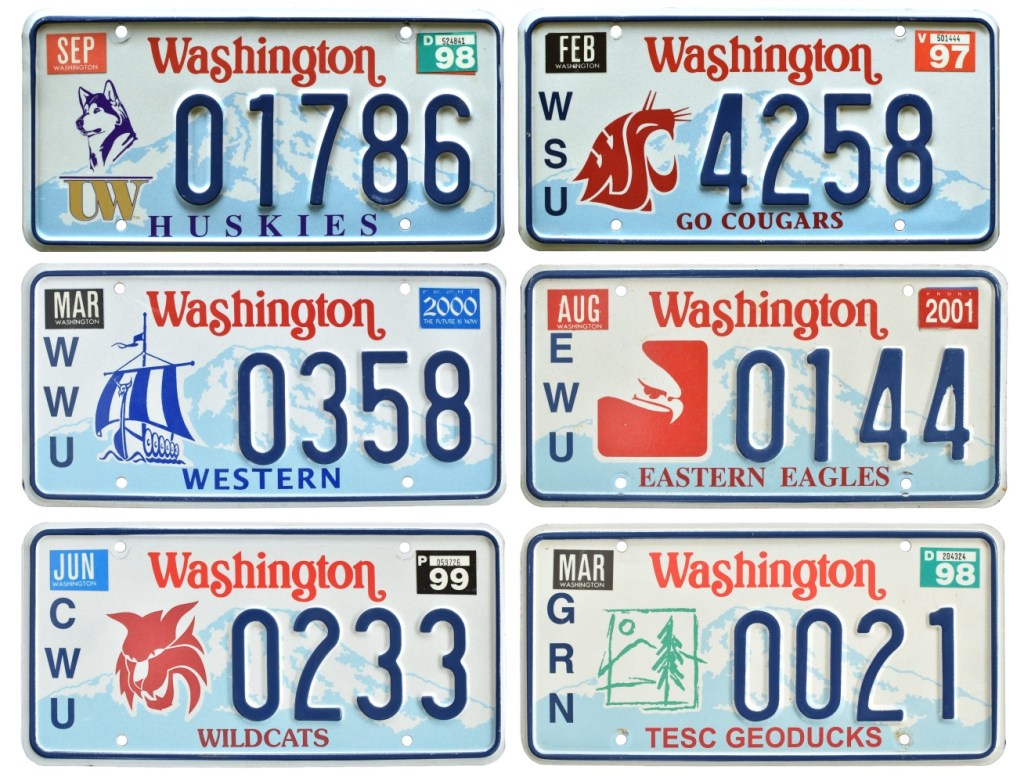
More options would follow, with the addition of colleges and universities in 1995 and 1996, and a Seattle Mariners plate in 1997 that helped fund the construction of the team’s new home, Safeco Field.
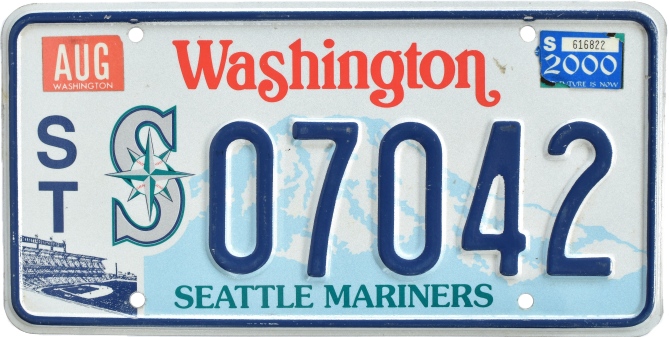
For almost a decade, these not especially exciting designs would be the only optional licenses available in Washington.
The Evergreen State
After 83 years of state-issued license plates, Washington for the first time displayed the state motto, “Evergreen State,” on its plates. The 1998 design, which ironically contains no green whatsoever, was a mild rework of the original Centennial plates. The embossed border was removed and the state name converted to block characters and moved to the top left, a format that first appeared in 1937 and was consistently applied for much of Washington’s plates since 1941. Plate 999-JNZ was the last to be issued in the old format, with 000-JOA marking the transition point to the new design.
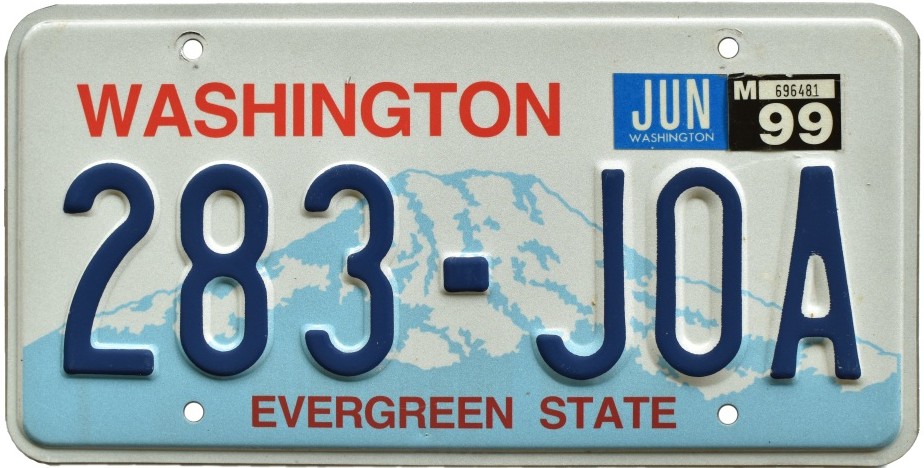
Shortly after Evergreen State design debuted, month stickers were updated to replace the three-letter month abbreviation with a month number (e.g. “JAN” and “FEB” became “1” and “2”, etc.).
For the year 2000, Washington broke with tradition and issued a special year sticker with a distinct font and the proclamation that “THE FUTURE IS NOW.” While the font reverted to the previous style for 2001, the use of a four-digit year became permanent.
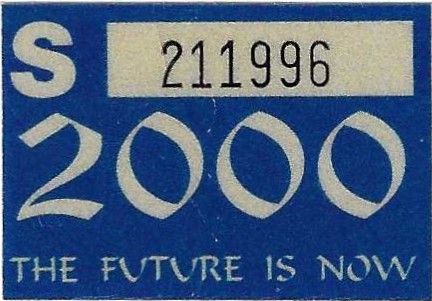
With the future came a break with the past. New laws effective at the start of 2000 phased in a program mandating replacement of license plates older than seven years. With license plates as far back as the infamous “WASH 63” base still on the road, this law standardized Washington’s license plates to the current design, and, like the old “WASH 63” issue had done almost four decades earlier, proved to be wildly unpopular with the public. Many people liked their old license numbers and viewed the program as unnecessary and wasteful, and it was finally repealed in 2014.
All of the old license plate styles may have disappeared from the roads at the turn of the century, but bumpers around the state did become more diversified starting in 2006, when a slew of optional special design license plates were made available, without any ties or resemblance to the Mt. Rainier base. New designs continued to proliferate for the next two decades.
In 2010, the numbering system that had begun at 000-AAA with the Centennial plates had finally run out, with plate 999-ZZZ being issued at the beginning of that year. Plate numbering restarted with a seven-character registration number, beginning with AAA0000.
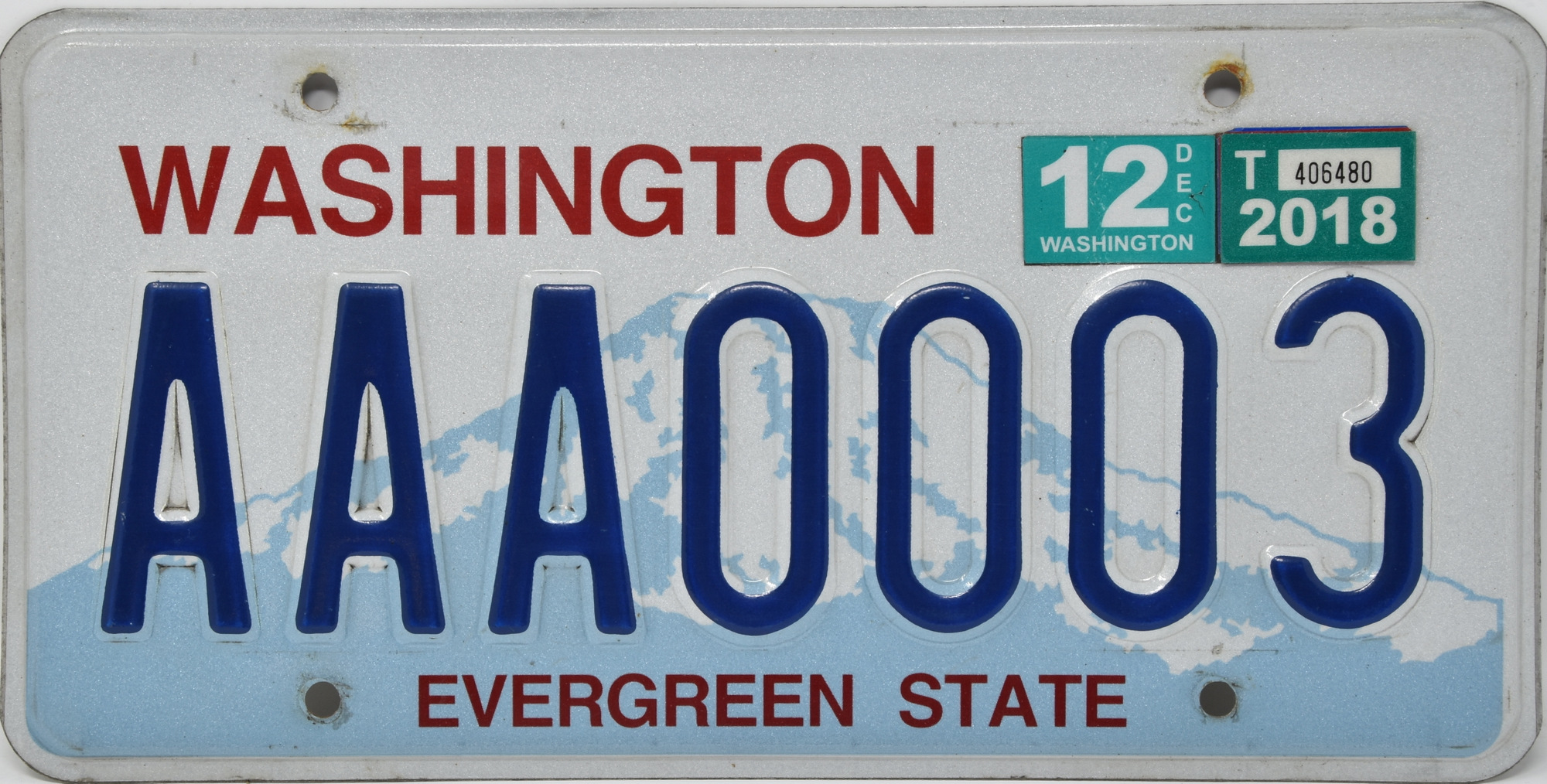
The current format theoretically can last decades before changes are needed. It has taken the state five to six years to run through a complete letter series (e.g. AAA0000 to AZZ9999), so any variety on Washington bumpers will have to come from the growing number of optional graphics.
2020s: Flat License Plates and Alternative Sources
In the 2020s, while the same general license plate design continues the post-1998 format, supply issues and technology updates have resulted in small changes.
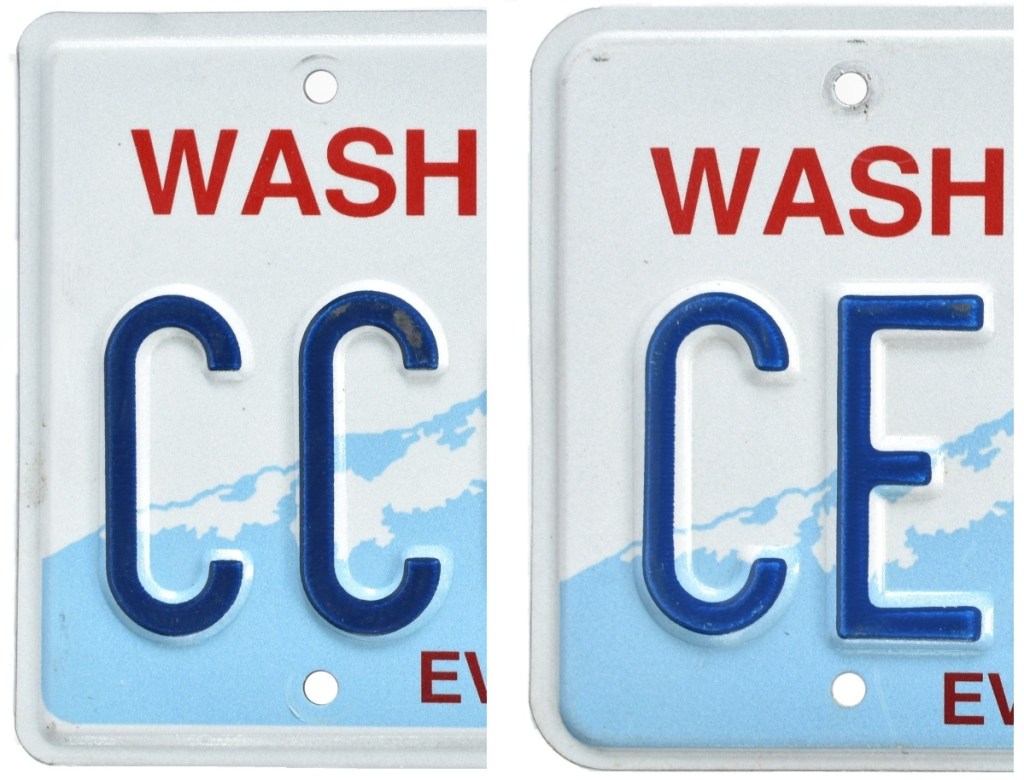
During the COVID-19 era, capacity constraints at the Walla Walla Penitentiary caused state officials to use outside vendors as secondary production sources. Production was split between Walla Walla and the Waldale Company of Nova Scotia. The Waldale-produced plates have slightly different stampings that result in more squarish corners.
More noticeable is the switch, in 2024, to non-embossed plates. This was the result of equipment updates at the Walla Walla Penitentiary and the need for greater efficiency to mitigate longstanding production backlogs.
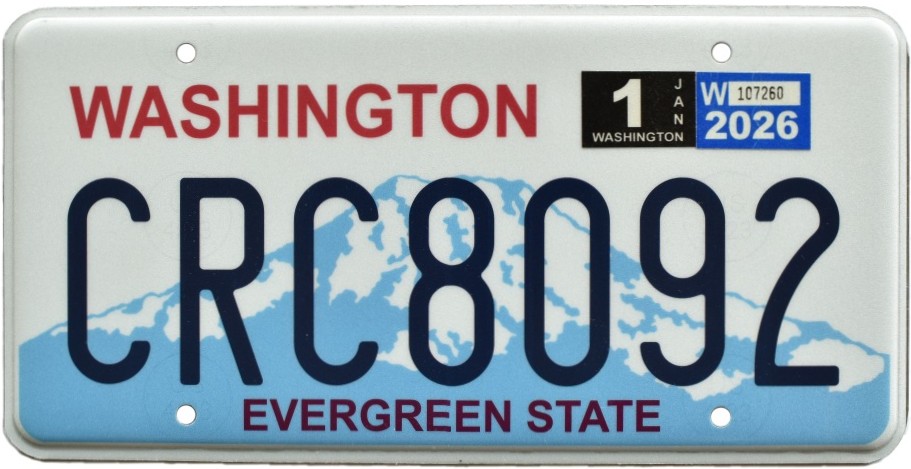
As of 2025, it appears the change to flat license plates is permanent, and Washington will join roughly half of the other states in no longer producing embossed license plates.
With no further design changes officially on the horizon, Washington’s standard-issue license plates will likely look the same well into the future.
 Danny's License Plates