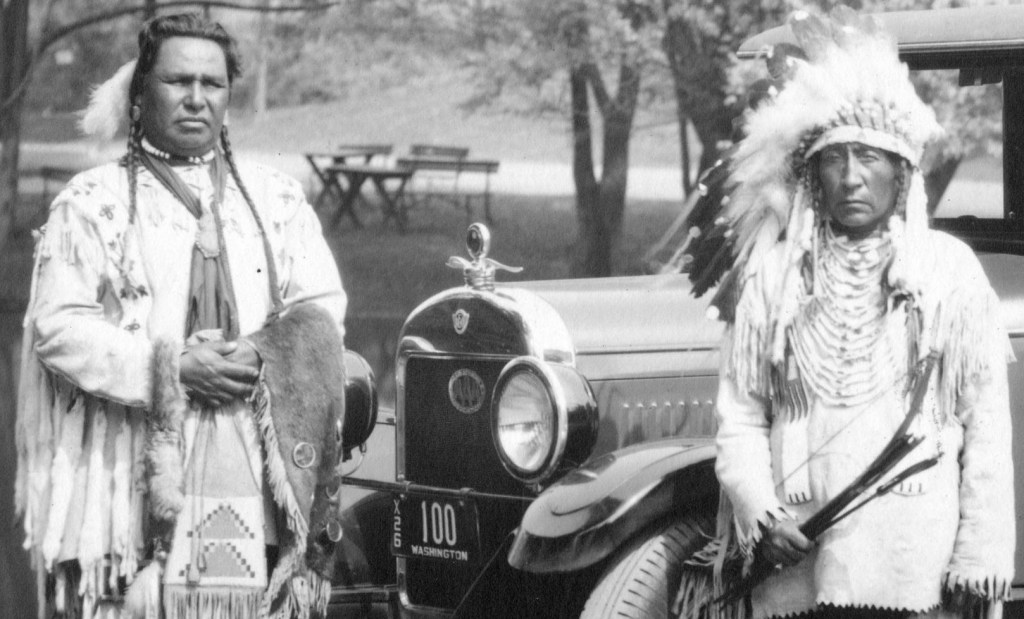
2026 marks a full century of Washington’s license plates spelling out the state’s name in full. One hundred years ago, in response to complaints, confusion, and a growing desire to promote the state, Washington officials revamped the license plates for 1926, abandoning the longstanding “WN” abbreviation.
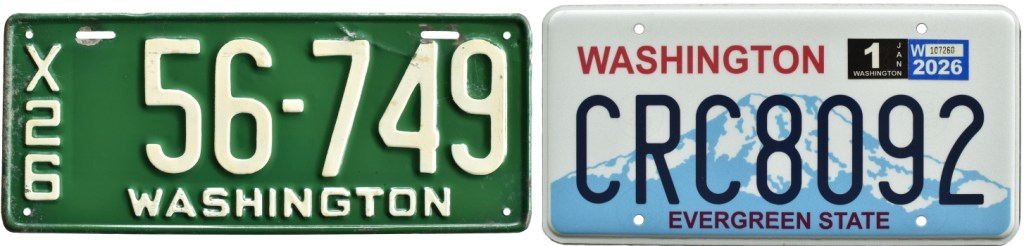
Aside from the infamous “WASH” scandal of 1963, the state’s name has been displayed in full glory on its passenger vehicle license plates ever since.
WN (not WA)

Few people alive today, aside from boaters, would associate the abbreviation WN with Washington state, but it was the sole identification on Washington’s license plates for two decades in the early days of the automobile, and persisted on some license plate types until the 1970s.
The “WA” abbreviation we know today resulted from the Post Office standardization in 1963, which defined the two-letter abbreviations for each state, along with ZIP codes. The codes were meant to reduce ambiguity that arose from other, non-standardized abbreviations widely used across the country.
Before this initiative, there was no set standard. For mailing, signage, and advertising, the general norm was “WN” or “WASH,” which is how the WN found its way onto license plates.
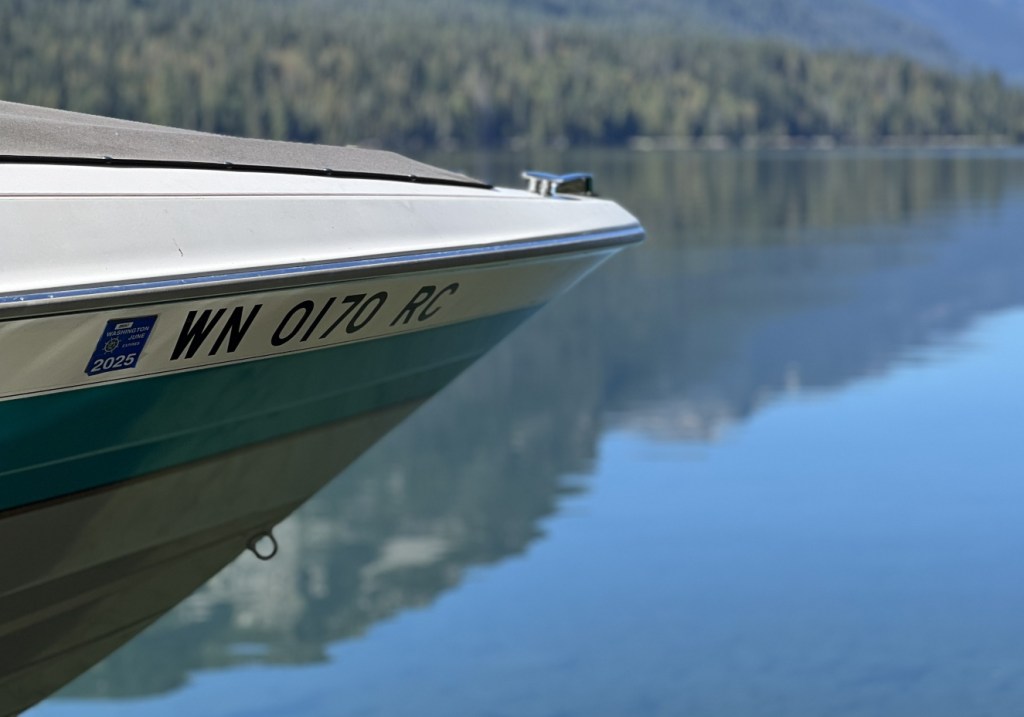
Interestingly, the US Coast Guard uses its own set of official abbreviations, which were never updated to align with postal codes. This is why boats in Washington even today begin with “WN” (and why Wisconsin boats have a WS instead of WI, Californians CF instead of CA, etc.).
In fact, registering a boat in Washington state today is quite similar to the prestate era of license plates: the owner is assigned a number and required to find a way to display it, preceded by “WN.” Just like a car owner in 1905.
The abbreviation “WA” was never used on Washington state license plates, although it is widely seen Down Under, in the state of Western Australia.
Change to “Washington”
By the mid-1920s, the automobile had been widely adopted and was increasingly used for long-distance travel. The license plate was seen as a means of promoting one’s state, with slogans and graphics starting to emerge.
Even without fancy gimmicks, the full spelling of state names became more common in this decade. Individuals began to care what was on their car, too. In the 1920s there was no shortage of newspaper editorials or letters to editors advocating for a more prideful, and clarifying, label than the austere (and ambiguous) “WN.”
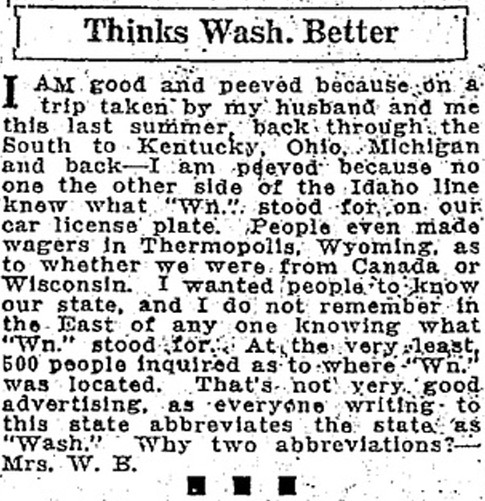
“If I have been asked once, I have been asked 50 times what ‘WN’ stood for, and if we were from a province in Canada” (Washingtonians recounting their roadtrip to Pennsylvania in The Columbian, July 19, 1924)
“People generally in the East – not any farther away than Wyoming – didn’t know what the ‘WN’ on our license plate stood for. It seemed foreign to everyone” (Sequim residents describing their drive to Washington, DC in the Sequim Press, August 21, 1925).
In an amusingly grandiose and florid essay in the Everett Daily Herald, local businessman John Healy expounded on the “innovation” adopted by British Columbia by replacing its “BC” with the full provincial name for 1924 and urged the same for Washington. He wrapped it up with this tale:
A big touring car stood at the curb, in the down town district of a big eastern city. The throng passed to and fro. They looked at the license plate and it was new to them. Some hesitated and looked again and passed on, still in doubt or wholly ignorant of what it meant. One, more inquisitive than the rest, came by, looked and stopped, studied for a moment and asked, ‘What state does Wn. stand for?’
Amused and peeved and with a feeling of pride and shame, we said, with a noticeable chest expansion, ‘the state of Washington.’ He followed this with ‘Out West, eh?’ ‘Yes.’ Then — ‘I have some friends in Buffalo,’ and we resumed the perusal of our road map and the easiest way to the next town.
It not only pays to advertise but it is very necessary. In 1925 instead of hiding our identity in a meaningless abbreviation, let us put across the bottom of our license plate plate ‘Washington,’ thereby showing an emulation of the northern oasis and our love of country and state.
So many peeved citizens of WN!
One of the main problems with the “WN” abbreviation was that it could reasonably be assumed to represent Wisconsin, or even Wyoming. And there was a bit of vice-versa from the Midwest, as well: Wisconsin, with a dose of arrogance, ignored the two other states starting with the same letter and claimed the simple “W” for its earliest license plates (a much more helpful “WIS” was adopted in 1921 after being soft-launched in 1916 and ’17). Wyoming bucked ambiguity by going with “WYO” right out the gate.

Displeasure with the “WN” dovetailed with a growing evolution of license plate designs. In the Western U.S., each year in the mid-1920s saw another state abandon abbreviations on its plates. In 1924, western states were marked as WN, ORE, CAL, IDA, MONT, ARIZ, WYO, and NM, with only the character-light states of Nevada and Utah giving their full names.
Starting in 1925, Idaho and Arizona switched to full spelling, followed by Washington in 1926, Oregon, California, and New Mexico the year after; and Montana in 1928, at which point Wyoming’s “WYO” was the only holdout from the Rockies to the Pacific (rectified in 1930). Curiously, both Idaho and California briefly regressed to their three-letter abbreviations (1929 through 1931 for California and 1932 for Idaho), before returning to their full names.
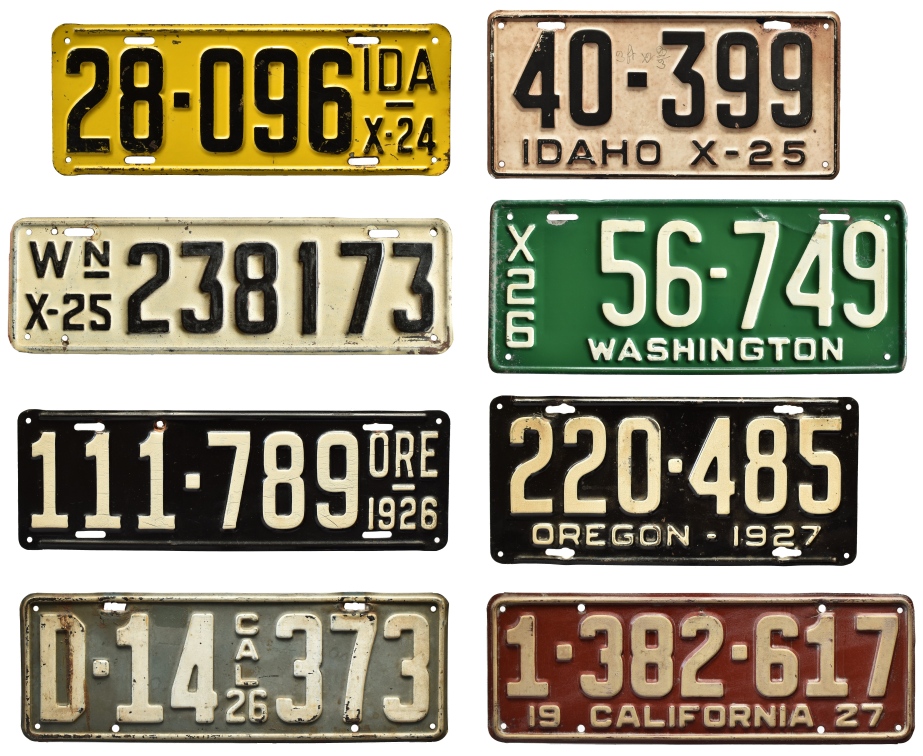
The trend was noticed. The Olympian noted in late 1927, in a brief article describing the “homely spud” that was to adorn Idaho’s license plates the next year, that “western states will stick by the new rule of spelling the name in full, which was started this year. Even the long names of ‘Washington’ and ‘California’ are spelled out.”
The “WN” had almost gone away a year earlier. Newspapers reported in late 1924 that, due mainly to the confusion with Wisconsin, the next year’s license plate would either have “WASH” or “WASHINGTON.” However, this change would have required retooling that funds didn’t allow.
That final change debuted with the 1926 issue, which was larger and further modernized the license plate design by adding a hyphen in the number to aid legibility.
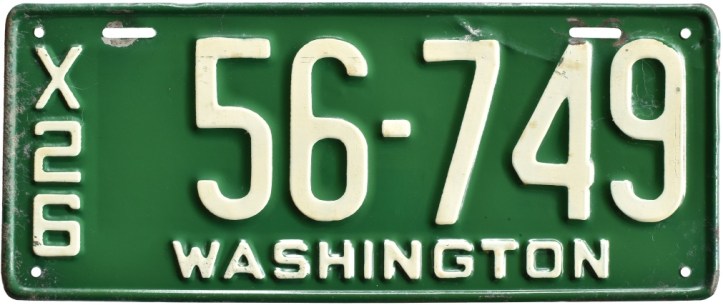
In a somewhat grumpy article, the Seattle Times saw the change primarily as a negative: since the new plates were larger going forward, motorists could not reuse their frames: “After those powers-that-be decided to spell out the name of their state,” the Times wrote on September 22, 1925, “they tried to find a place on the license plate to put it. There wasn’t any space, unless they made the figures smaller, and those powers-that-be had sense enough to know that that would never do. Then they had a happy idea; the name ‘Washington’ will be put at the bottom of the license plate next year, and as a result the plate will be one inch deeper than the heretofore uniform size.” The editors ended on the happier observation that “Washington cars will never again be mistaken in the East for Wisconsin cars. So that’s that!”
In a further reminder that you can never make everybody happy, even with Washington’s name appearing in full glory, people still complained. In September 1927, a short article in the Bellingham Herald summarized a letter from local resident Pat Renahan, who had driven all the way to Quebec, to P.E. Healy, president of the city’s Chamber of Commerce. Renahan “begged” that Healy use his influence to change the license plates to “Washington State.” He lamented that “from Chicago east everyone thinks Washington is Washington, D.C.”
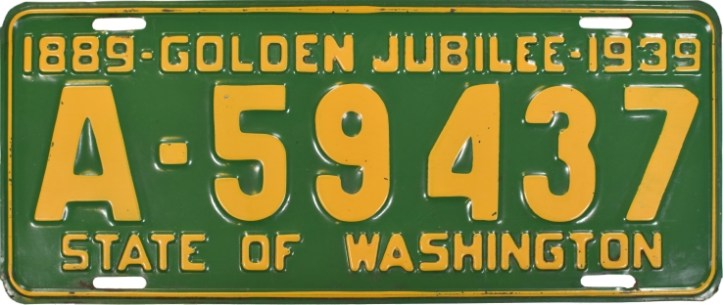
Renahan would have to wait more than a decade before the 1939 issue added a clarifying “STATE OF” to precede Washington (but only for that year).
Washington would be spelled in full on its regular-issue passenger license plates forever more, with a brief period from 1963 to early 1965 when it was shorted to “WASH,” a decision that was met with widespread outrage.
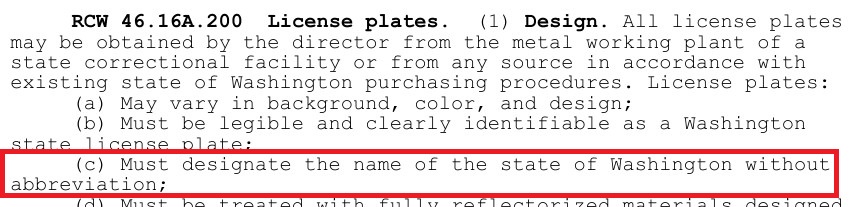
As a fallout of the “WASH 63” debacle, it is still a legal requirement that the state name be spelled in full on Washington license plates.
Lasting “WN”
Standard-issue passenger plates in Washington would have the name spelled out in perpetuity after 1926, aside from the “WASH 63” hiccup. But for other vehicle types, the “WN” abbreviation lasted much longer.
Motorcycle license plates, due to their smaller size, continued with the stylized “WN” for decades – all the way until 1953. In fact, their appearance changed little over more than 35 years, even hanging on to the “X” (or “E” for rarely-issued exempt motorcycles) preceding the date, which had last appeared on standard-sized licenses in 1935.
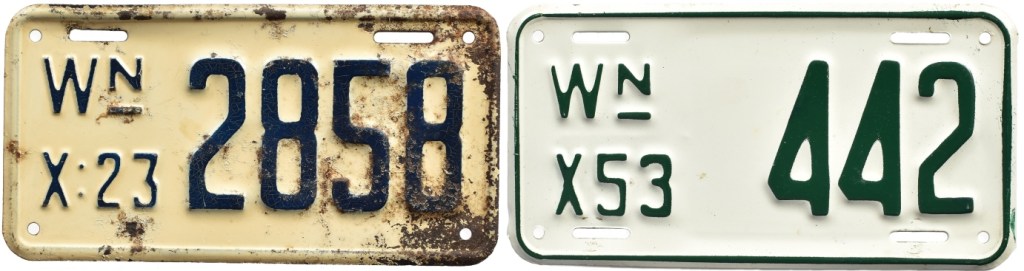
Had it not been for the Walla Walla Penitentiary plate shop burning down, requiring the use of an alternate supplier in 1954, these relics of the past would have probably carried on even longer.
The WN “logo” made a scarce appearance into the early 1970s, showing up on Special Taxi permit plates (which were used for out-of-state taxis operating in Washington, primarily from Portland, Oregon).
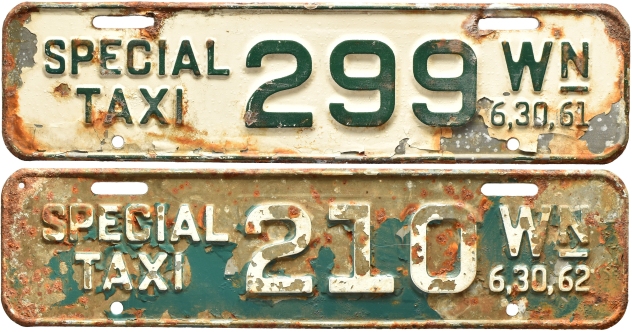
The WN was used, sans underlined superscript, for many non-passenger license plates in the 1960s that required abbreviation due to space constraints.
The state’s 1965 law in response to the “WASH 63” uproar mandated the full spelling of the state name on all license plates “commencing with the next general issue,” which generally aligned with a different state law requiring reflectorization of all license plates in 1968.
Aside from the Special Taxi licenses, the last license plates in Washington to carry the WN abbreviation were 1969 wrecker licenses: because this particular class had always had a June expiration instead of a normal calendar year, they were issued in mid-1968, valid through June 30, 1969.
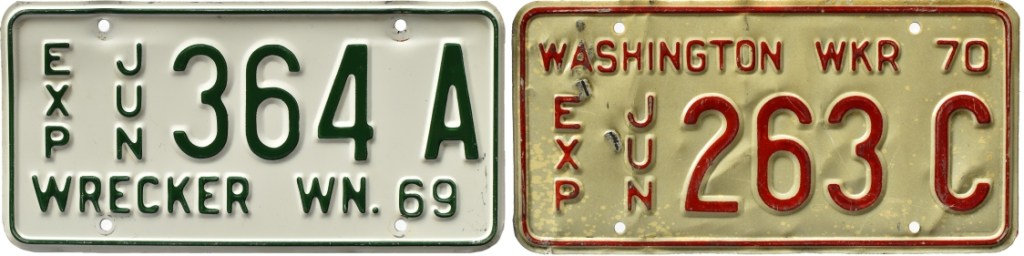
And since then, it’s been nothing but WASHINGTON. Happy state name centennial!