The automotive and mechanical engineers have been remarkably successful in developing a car with built-in safety features, which, when placed in the hands of a normally sane driver, is practically fool proof. The modern car of today is no more like its predecessor than Aurora Avenue is like the Oregon Trail. However, like our eyes, our ears, our heart and our mental and physical reactions, these modern up-to-date built-in safety features often become ineffective with use and age.
Seattle Engineer’s 1936 report
The late 1930s saw a heighted public awareness of the dangers of motor vehicles, with a multitude of public projects to reduce traffic accidents and fatalities. Campaigns to add first-aid kits to public vehicles (formalized in late 1937), increased calls for driver testing (required by law in Washington state in 1937), and, in 1938, state-mandated vehicle inspections, were all part of a larger effort to reverse years of increasing motor vehicle fatalities.
Much of the blame for traffic injuries and death was attributed to faulty equipment and poor vehicle maintenance. State motor vehicle laws dictated equipment standards and requirements, but most states did not have mechanisms in place to validate compliance as a part of the annual registration process. Across the country, many cities took it upon themselves to mandate regular testing to ensure vehicles were in good working order.
Reacting to this increased safety focus, the Seattle City Council passed Ordinance 66188 on March 31, 1936, which required vehicle owners to submit to a city inspection every six months, starting in 1937. It resulted in the construction of a large new building for the purpose, employed more than 50 testers, and forced car owners to make twice-annual treks downtown to have their vehicle thoroughly tested.
Period newspaper articles noted a “national movement for municipal testing stations.” Seattle was soon joined in this movement by Portland, Oregon, which inaugurated its own testing program at the start of 1937. Similar programs were proposed in 1936 in other cities all across the United States. The police chief of Omaha, Nebraska promoted that city’s new testing station on November 22, 1936 and noted that at least 12 other cities in the U.S. had launched testing programs.
But Seattle’s testing regime only lasted one year. The program suffered many logistical problems, primarily cost management and testing efficiency, but it was developments at the state level that prevented it from surviving past 1937. Seattle officials had jumped the gun on testing requirements: the state legislature mandated it starting in 1938, with the Washington State Highway Department assuming testing responsibilities across the state.
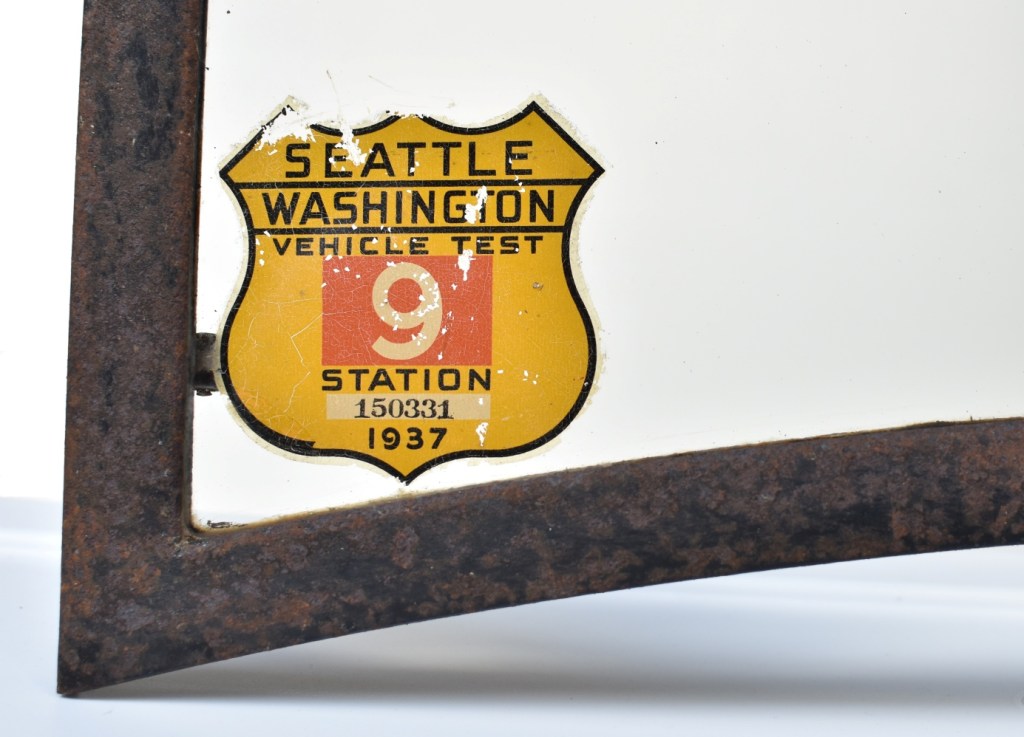
With auto licensing governed by the state, auto inspection administration at the same level is a more logical arrangement than individual cities creating their own rules. During that one year, Seattle-registered cars could be identified across the state by the colorful badges on their windshields indicating their compliance with their city’s inspection requirement.
Constructing the Testing Garage
Within weeks of the Seattle City Council’s ordinance mandating inspections, construction began on a facility to house a testing site. Throughout 1936, the city built a large concrete garage with six testing lanes on land that is now part of Google’s campus in Seattle.
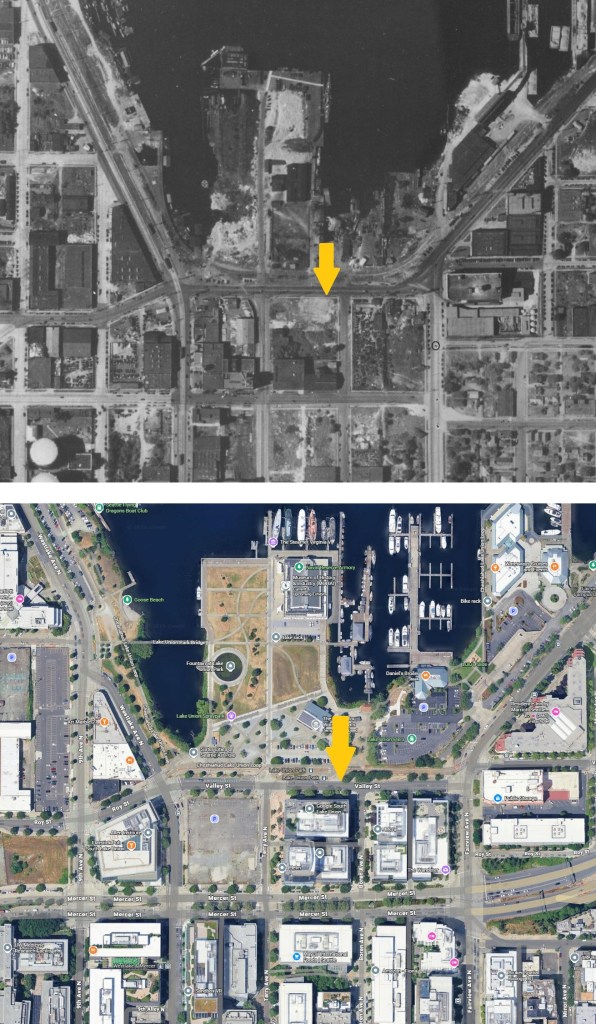
Like so much of South Lake Union, the garage’s site has evolved substantially. Early city development valued the lake and its surrounding shores as a garbage dump, and in 1908 an incinerator was built on the exact location where the inspection garage was sited in 1937.
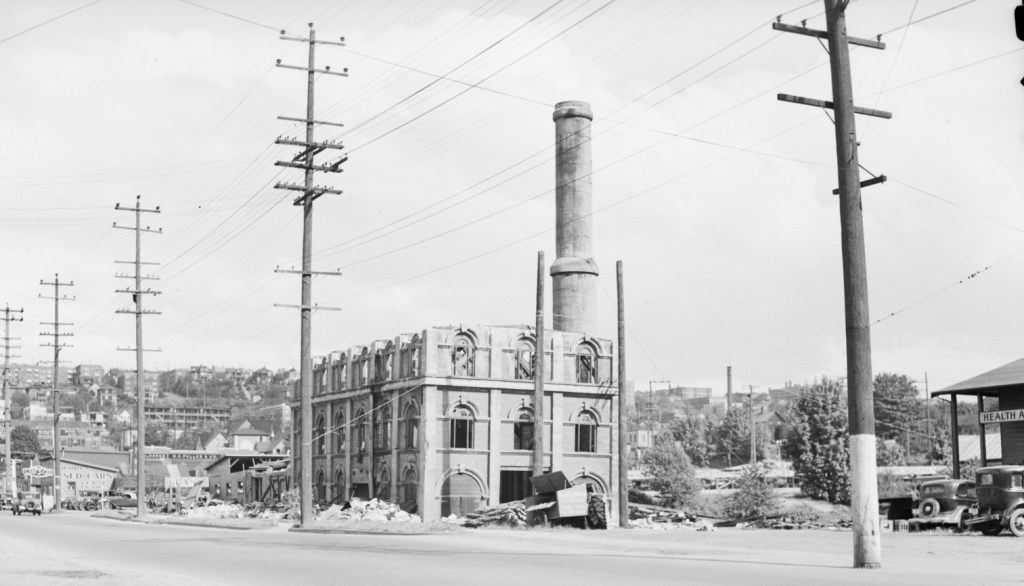
With an efficiency that is unfathomable today, the testing garage was completed and operational a mere six months after the old building had been demolished.
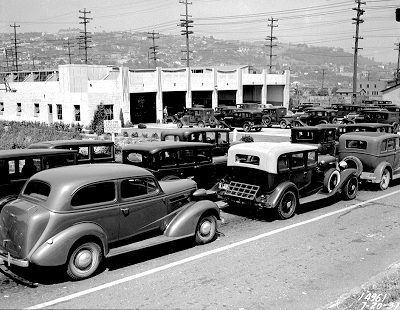
Reflecting the constant change in this part of Seattle, the garage itself was eventually demolished later in the 20th century, and the site was a parking lot into the early 21st century. Today it is a modern office building across the street from the park-like development surrounding the Museum of History and Industry.
Testing Begins
Seattle motorists reached an exciting new milestone in public safety, or burdensome regulations, depending on one’s perspective, when the inspection garage officially opened for business on Thursday, December 3, 1936.
The Seattle Times spun it optimistically, declaring that “instead of considering the required inspections as arduous,” the public “is giving unmistakable approval of the services as an important activity in the interests of safety.”
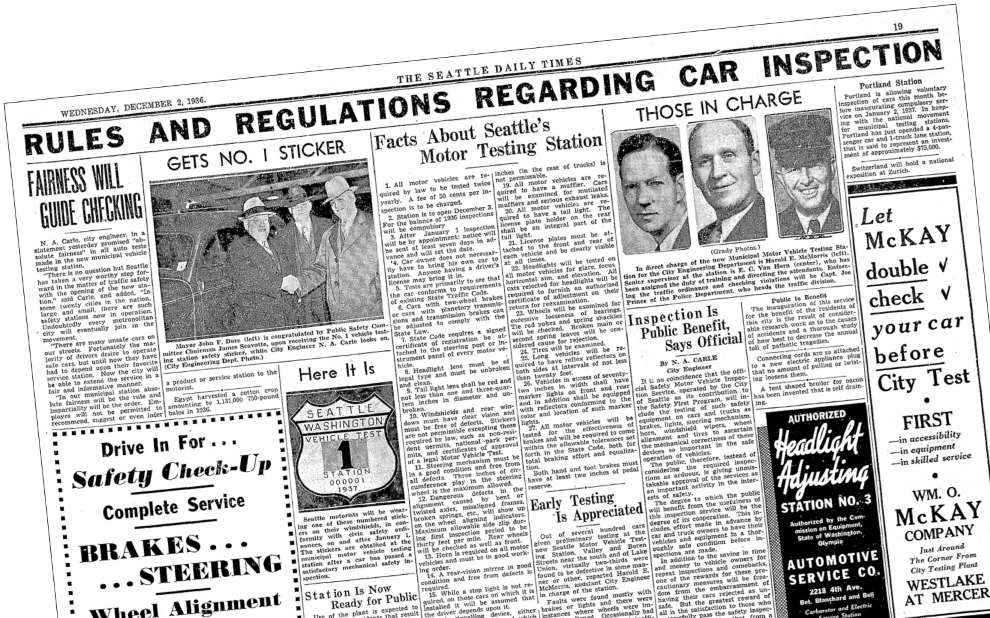
In reality, much of the public was generally less than pleased at the prospect of driving downtown twice a year, paying a fee ($0.50), and waiting in line, with a potential laundry list of needed repairs as the end result. The Seattle Post-Intelligencer reported on December 21, only a few weeks after the inspections began, that the city council members had “been deluged individually with complaints that the inspection at the municipal plant is unnecessarily severe.” The head of the testing station, H.E. McMorris, told the P-I that they’d failed about 40% of the 10,000 cars that had been tested, but also defended the process as “quite lenient.”
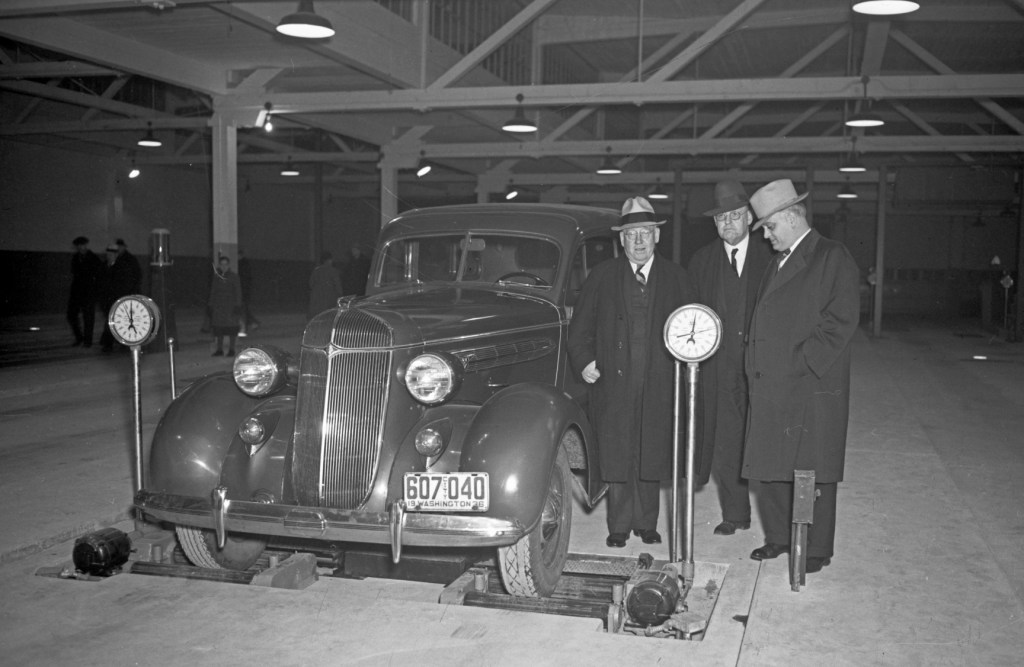
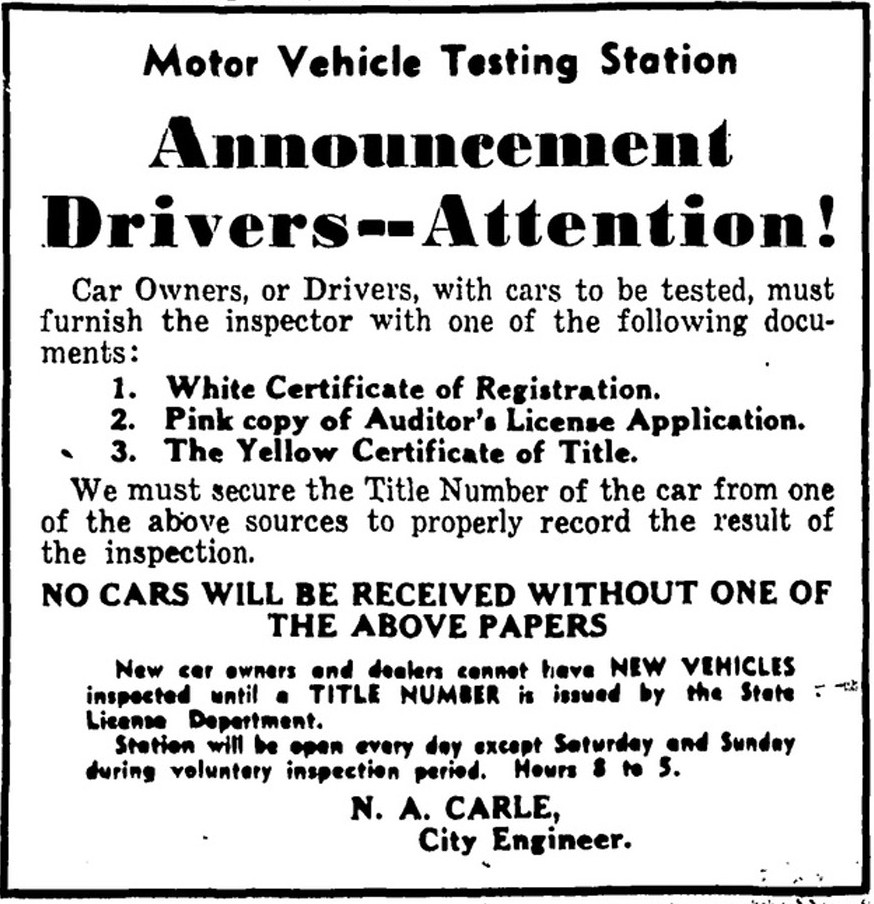
Anyone could voluntarily bring their vehicle in for testing early, but starting January 1, 1937, the city was to begin summoning vehicle owners by mail to undergo testing within ten days of receiving their notice. That process was slowed by one of the first hiccups in the Seattle inspection program: the paper forms needed for those mailings were delayed.
Notices were sent out based on title number, rather than license plate number, in order to prioritize older vehicles that were more likely to have defects. Visitors to the city were not required to have their vehicles tested unless they remained for more than six months.
The testing was extensive, and primarily focused on ensuring compliance with the state traffic code. Headlight adjustment, wheel bearing tightness, tires, license plate displays, windshield visibility, indicator lights, steering wheel precision, and brake effectiveness were among the areas tested.
Inspection Stickers
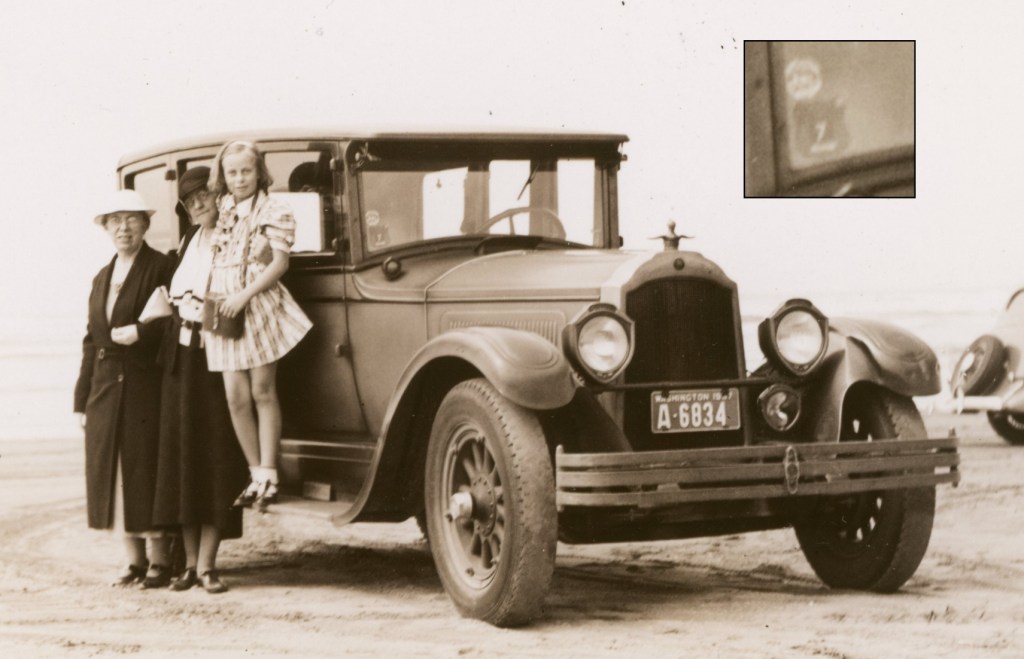
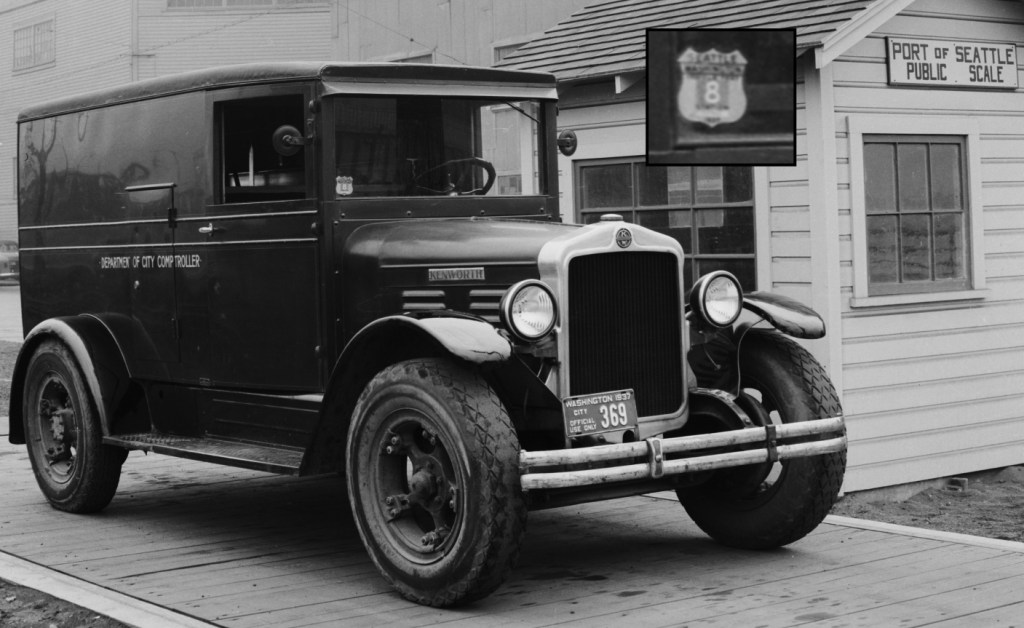
The reward for a successful test was a colorful sticker affixed to the lower passenger-side corner of the vehicle’s windshield. These bright shield-shaped decals abounded on the streets of Seattle throughout 1937 (and later, for those who couldn’t be bothered to scrape them off after the year ended).
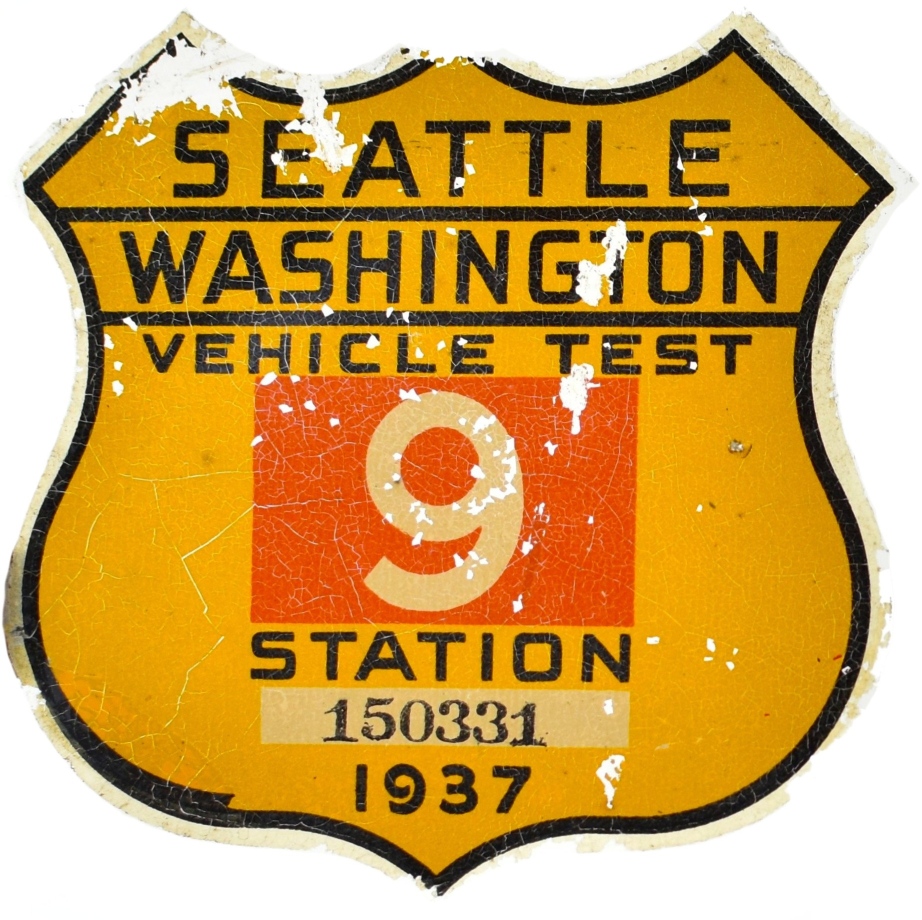
Once ubiquitous, surviving examples are extremely rare today.
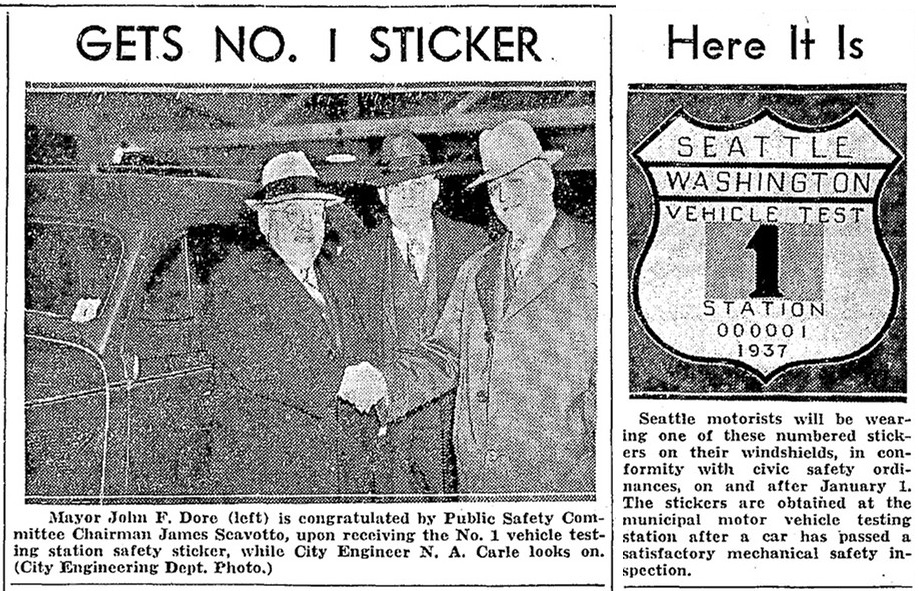
The stickers had a large block number in the center, which indicated the month the vehicle had been inspected, although it was not identified as such. With the law effective January 1, 1937, earlybirds choosing to get the testing over with in late 1936 would still receive a “1” for January.
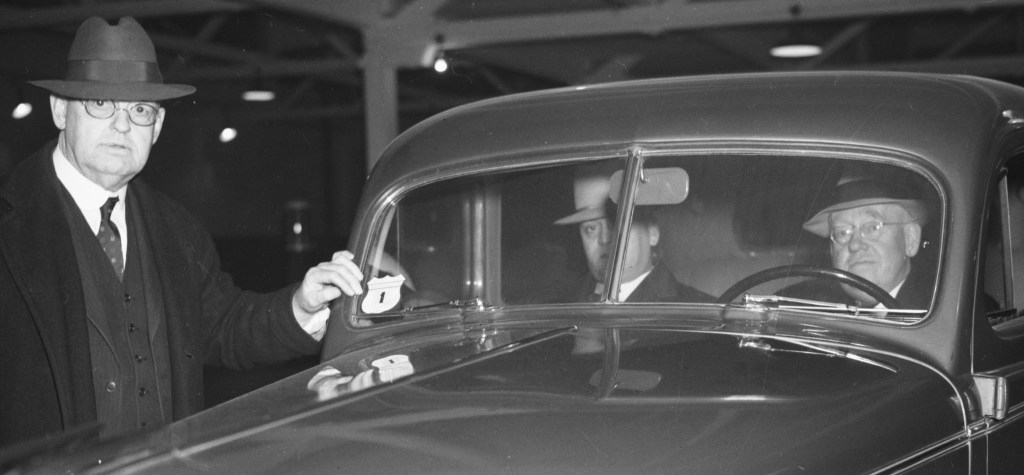
With period photos in black and white and newspapers silent on the colors, it is not clear if all 1937 test stickers were in the same color scheme. Photos of the first sticker, issued to Seattle’s mayor, shows the month number is black, while the surviving example in my collection (“9” month) and other period photos indicate later months (May, July, August, and October are known examples) had white numbers. It is likely that the “number one” permit used for photo ops with the mayor was a pre-production mock-up; the newspaper closeup shows different fonts, and it appears to have only been placed on the vehicle windshield, not applied as a decal.
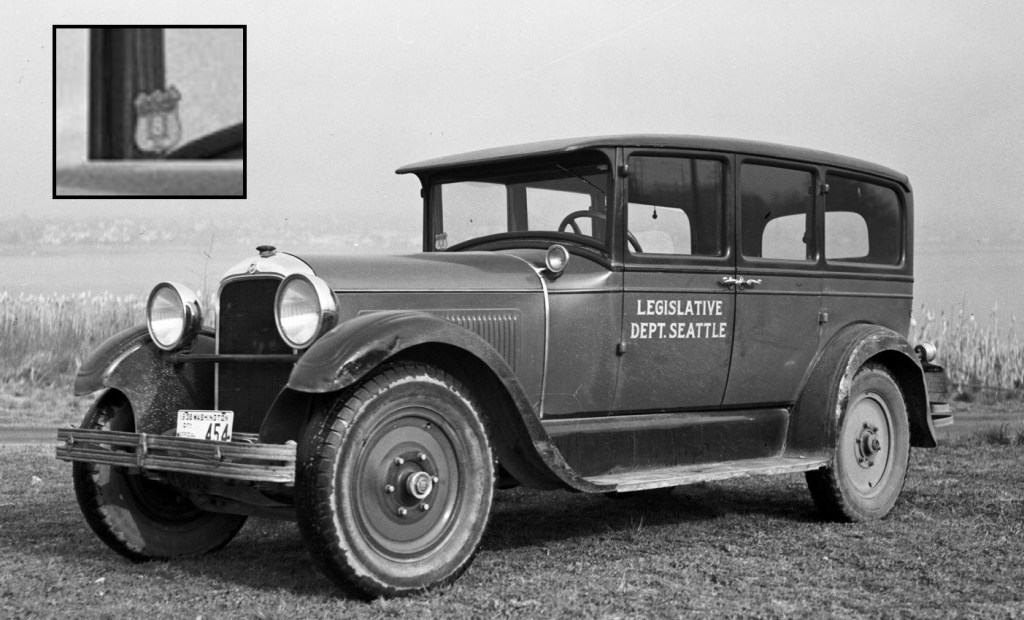
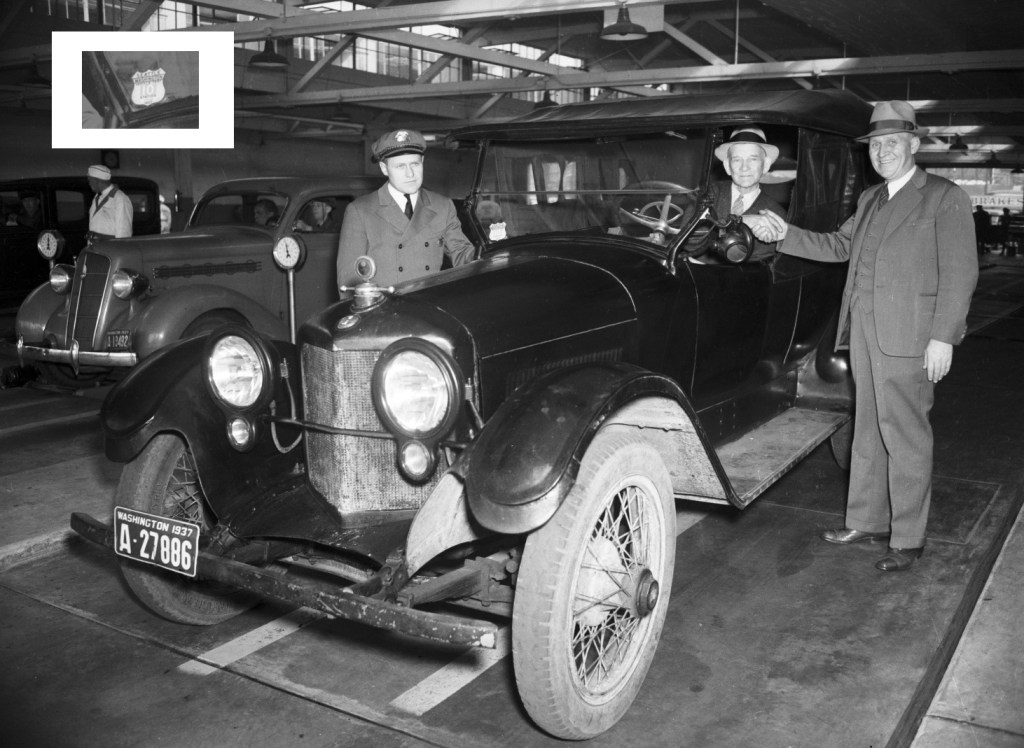
Public Reaction
“The present city testing station at Boren Ave. N and Valley St. is a foolish way to spend money,” University of Washington psychology professor Ralph C. Gundlach told the Post-Intelligencer on January 11. “The first thing to do is to test and train the drivers, not their machine. The old wheeze about the nut that holds the steering wheel causing most accidents is still true.”
Driver testing would indeed become a requirement for obtaining a driver’s license later in 1937, but many were firm believers in the safety merits of equipment inspection. Many national public safety campaigns were underway at the time, and notable persons helped support Seattle’s program.
The P-I reported on New Year’s Eve of 1936 that “one of the country’s greatest stunt drivers – Dare Devil Jerry Edwards” had given his “enthusiastic endorsement” of Seattle’s testing station. He told the newspaper that he “was pleasantly impressed with the courtesy and helpfulness of those in charge. They gave a lot of sound advice about car maintenance and repairs valuable to the average motorist. If the people of Seattle and the state have their cars tested every six months, I’m sure there will be a marked decrease in accidents.”
If Daredevil Jerry Edwards wasn’t a household name then (or now), he was one-upped by a more notable automotive celebrity. By the late 1930s, legendary pioneering racing driver Barney Oldfield was employed as the public face of Plymouth’s safety initiatives, and he and his crew stopped in for a photo-op inspection.
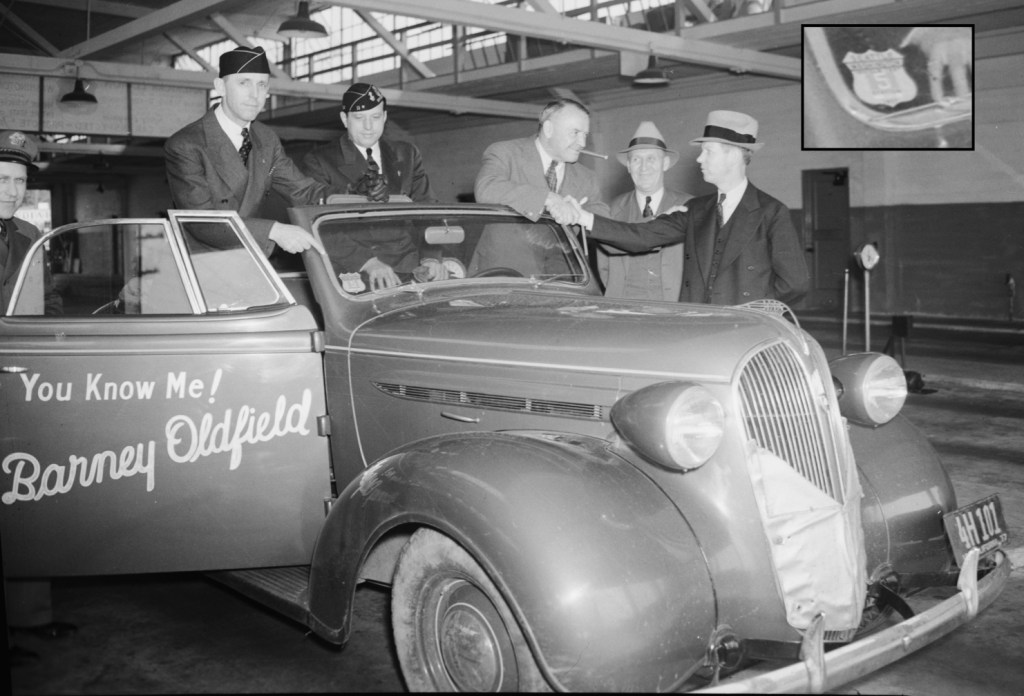
Oldfield’s flashy, California-plated Plymouth left Seattle with a bright yellow inspection sticker on the windshield.
But the Seattle experiment was doomed to end.
Closure
The City of Seattle officially got out of the automobile testing business on December 31, 1937, slightly more than a year after it started.
The testing station was plagued by massive budget deficits that required the city to provide numerous funding adjustments. Luckily, legislation at the state level made city testing obsolete, with a 1937 update to the motor vehicle code that assigned that duty to the state.
With Seattle’s inspection station already operational, the state highway department, headed by Lacey V. Murrow (of future floating bridge fame) took over the facility on March 20, 1938, paying a $200 per month rent to the city. The turnkey operation in Seattle was the first state inspection station to go live, with new stations in Yakima, Spokane, Vancouver, and Wenatchee already in development.
With the new state law, every vehicle was required to undergo an inspection every year. Unlike the Seattle-run system, there was no fee to the motorist. Inspection due dates were determined by license number.
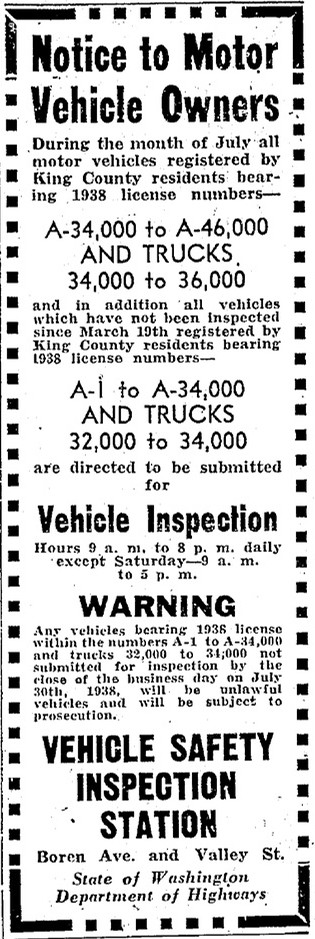
All Washington-licensed vehicles would bear official state inspection stickers in their windshields thereafter.
Impact
The 1937 Annual Report of the Seattle Engineering Department summarized the year’s activities, claiming a successful record “in spite of disheartening obstacles to be surmounted.”
Of the 170,000 vehicles inspected in 1937, less than 40% passed the first time. Forty percent required two inspections before passing, 15% required three, and 6% four or more before final approval. These statistics meant, according to the engineering department records, that the testing station completed 300,000 vehicle inspections, covering a total six million individual components.
Under the classification of the indifferent, careless, calloused, and irresponsible are the owners and operators of the dilapidated jalopies who use them for business or pleasure, or those who allow their boys and girls to own or ride in one. These persons are Public Menace Number One.
1937 Seattle Engineer’s Report
On October 22 of that year, the city had held an enforcement campaign against vehicles missing inspection stickers, in which “more than 250 vehicles were forced through the Station under police supervision.” Of these vehicles, “more than 90% had serious defects,” required registration documents were missing from 97, and 81 of the drivers lacked a license.
According to the report, Seattle saw a 14.9% decrease in traffic fatalities in 1937 versus the prior year, in spite of higher vehicle activity in Seattle and an increase in fatalities nationally.
“These figures should prove conclusively to the most skeptical that periodic motor vehicle inspection is a very important factor in highway safety,” the report concluded.
 Danny's License Plates