Early twentieth-century roadtrips within the United States often involved bureaucracy normally found in international travel. For nearly two decades in the interwar period, crossing into the state of Oregon on a roadtrip meant stopping, filling out forms, and pasting a sticker to your windshield.
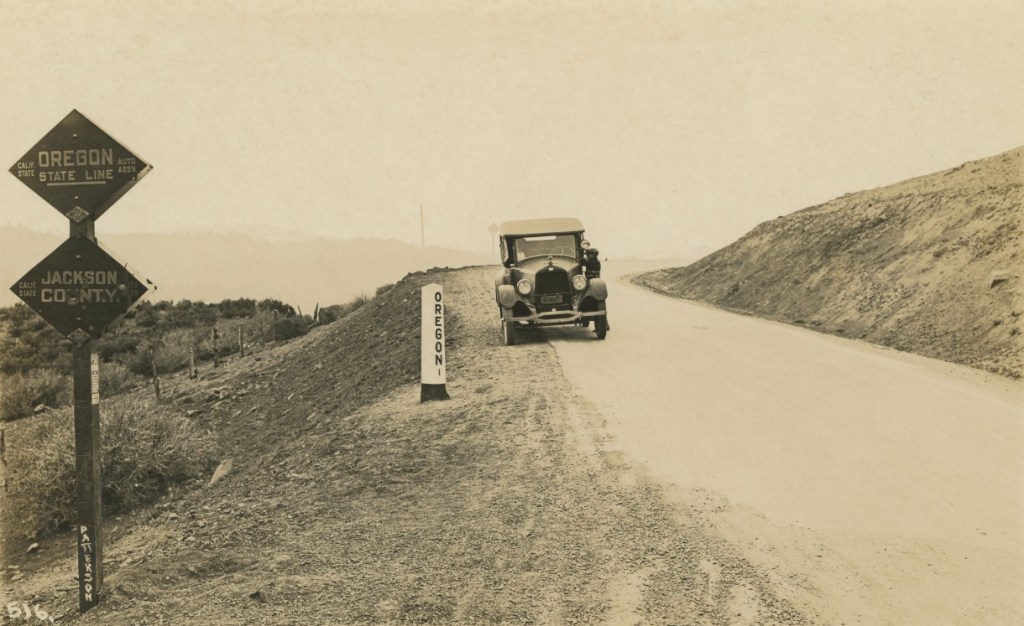
Effective May 1923, Oregon state law required all out-of-state vehicles to register with state officials, at no charge, within 72 hours of arriving in the state. The law was intended to prevent abuse of the license laws by limiting the amount of time a “foreign” vehicle could remain in the state (three months) without paying for Oregon license plates.
The idea was nothing new. Neighboring California had been requiring registration of non-resident vehicles since 1916, and other western states such as Nevada and Arizona mandated their own cross-border paperwork. And while the specific justification of Oregon’s law was not explicitly stated in period newspaper accounts, California was likely the main driver: it had just passed a law to reduce its automobile registration fees to a flat $3 per car, while Oregon’s weight-based fee structure was, by some accounts, the highest in the nation.
Oregon officials likely saw an imminent epidemic of residents registering their cars in the next state over as a means of avoiding higher fees (which did indeed become a problem through the 1920s, one shared by Washington state, as well).
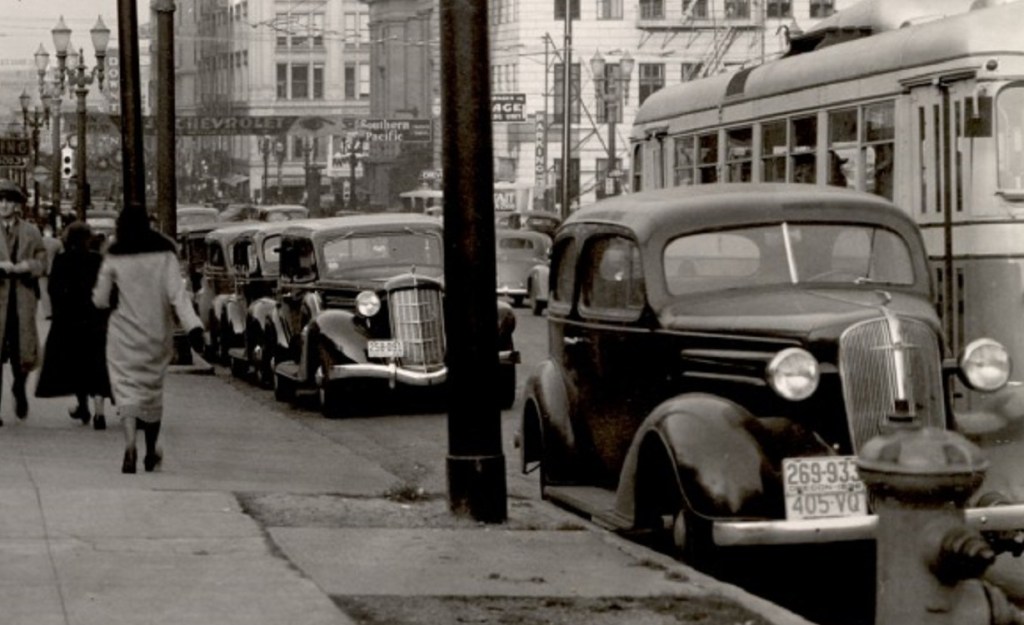
And so, for nearly two decades, any tourist driving into Oregon for more than 72 hours was required to stop at stations set up throughout the state, register their vehicle’s information with officials, and place a large sticker on the windshield indicating they had completed this duty.
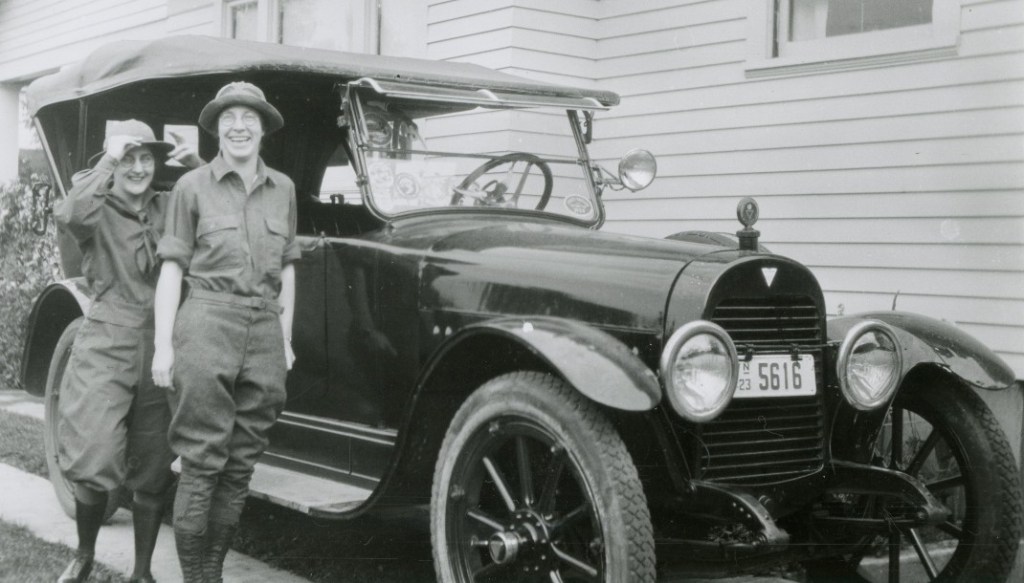

The 1923 sticker was an oval shape, but the following year it evolved into a large circle and would continue that format through 1928.


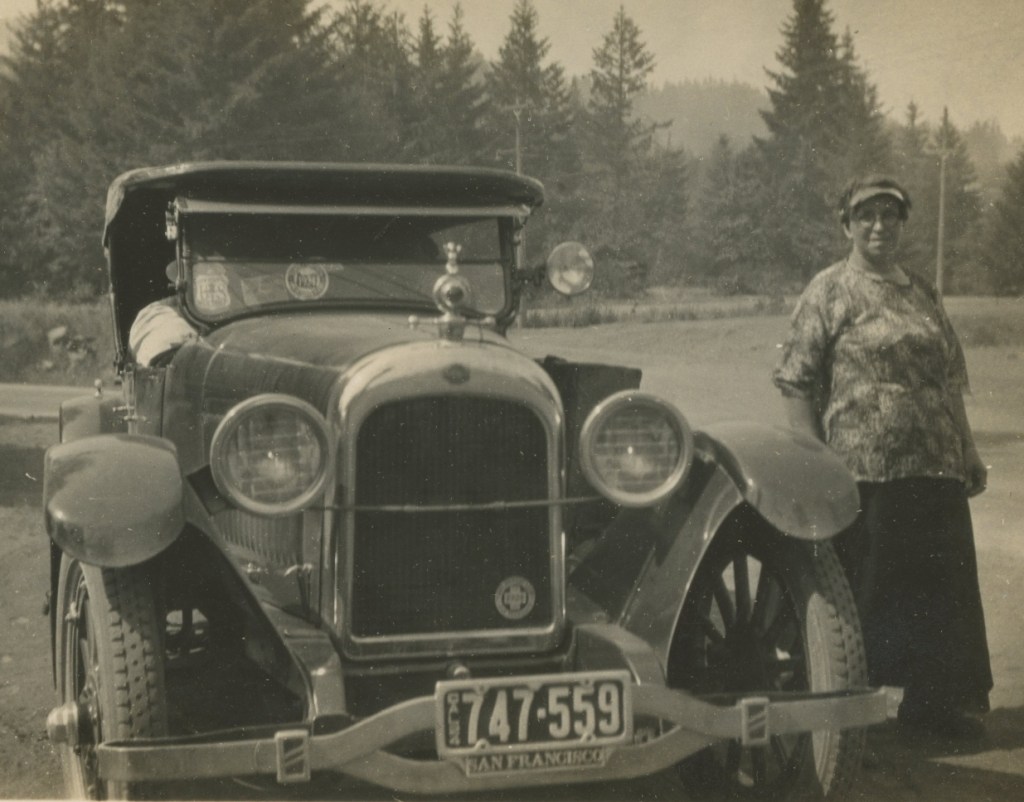
While the formats evolved over the years, all of them were two-sided, with the front indicating the year and the back providing many fields to be filled in when the car was registered. These recorded the car’s license plate number and state, the driver’s information and hometown, the location destination, the date of registration, and the expiration.

Since these permits were pasted to the inside of the vehicle’s windshield, they typically would be destroyed in the process of removal. Period photos and surviving examples show that many people considered them a form of souvenir, often taking care to remove and save them along with other states’ non-resident stickers, national park passes, and general souvenir stickers that were en vogue in the era. They served as a sort of passport stamp for a car on a long roadtrip.
And there were a lot of long roadtrips, even in what were still the early days of the automobile. Non-resident permit data from Oregon and other states show a very mobile population.
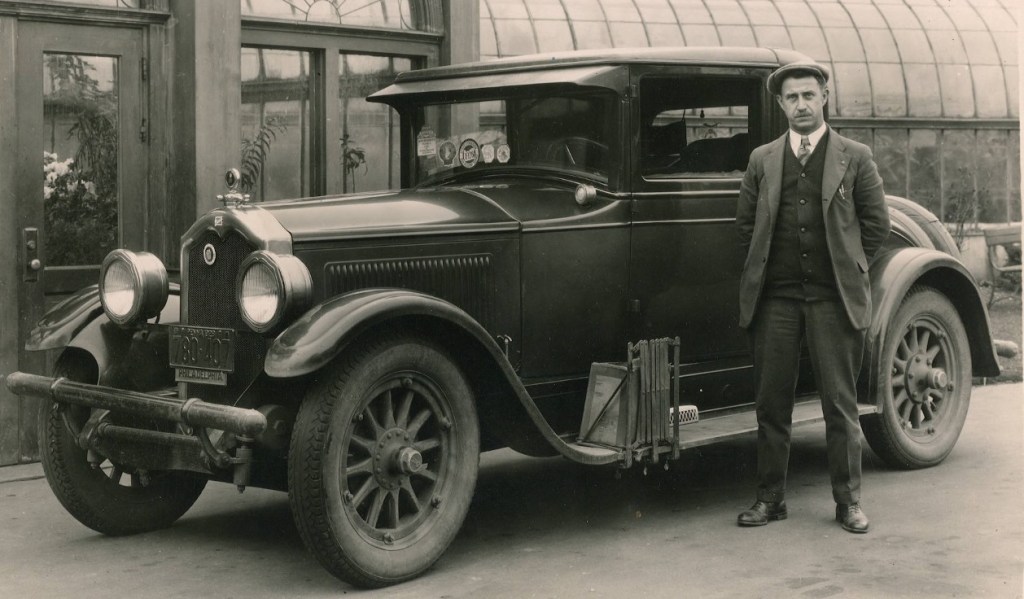
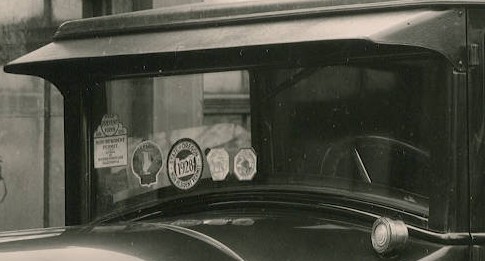
In 1929, the large circle format was replaced by a smaller rectangle. Month “tabs” were added to the bottom that could be torn off to visually identity the expiration period. Previously, that had only been recorded in writing on the back, creating an obvious problem where a permit could be used far beyond its approved period without an easy method to validate it.
Up north, Washington state adopted a similar format for its own brief, two-year foray into non-resident permits that began that same year.
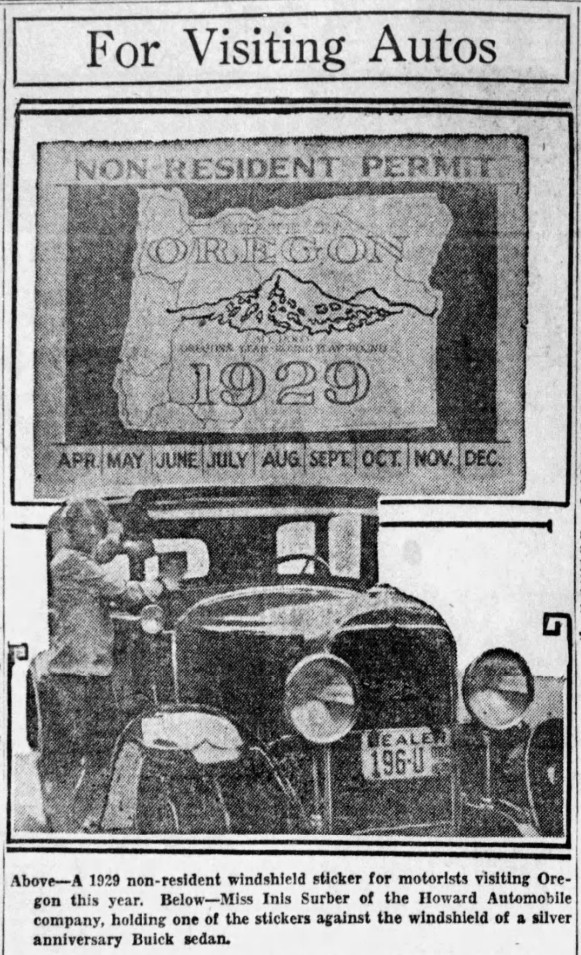
Colors for the 1929 Non-Resident permits were yellow on green, and depicted Mt. Hood over a highway map of Oregon.
The data collected through the issuance of these permits paints a very clear of picture of where foreign cars originated. Information published at the end of the summer of 1930 corroborated the common knowledge that California was the origin of most out-of-state traffic (and anecdotally, it seemed most long-distance roadtrips from across the U.S. proceeded in a clockwise direction, approaching the Pacific Northwest from the south).

Grants Pass and Ashland were by far the highest-volume points of entry. Ashland was the first major town reached after the California border (via US Highway 99, now roughly the path of Interstate 5), and Grants Pass was the point where coastal traffic from California intersected with the main north-south path of US 99.
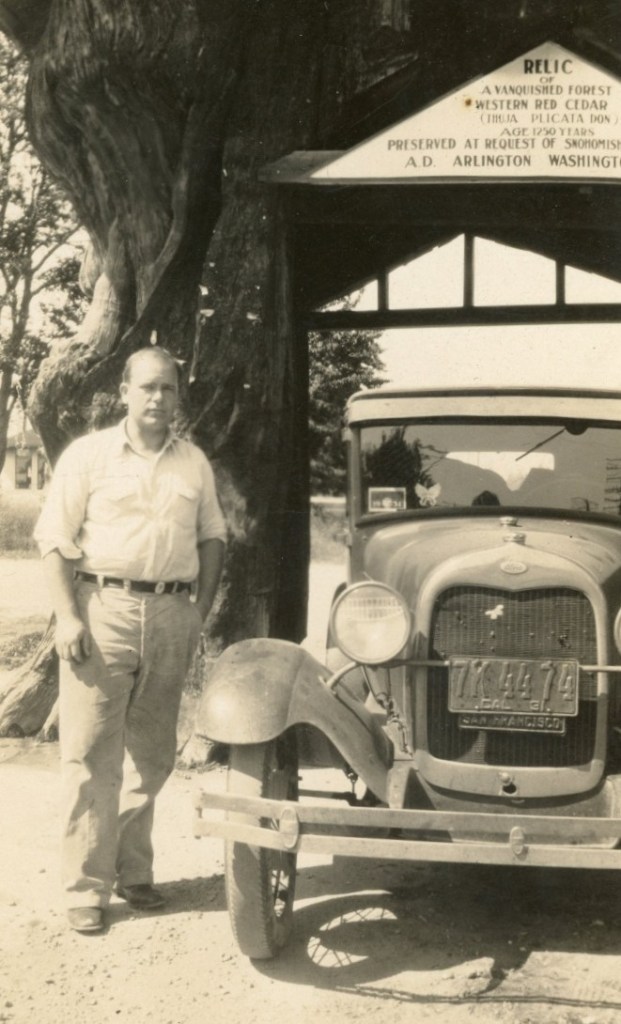
Through the mid-1930s, Oregon Non-Resident Permits used a consistent format each year, with the color changing annually for easy validation of expired limits.
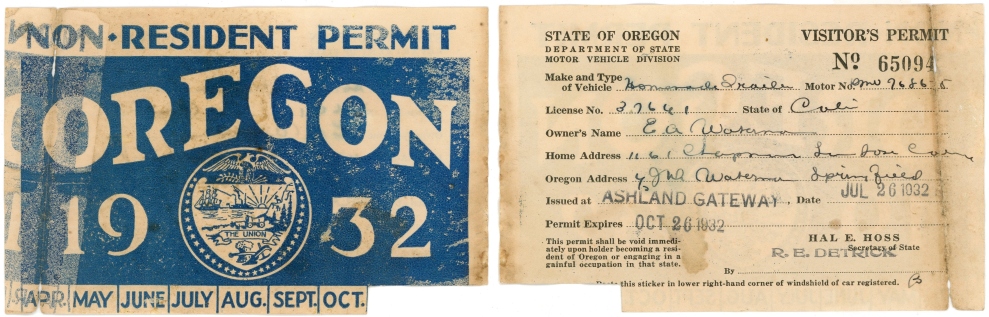
Abuse of non-resident laws was still prevalent enough that in 1932, Oregon took an additional step and began stamping the home-state registration cards for each vehicle that was issued a permit. Showing the date and place of entry, it prevented the apparently not-uncommon practice of taking out another non-resident permit when the first expired.

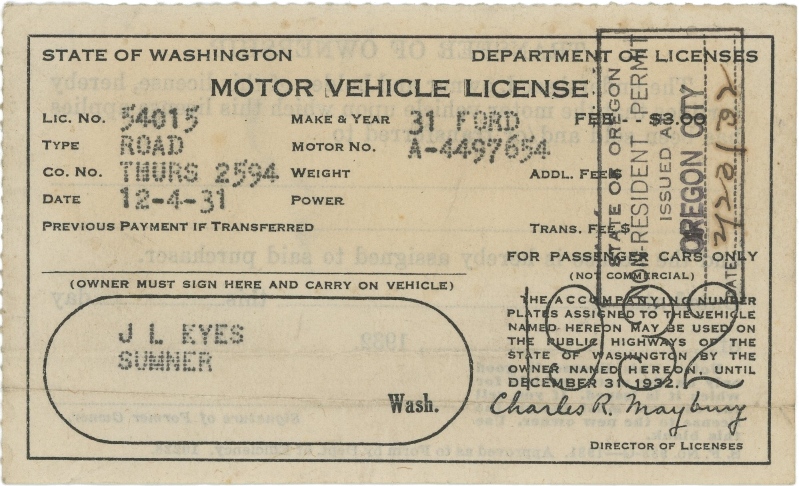
Interestingly, the tear-off month tab method for identifying the permit’s expiration was abandoned in the early 1930s. Once again, the only method for verifying the validity was by checking the handwritten date on the interior of the vehicle.

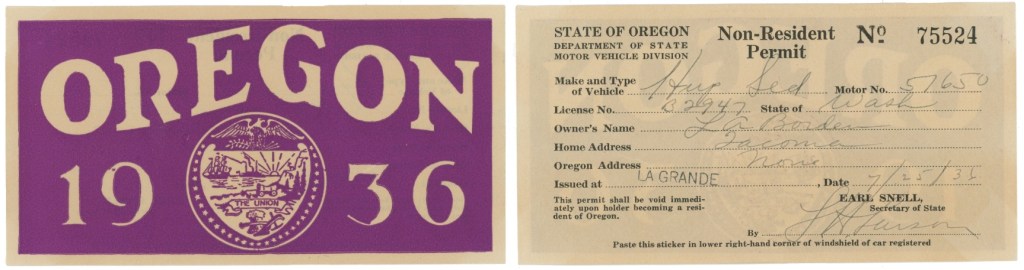

The final years of Oregon’s non-resident program saw an evolution in the sticker design from mere administrative forms into small pieces of artwork showcasing some of the state’s attractions.

Issued to Mrs. S.D. Patterson of Helena, Montana, license number 5-1166, on September 6, 1938 at Arlington

Issued to L.H. Stanley of Hampden, Maine, license number 50070, on June 14, 1939 at Grants Pass
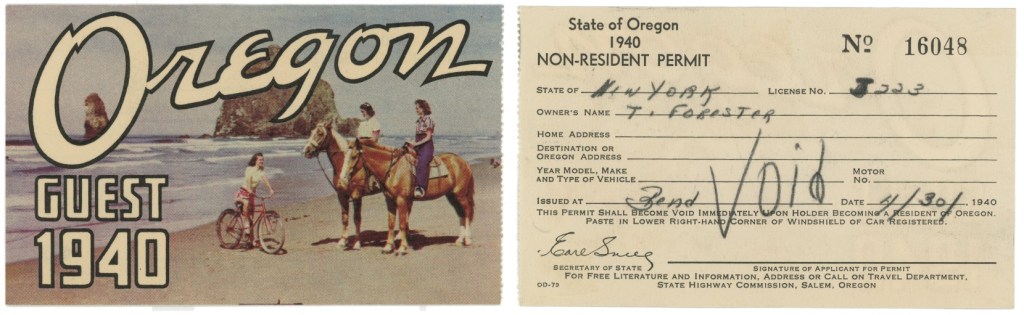
Issued to T. Forester of New York, license 3223, on April 30, 1940 at Bend (then voided)

Issued to J. L. Holherd of San Diego, California, license 80A802, on May 7, 1941 at Pendleton
1941 would be the final year these permits were used. By the 1940s, the practice was petering out across the United States.
Oregon’s non-resident experiment ended just before World War II rationing would severely hamper automobile tourism. On June 14, 1941, the law was terminated. Secretary of State Earl Snell had requested its repeal that January, telling the legislature that the requirement to register “has given the state a bad name among tourists” (Baker City Herald, January 8, 1941).
Beside the bad name, the law’s effectiveness was fading out, based on newspaper reports in early 1941 anecdotally commenting that many tourists didn’t bother registering. California had abandoned its non-resident requirement in May 1940, also citing the poor impression it made on tourists and its questionable effectivity.
WANTED: I am always looking for Oregon non-resident permits, and non-resident permits from other states, to add to my collection. Please contact me if you have any that could use a good home!
 Danny's License Plates