I am always on the hunt for license plates and related items to add to my collection – please see my Items wanted page or Contact me directly. Thanks!

In the first decade and a half of the twentieth century, the automobile rapidly grew from an anomalous rich man’s toy into a ubiquitous form of mass transportation. Like many major shifts in technology, it took a while for regulation and bureaucracy to catch up.
In Washington, like most states, officials recognized the need to license automobiles early on. But it was a crude and simple affair for the first decade: during this period, owners were required to license their vehicles, but the state would only provide a license number. It was up to the owner to find a way to display it. Most other states took this same initial approach, and this period of licensing is known as the Prestate Era, since it predates state-issued license plates.
Washington’s Prestate Era began June 1, 1905, when the first law requiring the licensing of motor vehicles in Washington State was effective.
The owner of every automobile or motor vehicle shall file in the office of the Secretary of State annually before June first a statement of his name and address, together with a brief description of every such vehicle owned by him and shall obtain from said Secretary a numbered certificate for each of said vehicles, which certificate shall state the name of the owner of such vehicle and that he has registered in accordance with the provisions of this act. These certificates shall be numbered consecutively, beginning with one.
1905 Washington State Session Laws, Chapter 154, Section 2 (approved March 11, 1905)
The law applied to all motor vehicles, including motorcycles. The fee was $2 annually. No distinction was made between vehicle class; rates were the same and the numbering sequence for license plates was strictly sequential regardless of vehicle type or usage.
Homemade License Plates
After paying the requisite $2 fee and registering with the Secretary of State, it was then up to the vehicle owner to determine the means of displaying the license number.
The number of each certificate, preceded by the letters “Wn.” shall be displayed upon the back of such automobile or motor vehicle in light colored arabic numerals at least four inches high on a dark background.
Section 5 of the 1905 motor vehicle law
The law described the general appearance and form of the number, and mandated “Wn.” precede it, but was otherwise silent on what media was to be used.
After sending in the required registration information, vehicle owners would receive a certificate like this one:

The next step was to make or procure a means of displaying the number on the vehicle.
Common License Plate Formats
The most common form of prestate license plates used in Washington was a leather pad, reinforced with a metal frame, onto which aluminum house numbers were attached.
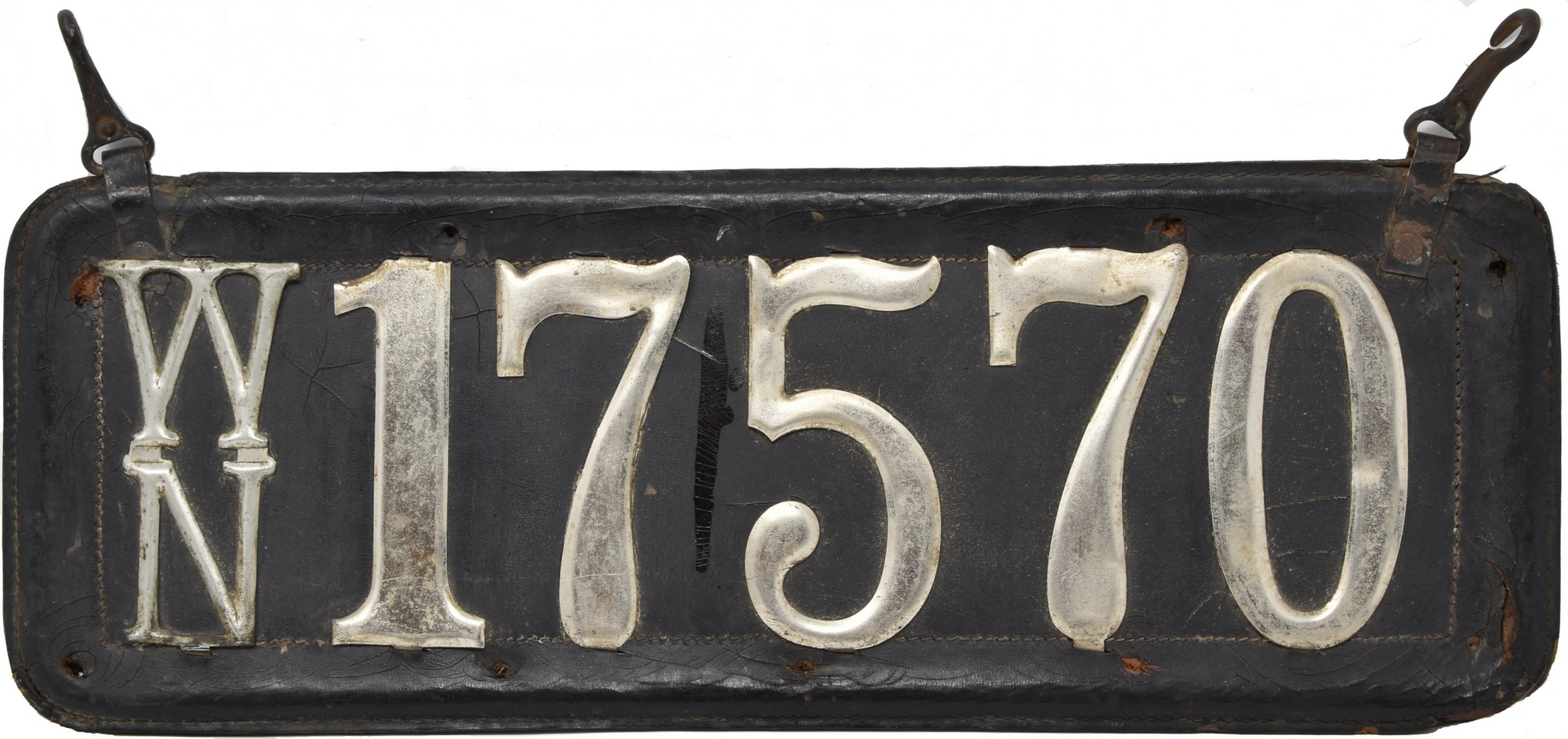
These were assembled from kits that were commercially available from private companies.

Also widely seen are pressed cardboard plates with metal frames, again with aluminum numbers attached.
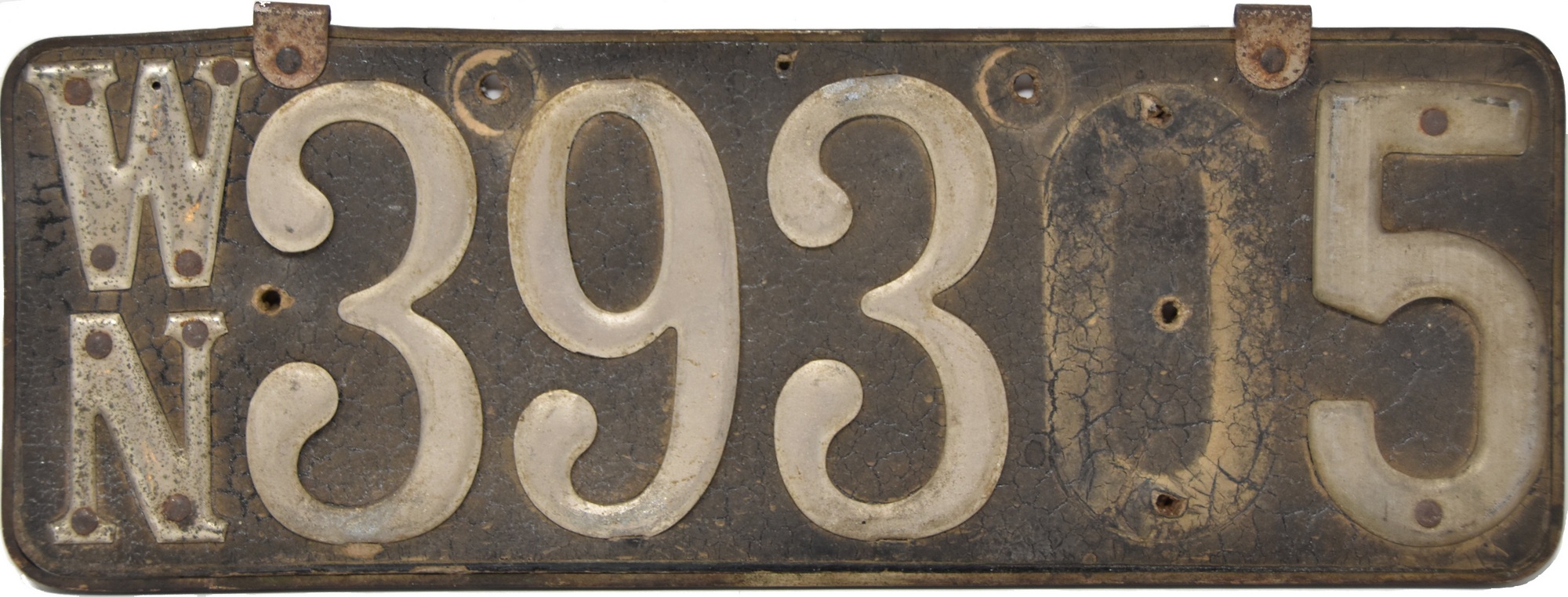
A wide range of other examples are known, ranging from crude to professionally-made.


Professional, embossed metal plates are seen with relative frequency in historic photos, indicating a local company was creating made-to-order plates closely resembling what would eventually be the standard issue. The Pacific Coast Stamp Works in Seattle and the Spokane Stamp Works were some local companies that advertised automobile license plates in the era.

Some people took the most simple path and painted the number directly on their vehicle.

The law specified the state designation of “WN” appear before the number, and most license plates of the era conform to that format, but it is not particularly uncommon to see it after the numbers, or sometimes even split on either side of the numbers (e.g. W12345N).
Front license plates
The 1905 law only required license plates on the back of vehicles. However, by 1913 many cities, fed up with reckless driving and frustrated by the difficulty identifying scofflaws, began requiring license numbers on the front of vehicles. Seattle, Everett, and Bellingham all passed city ordinances to that effect in close succession that spring. Consequently, while by state law only the rear of vehicle was required to have a license plate, front license plates became much more common, if not practically standard (also common was the practice to forego a front license plate and paint the number directly on the vehicle’s grille).
Identification of a vehicle from the front had been addressed, ineffectively, in the 1905 state licensing law. Section 7, which covered lighting requirements, contained a clause that was widely ignored and seldom enforced:
Every automobile or motor vehicle … shall [have] at least one lighted lamp, showing white to the front and red to the rear, and shall have the license or certificate number of said vehicle painted in dark Arabic numerals across the white glass in said lamp.
Section 7 of the 1905 motor vehicle law
The license number was to be painted onto the glass of one of the front-facing white lamps.

Period photos, and contemporary newspaper articles, confirm that was rarely done, with law enforcement attempting a crackdown in 1911. The Spokane Chief of Police even acknowledged that “the law seems to have been generally disregarded for some time,” but gave motorists 20 days to comply (Spokane Chronicle, April 13, 1911). The success of that crackdown is undocumented, but was likely low. What may have been a reasonable request early in the licensing era, where registration numbers were small, was increasingly onerous as numbers grew to five digits.
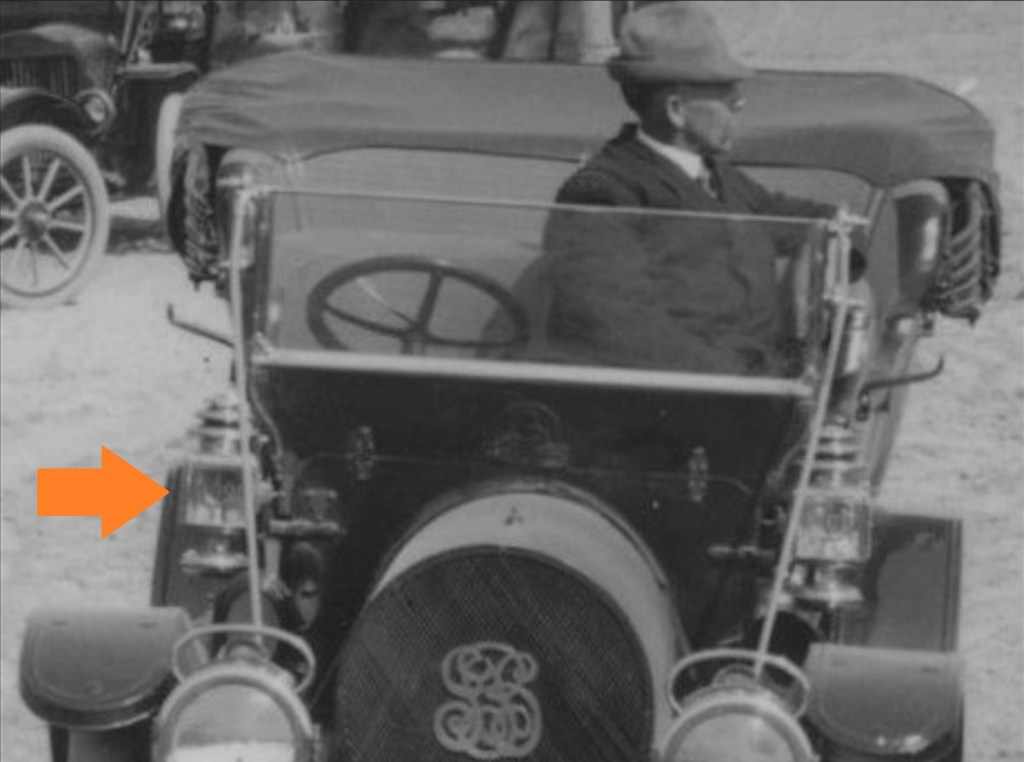
The Tacoma News Tribune reported on August 3 that “due to a protest made by an attorney who happened to look up the matter, the prosecuting attorney’s office may enforce the statute requiring owners of automobiles to have their numbers on the lights of the machine. It is said that practically none of the automobilists are obeying this rule. The attorney, after protesting to the prosecutor, investigated the county commissioner’s automobile and found that even it was not in keeping with the law.”
Reissued Numbers
Number issuance by year has been well documented and is a useful tool to approximate the date of a prestate license plate or an historic photo.
Halfway through the prestate era, number issuance grew more complicated, with the state beginning, in 1910, to reissue low numbers that were not actively registered. According to the Tacoma Daily Ledger (May 6, 1910), this mainly served as a courtesy to motoryclists: “The Tacoma Motor Cycle club has requested Secretary of State Howell to reserve all license numbers under 1,000 for motor cycles,” it reported. “The machines, like the automobile, have to have licenses, but with them space is at a premium, so they are asking for the small numbers.” The state agreed, and registration details confirm that lower, reissued numbers were applied exclusively to motorcycles.

By 1915, there were more than 6,000 motorcycles registered in Washington state, so the state’s willingness to supply lower numbers could not accommodate everyone. Additionally, low registration numbers have always been a status symbol, and many original recipients of such numbers were loathe to give them up. Thus, plenty of motorcycles were issued licenses with four or even five digits.

The upshot is that dating a prestate license is not an exact science. A number originally issued before 1910 could have been reassigned to another vehicle in the later years of the Prestate Era. Of course, any plate could have been remade during its time in use on a vehicle, to correct damage or freshen up the vehicle. Additionally, numbers were assigned to individuals, not vehicles, so a motorist who traded in a car would place the same number on the new vehicle, potentially having a new license plate made at the same time.
System Outgrown
This simple system, which was workable in the early years when the state’s vehicle population was in the low thousands, became unsustainable as motor vehicle sales surged. By the mid-1910s, most states already were issuing annually-dated, state-supplied license plates (most eastern U.S. states had started even before 1910; Massachusetts was the first state to issue its own license plates, in 1903). Washington was one of the few states still using the increasingly archaic method of owner-supplied plates.

One of the more obvious shortcomings of this system was the difficulty enforcing compliance with the annual license laws. With vehicle owners responsible for suppling their own license plates, there was no easy way for law enforcement to confirm a number was valid without consulting a printed directory. Even harder was validating that the annual fees were current: motorists were responsible for mailing payment to the Secretary of State’s office, and received certificates in exchange, but nothing displayed on the vehicle indicated whether this duty had been fulfilled.
This resulted in the legislature passing a new motor vehicle law in 1915, which resulted in every vehicle in the state receiving industrially-made, annually dated metal license plates expiring in 1916. Every year thereafter, vehicles would receive new license plates or tabs to indicate that the registration was current.
Registration Data
Washington’s Prestate Era is a rare example where registration data is generally well-preserved. All registration activity between October 6, 1909 and June 3, 1913 was recorded in three large ledgers at the Secretary of State’s office, which still survive at the Washington State Archives. Recording all transactions chronologically, they are a sometimes-convoluted mixture of new registrations and annual renewal payments. As a reference volume for identifying the vehicle and owner information for a given license number, they are inefficient and cumbersome, but as a tool to understand how motor vehicles were licensed in the era, they are indispensable.
Information or Discussion
This was a fascinating era in history, with private motorized transportation rapidly transforming the society and nature. Artifacts of this era are a treasure to behold, and photographs of early vehicles are fun to analyze. I am always on the lookout for new information or license plates from this era and beyond. Please contact me with any questions identifying an old license plate or to share any photos or surviving license plates.
 Danny's License Plates