The world changes and evolves, but some things always stay the same. Here in Washington state, some reliable truisms are that people 1) will complain about high car registration fees and try to avoid said fees; and 2) blame our problems on Californians.
In the late 1920s, when Washingtonians paid exceptionally high fees for car registrations, officials began noticing an anomalously high amount of California license plates on local roads. Investigations revealed something more nefarious than enthusiastic northbound tourism. By 1929, it would result in a major administrative effort that required every out-of-state vehicle visiting Washington, for even a few days, to register with officials.

Washington motorists paid high registration fees to license their cars, with a rate structure based on the vehicle’s weight. In place since 1920, it caused a lowly Model T to incur annual registration costs of $10 (roughly $160 today), with heavier cars commonly running nearly double that. California, on the other hand, imposed a flat fee of $3 to license any passenger vehicle, starting in 1924.
Not long after the Golden State set its cheap fee structure, people up north took note. The Sacramento Bee announced on May 30, 1924 that “war has been declared by the police of Seattle against residents of Washington who are attempting to avoid payment of the Washington motor tax through the wrongful use of California automobile plates.” Police estimated 1,500 cars were registered that way.
Why pay high registration costs at home when a paltry $3 could license the car? If one was traveling south around the first of the year, why not go to a California DMV office and register the car there? Maybe a friend in California could help process a license application and mail the plates back home. How many people would even notice or care if their neighbor, friend, or colleague somehow had California plates on their car? For several hundred dollars (in today’s money) of savings, these scenarios seemed worthwhile for many.
“Californians” Everywhere
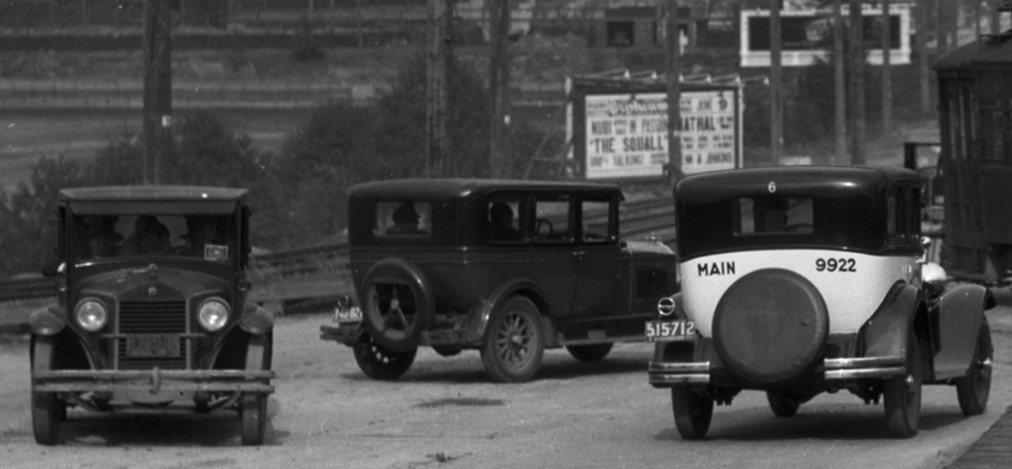
Newspaper articles in the Pacific Northwest through the late 1920s often commented anecdotally on the high volume of California cars seen on highways, attributing it, perhaps naively, to a successful tourist draw. In July 1925, a tourism group representing major cities from Tacoma to Vancouver, BC, conducted a survey of northbound vehicles on the Pacific Highway through the Puget Sound region, and noted California license plates on an astounding 40% of the cars. The group had conducted an advertising campaign in California and was using its car survey as a proxy for measuring its effectiveness (Everett Daily Herald, July 3, 1925). How much back-patting was really warranted?
A short note in the Corvallis [Oregon] Gazette-Times on October 3, 1928, noted that on a Seattle-bound trip over the summer “it seemed that more than half the license plates showed that the car owners lived in the state of [former California governor and then-current U.S. Senator] Hiram Johnson.” The paper then asked, “Do Californians do anything else for a living and are any of them ever at home to do it?”
As the decade progressed, general skepticism about the legitimacy of all those tourists persisted and grew.

By 1929, the simmering police concerns about registration scofflaws grew into a more concerted public campaign against the problem. In January of that year, it became widely discussed in local newspapers.

Douglas Shelor, manager of the American Automobile Association of Washington, declared in a Seattle Post-Intelligencer interview on Jan 3, 1929, that between 2,000 and 3,000 Washington residents displayed California license plates. “We are told of instances where students at the University of Washington send to fraternity brothers in California and have them obtain California plates for cars that are owned and used exclusively in this state,” he said. Shelor further noted instances where “Washingtonians drive South before Christmas, take out a California license for $3, and after they return home do not get their Washington license until August [at which point the state charged half the annual rate for a license that was valid for the rest of the year].”
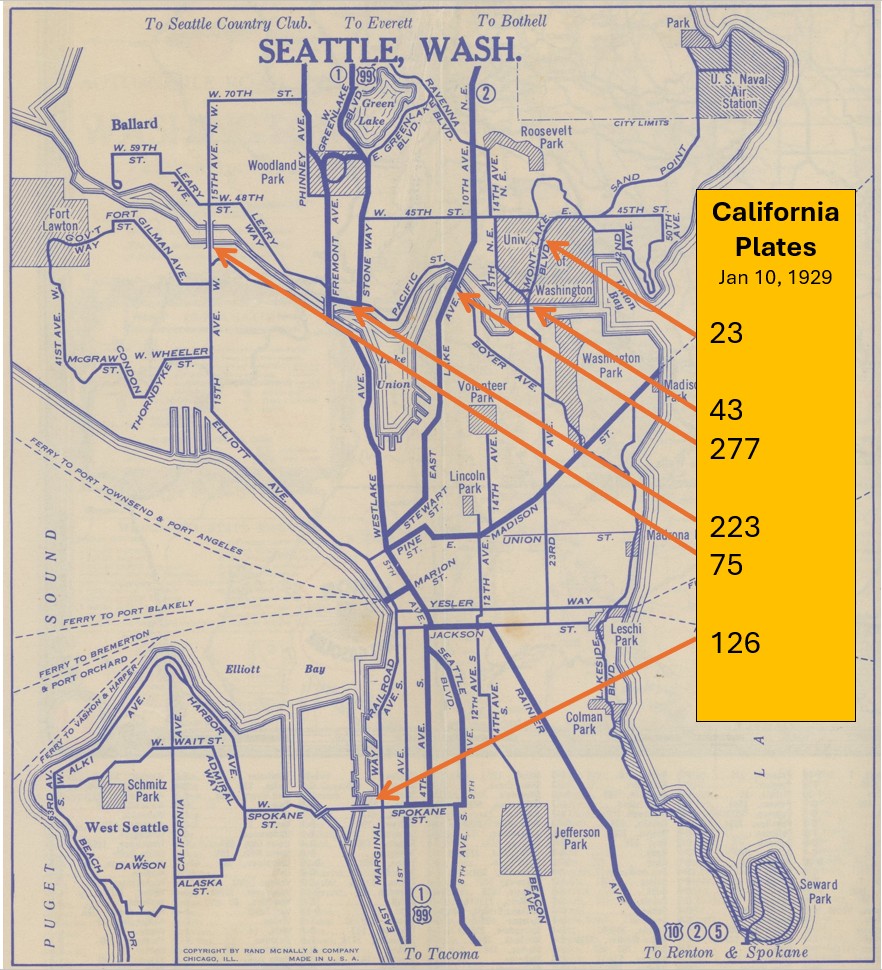
The P-I reported on January 11 that in response, Seattle police had conducted a traffic survey of vehicles in the city. They noted that between 6am and 7pm the day before, California license plates appeared on 75 vehicles on the Ballard Bridge, 223 on the Fremont Bridge, 277 on the University Bridge, 43 on the Montlake Bridge, 126 on the West Seattle Bridge, and 23 around the University of Washington. “It is extremely unlikely, police said, that 767 visiting California cars are in Seattle at this time.”
The plot thickened: on January 14, the Bellingham Herald reported the “possible existence of a ring dealing in counterfeit California plates.” A bricklaying contractor in Seattle had “reported a stranger had canvassed his workmen last week, offering to sell them sets of California plates. The man had five sets left at the time he reached them, he said, and could sell any man a pair of plates for $5.” Part of the man’s pitch was his desire to help the “workingmen.” It was noted that “he did not, however, indicate any need for the buyer to register with the California license bureau.”
For their part, California officials assured their counterparts in Washington that they only issued license plates to motorists who could prove residency in the state, and shipped the plates only to California addresses. But it was apparent that many people found workarounds.
The AAA of Washington was vocal in the press about the issue, and had a motive for highlighting the fraud: it was lobbying the state legislature strongly in favor of a flat $5 registration fee, offset by a higher gas tax. The AAA’s position was that this would drive a more fair cost structure – those who drove more would contribute more proportionally to funding roads, this in an era where Washington’s highway infrastructure was expanding rapidly. Bolstering the argument for a lower registration fee was that it would eliminate the incentive for car owners to cheat.
It is probably not a coincidence that the AAA so prominently alerted the public to the problem less than two weeks before the 1929 legislative session began.
Non-Resident Permits
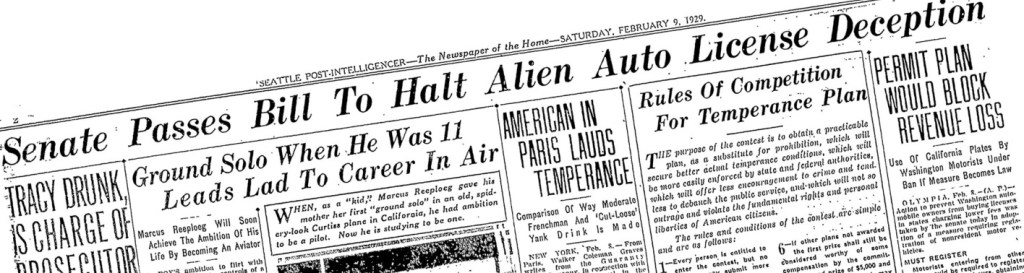
When the legislature convened in Olympia, its session covered numerous issues related to roads and automobiles. The flat registration fee proposal was ultimately vetoed by Governor Roland Hartley, but lawmakers did pass a bill meant to stop California plate cheats.
The state’s workaround to help identify tax cheats was a practice that had been used for years in Oregon, California, and other states: require non-resident permits for out-of-state vehicles (Oregon, with similarly high registration fees, was plagued by the same California workaround as Washington, made even worse as a bordering state).
Effective June 13, 1929, the new law mandated all vehicles not licensed in Washington would be required to obtain a non-resident permit within 72 hours of entering the state. There was no fee, and the paperwork was primarily administered by the AAA at its offices across the state, with county auditors and police departments also stocking the forms.

The permit was in the form of a sticker to be displayed on the windshield. A colorful state seal appeared along with the year, and month boxes that were intended to be punched out to indicate the expiration.

On the reverse, the registrant’s name, address, license number, and vehicle attributes were recorded.

Although the visiting motorist did not have to pay anything to the state, this certainly added an inconvenience on a road trip, not to mention a substantial administrative burden to record and file this information.
One benefit of this data collection is the picture it provides of how well-traveled the population was. In what was still an era of primitive roads, with railroads dominating long-distance travel, Washington state, tucked away in the upper corner of the country, welcomed a wide array of automobile visitors.
State and AAA officials provided summaries to the press throughout 1929. In June through September alone, 22,152 out-of-state cars had been registered, according to Department of Licensing results published in the Tacoma News-Tribune on October 17. Some surprising figures arose: California had by far the largest numbers, which given the state’s population (and potential over-representation from scofflaws) might not be unexpected, but it far eclipsed Washington’s immediate neighbor, Oregon, whose biggest population center sits just across the Columbia River from Washington. However, given the law’s grace period of 72 hours to register, it’s likely that a majority of Oregonians entered the state for quick trips that fell within that timeframe, and thus did not obtain a permit.

Washington saw cars from every U.S. state that year, as well China, England, Holland, France, New Zealand, the Philippines, Mexico, and the Panama Canal Zone. Impressive for the modern era, and doubly so for then!
No Longer Needed
The practice ended quickly. 1929 and 1930 were the only years these permits were issued (WANTED: do YOU have a 1930 Washington Non-Resident Permit? Please contact me!)
In March 1931, the non-resident law was officially repealed. Frank Guilbert, manager of the Inland Automobile Association in Spokane, noted that the state, expecting the law to change, hadn’t even bothered to print 1931 permits. Guilbert told the Spokane Press on March 26 that “this will relieve the tourist and, as this law was not enforced during the year and a half it was in effect, will remove a half-enforced law from the state’s books.”
Why, after all of the histrionics about lost revenue and the effort to print and administer thousands of permits, did the law so quickly fall out of favor? Maybe the extent of the California scam problem had been exaggerated, or maybe the non-resident law had been effective at scaring away scammers (although, almost a year after the non-resident law passed, Seattle police still estimated that at least 1,000 city residents were illegally using California plates, and even assigned a team of 18 motorcycle officers to stop and check every California-plated car in the city, as reported in the Spokesman-Review on April 14, 1930).
But other developments rendered the problem moot: in early 1931, Washington also passed legislation changing the automobile licensing fee structure. The AAA-supported flat registration fee was finally approved (for $3/year instead of the $5 rate proposed in 1929), going into effect starting with the 1932 licensing year, with the lost revenue offset by a two-cent increase in the gas tax (bringing the total state tax per gallon to five cents).

With this change, there was no longer an incentive for someone to work around the system and try to license their car in California.
So, after two short years, Washington ended the practice of issuing non-resident stickers to out-of-staters, and roadtrippers could cross over the state border without any cares. Other states would continue to require non-resident permits, with Oregon and California mandating them for another decade.
Tax avoidance is a perpetual problem. It would surface again at the end of the century, when a publicized epidemic of Oregon-registered cars hit the news in the late 1990s. With Washington imposing massive, value-based registration fees at the time, this time it was Oregon, not California, that offered the dirt-cheap alternative ($33 for two years). Plenty of Washington motorists found ways to register their cars (and especially RVs) in the state’s southern neighbor, and the cost disparity between the two states was one of the drivers that eventually led to voter approval of the highly controversial “$30 tabs” Initiative 695 at the turn of the century.
WANTED: I am always looking for Washington non-resident permits, and non-resident permits from other states, to add to my collection. Please contact me if you have any that could use a good home!
 Danny's License Plates