In 1936, the license plate manufacturers at the Walla Walla Penitentiary had a problem.
On what must have been a slow news day, the Seattle Star‘s top front-page headline that November 30th declared: FADING LICENSE PLATES CAUSING WORRY.
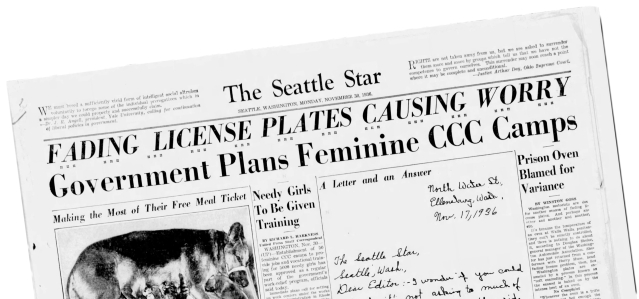
The article announced that ‘Washington motorists are due for another season of fading license plates. And perhaps another and another and another, etc.” The problem: the baking ovens at the prison factory could not be precisely controlled, resulting in license plates with improperly cured paint.
“Whenever the oven is a trifle too hot or not hot enough the baker tries to correct it by changing the length of time the licenses are baked,” Douglas Shelor, general manager of the Washington Automobile Association told the Star after touring the prison. “Sometimes it doesn’t work out quite right, but that is bound to happen.”
The Star went on to helpfully suggest, surely to the great irritation of the plate mill managers, that Washington officials reach out to the company producing California’s licenses, which didn’t seem to have any problem, to find out “how satisfactory licenses can be made.”
“Let’s progress with the rest of the states,” the Star concluded.
At the time the article was published, Washington was in its second year of blue and white license plate colors, with the 1937 issue, days away from appearing on the roads, continuing the pattern.

Modern license plate collectors struggle to find examples from these years with satisfactory blue paint, which does not clean easily and can blacken with incorrect methods. After more than eight decades, aging is expected; whether there was a widespread scourge of fading license plates when they were new is less documented aside from the Star‘s complaint.
However, one surviving artifact of the era supports the Star‘s claims of paint issues and indicates that officials were trying to correct it.
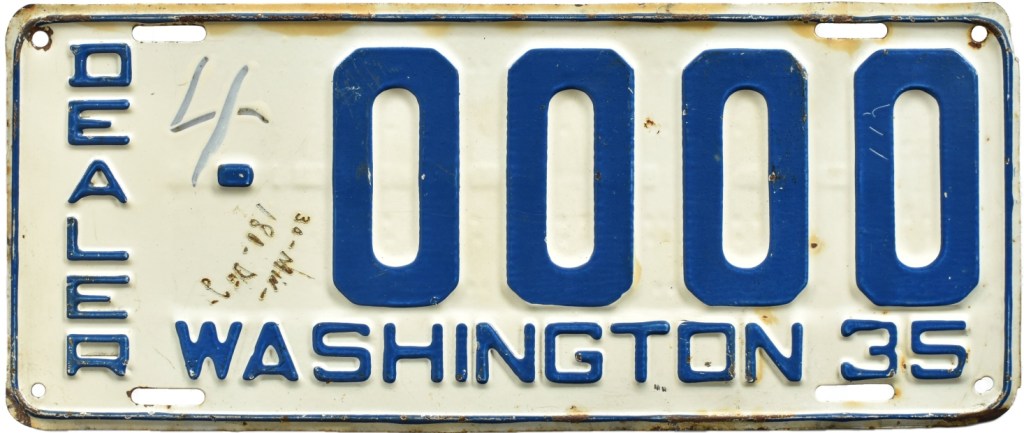
This sample license plate in my collection is a real oddball. Stamped as a sample 1935 dealer plate, it is painted in 1936 colors (blue on white rather than the white on blue used in 1935) and has cryptic markings that make perfect sense given the context of the Star article: this was used to test baking times and temperatures.

Scratched into the paint are the words: “30-min-180-deg.” How should one bake a license plate? At 180 degrees for 30 minutes, based on this sample. The number “4” was written into the paint while it was still wet; this appears to be sample number four (out of a batch of how many?) from a test run at different temperatures and times.
Was this the winning combination? Given its condition after almost 90 years, and the fact that it was saved, it would appear so.
What’s not clear is if this was produced before the 1936 license plate run, or later in the year, around the same time the Star so snidely suggested the plate mill officials ask for help from others.
How did a one-off test plate like this survive in the first place? The license plate factory burned down in 1953 – was this sent to Olympia for review or filing? Did it end up walking out with a plate factory official, or stuck in a drawer in a non-burned office at the prison?
A one-off test like this one is as ephemeral as it can get with old license plates. Its survival is a bit of a miracle, and it provides a rare glimpse of the behind-the-scenes methods that were used to produce license plates in a very different era.
 Danny's License Plates