Idaho potatoes: the state’s most famous product has been a near-constant presence on Idaho license plates for seven decades.
Idaho’s license plates have proclaimed the potato’s fame since the 1950s, but the tuber had two trial runs as bold graphic depictions on two of the state’s early license plate issues (1928 and 1948/49). Both are among the most beloved designs in license plate history, but like much art, were widely reviled and unappreciated in its time.
In the 1950s, several years of arguments on how best to advertise the famous potatoes, and if it was even proper to do so, ultimately resulted in the phrase FAMOUS POTATOES having a lasting home on Idaho’s license plates.
The love of potatoes on license plates has never been unanimous or without controversy.
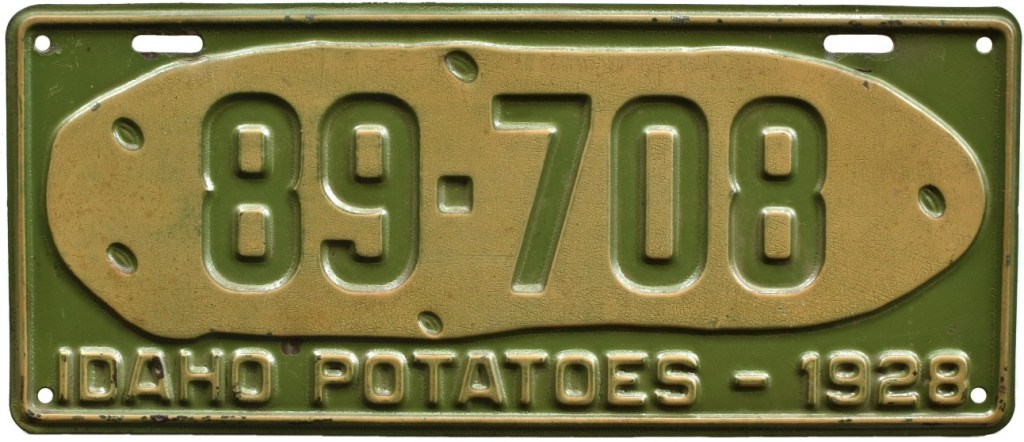
Idaho Potatoes – 1928
Today’s license plates serve many purposes beyond vehicle identification. So commonplace as to be unremarkable, tourism slogans, fundraising causes, sports teams, colleges and universities abound across thousands of standard-issue and optional designs.
But a century ago, the license plate was still a simple tool to identify a vehicle. With improved highways and cars, interstate travel by automobile became more common, and with it came the opportunity for states to promote themselves. Idaho found itself at the forefront of what would become a common practice: advertising itself on license plates.
For its 1928 license plate issue, Idaho commissioned its frequent license plate supplier, the Irwin-Hodson Company of Portland, Oregon, to produce 120,000 pairs of plates with a large embossed potato, under which the phrase “IDAHO POTATOES – 1928” would appear.
A bold departure from anything else that had graced the roadways of the United States, it received no shortage of attention, in Idaho and everywhere else.
Only now do we approach a more colorful stage of our national and state life – that of state personality
Spokane Press, commenting on Idaho’s potato license plate, September 7, 1927
The potato plate was announced in early July 1927, and immediately made an impression. There was no shortage of editorials and published letters suggesting similar stunts for other states, sometimes serious and more than occasionally facetious.
Just across the border, the Spokane Press mused that Washington’s license plates could be shaped as timber, salmon, or an apple. “Idaho,” it said, “has worked out a fine advertising stunt; other states in the Northwest should be quick to recognize its possibilities and cash in, too.” (August 1, 1927). Similar proposals would abound in Washington in the ensuing decades, to no avail. A Kiwanis club in Nebraska suggested that its state’s license plates be designed to resemble an ear of corn, and the Utah State Wool Growers’ Association submitted a request for Utah’s 1928 license plates to represent a sheep.
“We suggest that Indiana and Illinois toss coins to see which will design her license plates showing a profile of a jack ass to symbolize some of their politicians.” the Courier-Herald snidely proposed on December 1, 1927.
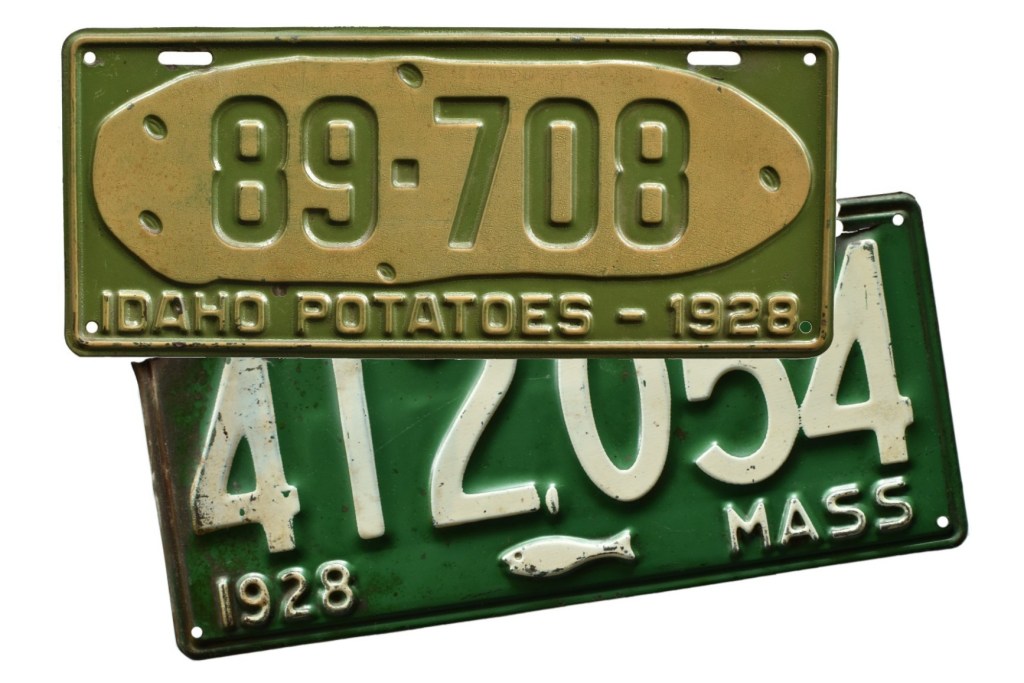
Idaho was not the first state to add a graphic to its license plates; Arizona had embossed a steer head on its 1917 issue, and New Hampshire placed a large embossed outline of its famed Old Man of the Mountain granite cliff on its 1926 plates. Nor was Idaho the only state featuring a decorated license plate in 1928: that same year, Massachusetts embossed a codfish on its plates, to plenty of controversy in the Bay State and beyond. And, in a strange coincidence, Idaho’s license plates weren’t the only ones boasting about potatoes that year: way on the other side of the continent, Canada’s Prince Edward Island had also chosen 1928 to debut the slogan “Seed Potatoes Foxes,” listed vertically on the left-hand side of the plate, to advertise its natural offerings (the slogan only lasted that one year).
1928 saw controversial graphics in Idaho and Massachusetts
The obvious culinary jokes of potatoes and fish appearing on license plates in the same year were not lost on newspaper editors. “Idaho has a potato on its new auto license plates, and Massachusetts a codfish. A couple of summers from now, the traffic stream on any first-class highway will be a complete table d’hote dinner.” joked the Spokesman-Review on January 3, 1928.
In Idaho, however, the reaction was less amused. Widespread mockery and distain appeared in newspapers across the state.
Beef with Potatoes
Idahoans had many issues with the potato plate.
Criticism was leveled on the design (too crude), the slogan (“Idaho Potatoes” being a vague label of a product and not the state itself), the crassness of advertising in general, and (reasonably) the problematic idea of the state promoting one industry over others.
A sampling of editorial outrage:
“The Tribune does believe it beneath the dignity of the state to turn its official license plate into a billboard, no matter how good the cause. It believes that it is impossible to advertise all the industries in this manner without undue discrimination for certain favored ones. It believes attempting to do so will breed discord which would far outweigh the good effects of the advertising.” Idaho Statesman, April 15, 1928 (emphasis added).
“At first blush, it occurs that license plates are designed for the specific purpose of revealing a serial number, the name of the state and the year of issue. To have this information cluttered up with potatoes and such is confusing. True it is, the plate this year has attracted much publicity in out-of-state newspapers, but whether or not the plates themselves have actually been of benefit to the potato industry of Idaho is problematical.” Idaho Statesman, April 22, 1928 (emphasis added).
“The fault with the present year’s plate appears to have been in the execution. Where most persons had expected the license sign to be in the shape of a potato, embossed to accentuate the beauty and gastronomic appeal of the Idaho tuber and pictured to proclaim its superiority over ordinary spuds, they were met by a more or less distant representation of a spud that might have gone unidentified had not the legend, ‘Idaho Potatoes,’ appeared beneath it.” Shoshone Journal, quoted in the Idaho Statesman, May 8, 1928 (emphasis added).
“But the words ‘Idaho Potatoes,’ immediately lifts the tag from the category of a license plate to that of an advertising sign and a poor advertisement at that for it neither says ‘Use Idaho Potatoes,’ ‘Buy Idaho Potatoes,’ or urges anything.” Idaho Citizen, quoted in the Idaho Statesman, July 9, 1928 (emphasis added).
Unloved as they might have been in 1920s Idaho, today the 1928 Idaho Potatoes issue is one of the most beloved and desired license plates among collectors.
The plan had been for the 1928 potato license to be the first in a series of designs each year that showcased a part of Idaho’s economy or beauty. Prototypes exist for a 1929 issue with a large embossed cornucopia promoting the state’s agriculture. But the backlash to the potato plate killed the hopes for anything fancy, and a very generic orange and black 1929 plate was issued instead.
And while that nothing-special license plate might not be highly valued by collectors of license plates or Americana today, citizens at the time seemed generally relieved.
“Good news comes from Boise,” the Lewiston Tribune annouced. “Idaho’s automobile license plates next season will not be adorned with a potato, cow or egg, cube of butter or other monstrosity similar to the ‘spud’ that was wished on car owners during this year. Fred E. Lukens, secretary of state, is to be congratulated upon ordaining that the license tag shall again be conventional. The potato plates were unwelcome to many Idaho motorists, not because they did not wish to advertise Idaho, but because the medium was a very poor one from a matter of taste and desire. Idaho is but following in the footsteps of Massachusetts, which state tried the same advertising scheme, beginning with an alleged codfish, and abandoned the plan after a single year. Massachusetts found that singling one industry out for exploitation at the taxpayers’ expense aroused jealousy and charges of unjust discrimination from the other industries of the state. Idaho has happily avoided this probable situation by returning to the unadorned tag.” (quoted in the Sandpoint News-Bulletin, July 17, 1928, emphasis added).
But all was not lost for the potato-plate lover; two decades later the spud would return.
1948: Back with a butter better design
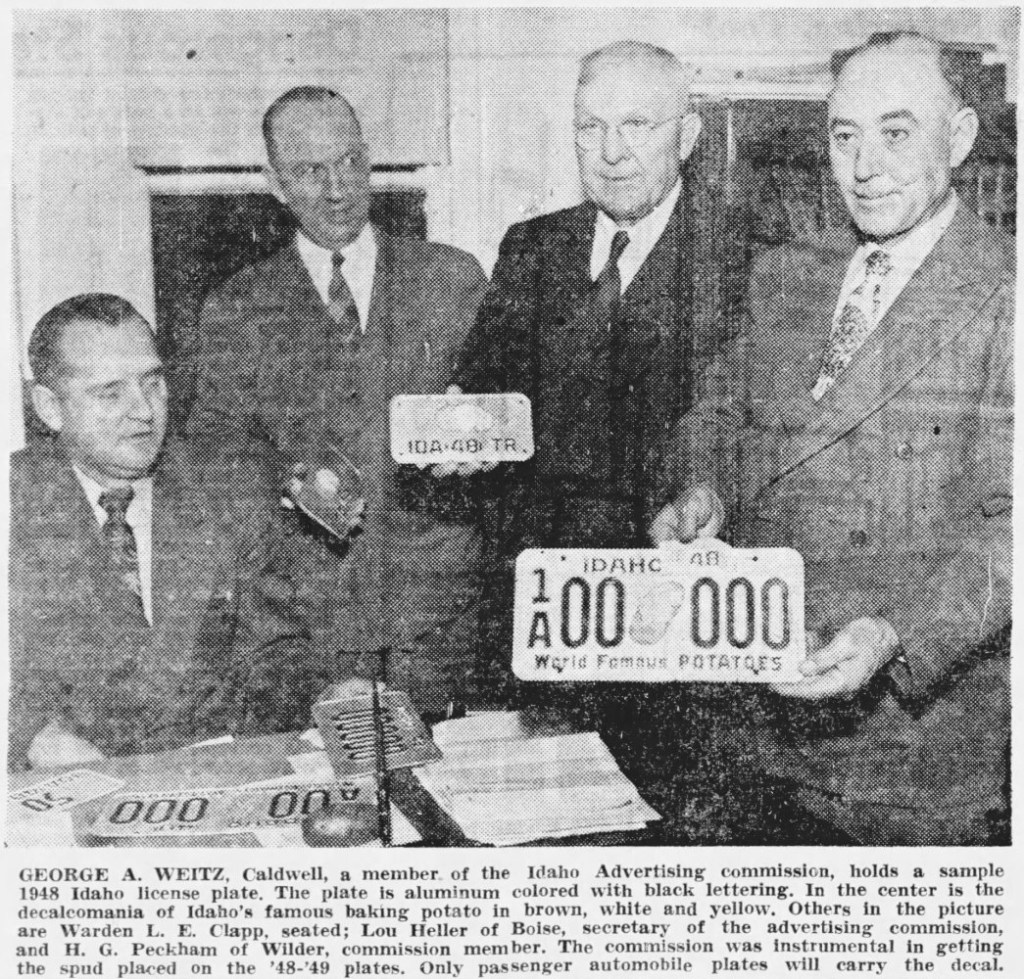
After a twenty-year absence, a plate of potatoes would again be served up to Idahoans for 1948. “[Governor] ROBINS OKAYS BUTTERED POTATO FOR ’48 LICENSE,” declared the Idaho Statesman, in one of the more ridiculous headlines ever published, on May 20, 1947.
The potato was back! And better than ever. Instead of the rough embossed version of 1928, this time a full-color decal was to be applied to the license plate, depicting a baked potato with a pat of melting butter inside. It was the first license plate to be produced at the Idaho prison’s new license plate factory, and it was a stunner.
Idaho Statesman, November 8, 1947
The world of license plates had changed since the 1928 design caused heartache from those who felt such gimmicks were beneath the dignity of motor vehicle licensing. State advertising had gone mainstream over the previous two decades, with slogans and graphics appearing all over the country.
By 1948, using license plates as form of advertising had become commonplace
South Carolina staked its claim to iodine on its license plate from 1930 to 1933, evolving from a simple “Iodine” slogan to “The Iodine State,” to “The Iodine Products State.” New York had shilled for its World’s Fair for three consecutive years (1938, 1939, and 1940), while on the other coast, California advertised its own “World’s Fair,” the 1939 San Francisco Exposition. Wyoming had presented a bucking bronco on its license plate since 1936 (and still does), Maine started soliciting tourism with its “Vacationland” slogan the same year (and still does), and Wisconsin had proclaimed itself “America’s Dairyland” in 1940 (and also still does – who says the world changes too much?).
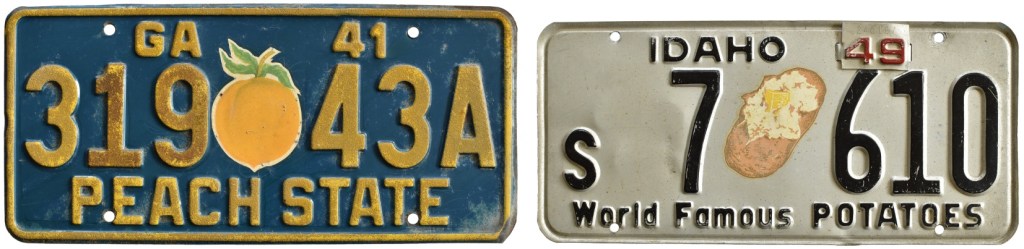
Decals of produce: Georgia’s peach decal of 1941 and Idaho’s potato decal of 1948/49
Georgia had pioneered decals depicting produce with its 1940 license plate issue, which featured a giant peach in the middle and a massive PEACH STATE at the bottom. The decal allowed a more successful rendering than the crude embossed peaches that had appeared in 1940 (its geographic and alphabetical neighbor, Florida, had embossed crude oranges on its 1934 and 1935 license plates, which looked more like cartoon bombs).
The potato decal was the second year of creative graphics for Idaho. The Gem State had dipped its toe back into the license plate advertising practice in 1947, avoiding potatoes and instead featuring an embossed skier with the slogan “Vacation Wonderland” beneath.
Idaho’s brief and controversial break from advertising potatoes
Potatoes were not the only source of controversy, it turned out: the skier design was also met with widespread criticism. People disliked the state favoring the nascent skiing industry in Sun Valley, thought it ridiculous to advertise winter sports during the hot summer months, and frequently compared the skier profile to a drawing of an insect. Idahoans were an ornery bunch on the subject of license plates.
When the baked potato debuted the year after the unpopular skier, it kicked off another round of controversy. Newspaper editors and angry letter-writers staunchly opposed to the potato plate abounded, but there might not have been a greater foe of the spud license than State Representative Helen J. Miller of Glenns Ferry. She issued a scathing attack on the “potato mutilation:”
“This nonessential discriminatory legislation to deface the new automobile license plate by the additional small utilitarian potato smothered in butter cost the state a neat sum of $16,000.
“And now to preserve the costly emblem it must be smothered in shellac.
“It is considered good business to advertise, but better business to use discretion in selecting adequate space for same.
“We give thanks the potato mutilation will only be a two-year period and not a permanent nuisance as first considered by some who aspired to go whole hog. The insignificant appearing potato is a costly but feeble effort to represent the world’s famed Idaho Russet potato but does portray and excellent representation of the small inferior grade of potatoes the majority of the citizens of the state are privileged to purchase only at exorbitant prices.
“If the next legislature favors the continuation of the practice to mutilate the license plate for advertising purpose and the identification lettering is kicked around, the highway patrol eventually will be using binoculars to identify the smaller lettering. There are some who are reluctant to comprehend the real intent of the license plate.
“Not until there is a law passed that prohibits the automobile license plate from being used for nonsensical purposes will it again come into its own and serve the sole purpose for which it was intended originally.”
quoted in The Idaho Statesmen, February 20, 1948
The 1948 issue was designed for two years of use, with a metal tab used to renew it in 1949. The decal was expensive (six cents per plate) and fragile, and the pushback on the potato theme strong. It was replaced by an unremarkable, graphic- and slogan-less design for 1950.
Representative Miller ought to have been satisfied by the generic license plates of 1950, but her rancor for the potato license would resurface a few years later.
Giving it another go
On January 17, 1951, the Idaho Statesman reported that Representative Grover W. Jensen of Bonneville, a member of the “potato bloc” in the state legislature, attempted to resurrect the Idaho spud with a resolution requiring it to be pictured on the next years’ license plates. Representative Helen Miller, the same anti-potato legislator who had issued a scathing attack against the “potato mutilation” in 1948, countered that a potato graphic would “deface” the license plates, prompting Rep. Jensen to change his bill to substitute the potato graphic with the slogan, “WORLD FAMOUS POTOTOES” on the bottom of the plates.
Representative Miller subsequently issued a press release stating that: “The potato growers in Idaho have the idea they should be privileged to monopolize and hold priority over all other famous Idaho products and clutter and deface the Idaho automobile license plates to advertise their product.” She also went a step further and declared license plate slogans and graphics a public safety menace that cause distractions and difficulty reading license numbers.
In February, House Bill 176 was introduced, “To prohibit display of any matter other than identifying figures on auto license plates.”
Helen Miller really hated potatoes and fancy license plates.
The WORLD FAMOUS POTATOES bill finally did pass in the house, 40 to 11, and in the senate, 26 to 15. Representative Helen Miller, as always staunchly opposed, said, “I am opposed to this bill because it is class legislation, pure and simple, and I cannot support legislation that places Idaho license plates in the billboard category and subject to be defaced by screwball advertising and corny slogans. Idaho had the same bunk in 1928 and again in 1948 and now they want it once more in 1951.”
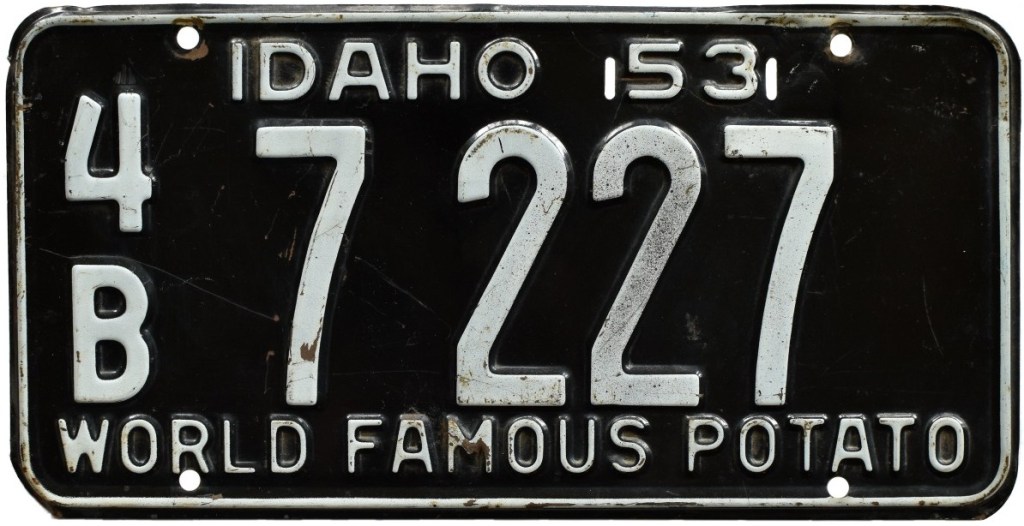
While the legislation had specified the phrase “World Famous Potatoes,” the final version singularized the potatoes by dropping the final two letters. News articles in later years attributed this to size constraints, with the prison lacking stamping dies that would fit the entire slogan.
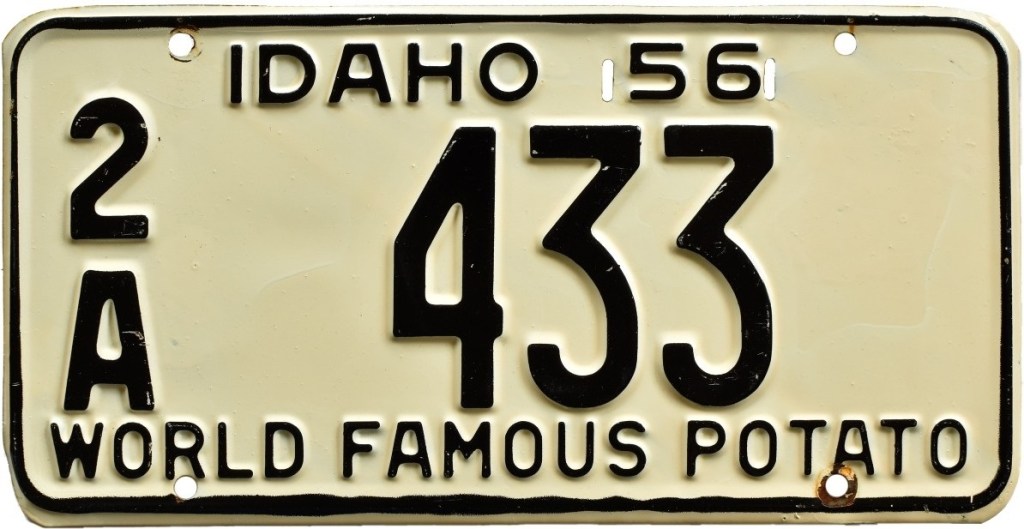
Pushback against the potato was still strong, and the slogan was only allowed for one year. 1954 and 1955, the Great Potato Interregnum, saw sloganless license plates of an extremely bland design, before the WORLD FAMOUS POTATO returned in 1956.
But the respite for the anti-potato factions was short-lived, and their battle would soon be lost forever.
A proposal to put the WORLD FAMOUS POTATO back on the license plates for 1956 was easily approved in March 1955, despite the continued objection of those who felt slogans didn’t belong and “hampered the law enforcement division by messing up the license plates,” (said Senator George Moody, with an attitude to match his surname), and those who were all-in on potatoes and wanted to “return to the luscious potato with the butter on it” (Senator Tom Heath).
Famous Potatoes
“Famous Potatoes,” the simple slogan that persists on Idaho license plates to this day, was the result of a compromise. One of the many complaints against the potato slogan was not the message itself, but the visual clutter it added when embossed across the bottom of the license plate. For 1957, it was shortened to “FAMOUS POTATOES,” which allowed it to fit between the lower bolt holes of the license plate. State law continued to require “World Famous Potatoes,” a technicality that clearly was not a priority to enforce.
This time it was here to stay. With the exception of 1990’s “Centennial” slogan, every Idaho general issue since has carried the FAMOUS POTATOES slogan.
The phrase still has had its foes that have attempted to remove it.
How’d you like to work hard for 10, 15 years, save maybe $18,000, buy yourself a new Cadillac and then drive around all day with a sign on your back that says “Famous Potatoes?”
Andy Rooney, on “60 Minutes” in 1978
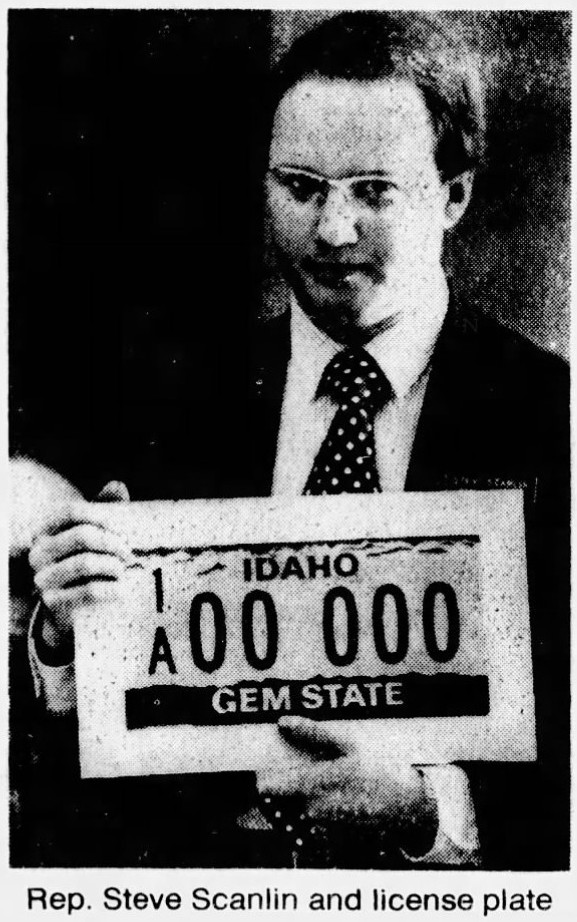
A 1959 initiative proposed “Family Vacationland” (which could have implied Maine’s longstanding “Vacationland” was more of an adult nature). In 1965 “Last Wilderness” failed to make the grade, and in 1979 Idaho’s state motto, the “Gem State” was rejected.
What could have been: an unrealized mockup of the Gem State motto. Idaho Statesman, January 31, 1980
Whether the slogan is loved, hated, or ignored, it has succeeded in forever linking potatoes to the state of Idaho.
Grant County, Washington would like to remind anyone headed in the direction of Idaho on I-90 that it grows potatoes, too (Google Streetview)
Potato enthusiasts and license plate history buffs residing in Idaho are able to pay tribute to past designs with the optional “World Famous Potatoes” plate, which resurrects the 1948 slogan and reproduces the “luscious potato with the butter in it.”









 Danny's License Plates