Seattle’s second-biggest legacy of the 1962 World’s Fair, the short, two-stop monorail line from the Space Needle to Westlake Center, never grew into a full-fledged transit system that was originally envisioned, and functions today mainly as a tourist attraction.
As the 21st century began, a series of ill-fated voter initiatives and city plans attempted to develop a regional expansion of the monorail line, never with tangible results.
Years of voter initiatives and tens of millions of dollars never produced a functional monorail transit system, but it did result in little drawings of monorails appearing on cars for a short while. Remnants of the dream can be found on old license plates from about two decades ago.
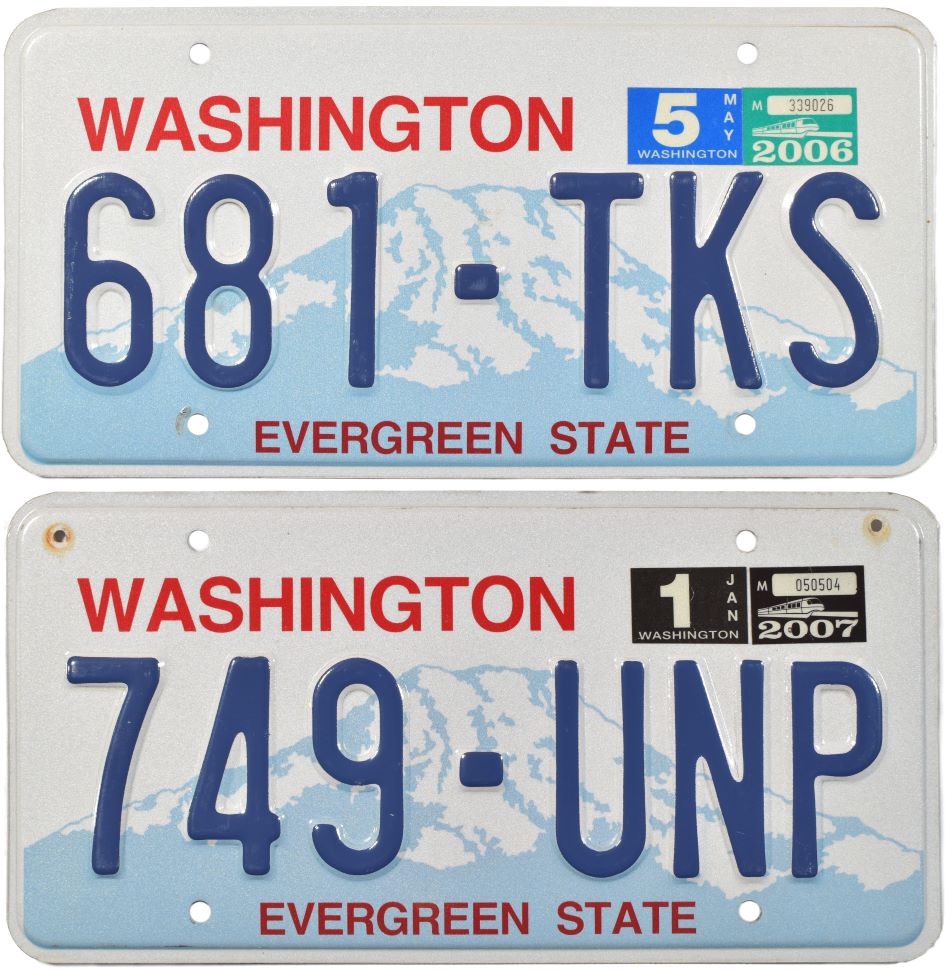
Attempts to make the monorail a full-fledged transit system were running at full steam in the early 2000s. Funding for the project was partly driven by increased registration fees on vehicles licensed in the Seattle area, which were authorized by Seattle voters in an extremely close 2002 vote.
Under the approved plan, motor vehicle owners living in Seattle would pay an additional annual registration fee of 1.4% per $10,000 of the vehicle’s value (new cars would be exempted in their first year).
While only Seattleites were subject to the fee, the line item appeared on registration documents for vehicles across the state, with forms redesigned for 2003 to include a “Monorail Tax” field. People living outside of Seattle had the satisfaction of seeing a blank charge.

Evasion of the additional tax was a real problem. Officials estimated about three percent of vehicle owners had avoided paying the monorail fee by using addresses outside of Seattle to register their vehicles (Seattle Times, May 28, 2004). The Department of Licensing tried to prevent this workaround by requiring vehicle owners to provide their home address instead of a post-office box or other property located outside the tax jurisdiction. “The DOL briefly imposed the rule last spring,” the Seattle Times noted on January 21, 2005, “but suspended it because of citizens complaints. Some Washington citizens eliminated mail service to their homes for safety or privacy reasons, but DOL software couldn’t record both the post-office box and a home address. Now it can.”
Monorail Tabs
Several years into the new program, there was little physical progress to be seen on actual monorail extensions in Seattle. Anyone anxious to get their monorail fix had a consolation in the small monorail illustrations that started appearing on license plates. For 2006, registrations under the monorail fee jurisdiction would receive special monorail tabs that were distinct from the state-wide issue. This served two functions: to flag tax cheats who found ways to avoid the fee, and to spur enthusiasm for the project.
The Seattle Post-Intelligencer explained on November 20, 2004: “Pro-monorail activist Peter Sherwin first made the suggestion three years ago, thinking the icons would create peer pressure to pay the tax. If a police officer pulls over a car owned by a city resident without the tab, that might raise questions about compliance.” Sherwin also suggested monorail-tabbed cars receive benefits such as preferred or discounted parking, which didn’t come into fruition.
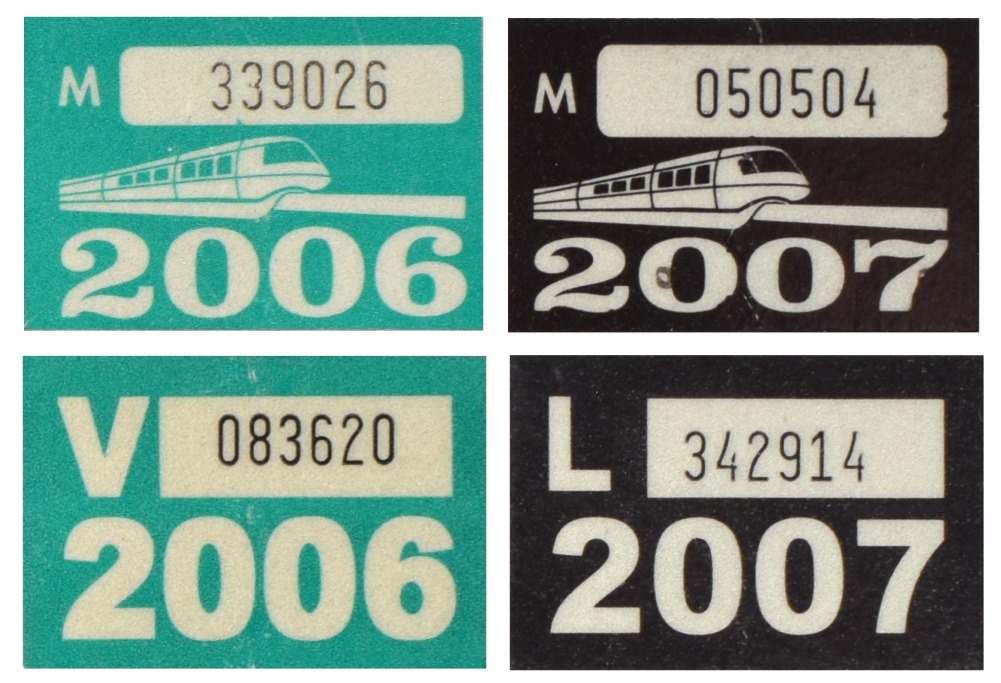
“We thought it would be kind of a fun way of celebrating the project and everyone who is contributing to making it a reality,” said Natasha Jones, a spokeswoman for the Seattle Monorail Project (SMP), further commented, on a less punitive note.
But the monorail was not meant to be. In November 2005, after the project scope had been reduced while the proposed costs increased, Seattle voters killed off the project:
Proposition 1, which would have authorized the Seattle Monorail Project to go forward with plans for a scaled-back elevated train line from Interbay to West Seattle, was soundly defeated Tuesday night.
The defeat means the financially troubled project will fold. But city drivers will keep paying the SMP’s car-tab tax for about two more years to help retire the agency’s debt of $110 million.
Seattle Times, November 9, 2005
By this time, most cars in Seattle had already been renewed with 2006 expirations and were displaying their monorail-themed stickers. Early-birds were already renewing for 2007, and the same sticker design was making its way to their license plates as well.
The car-tab tax lived on even after the project was killed. Monorail stickers for the 2007 expiration year continued to be issued for the first weeks in 2006, at which point the monorail faded away there too, with Seattleites receiving standard license stickers after that.
The 1.4% assessment officially ended June 30, 2006, with the car-tab tax ultimately netting $124.3 million for the project (Seattle Post-Intelligencer, October 21, 2006).
Reminders of the project remained on car registration forms for a few more years, with the Monorail fee field persisting as a blank vestige of a once-ambitious dream.

In the second decade of the 21st century, Seattle finally got its mass transit in the form of conventional light rail, which is still expanding beyond the city. Not as iconic as a monorail, it unfortunately has not left its mark on Washington license plates.
 Danny's License Plates