They might not have been the greatest practical jokes, but they did have their moment of popularity and turned into interesting collectibles. They fooled motorists and pedestrians back in their era, and probably confuse pickers and antique-store hunters today.
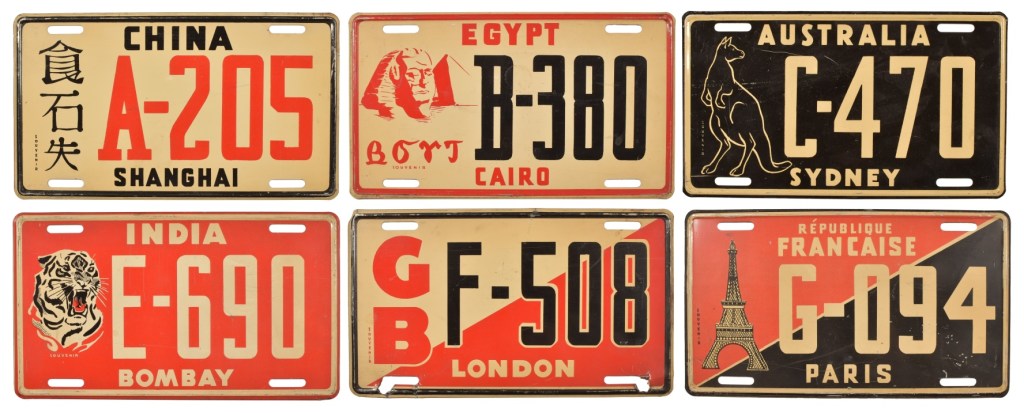
They’re the Globe-Trotter series of license plates from “foreign” countries. Dating from 1939, they were sold by H. Fishlove & Co of Chicago, a prolific creator of gag and novelty items, and were a relatively highbrow creation for a company that specialized in bathroom humor and fake vomit.

While obvious candidates for oddball wall-hanger souvenirs, their intended use was on a car (in conjunction with your legally-issued license plates from your local jurisdiction, naturally) to represent oneself as an exotic traveler.

Labels applied to the backs of most of the license plates depict passersby shocked and delighted at the sight of one of the bright and interesting “foreign” license plates on the back of a passing car.

The labels also advertise the full set of six countries available at the product’s debut in 1939: India, China, Australia, Egypt, Great Britain, and France. They also add a little bit of grown-up lawyerly clarification that “these souvenir Globe Trotter plates are to be used for humorous purposes only, and are to be put on your car in addition to your regular state and city license plates. The numbers and lettering thereon are purely fictitious and shall not be construed to be copies of numbers and lettering of any country, state, or municipal license plates.”
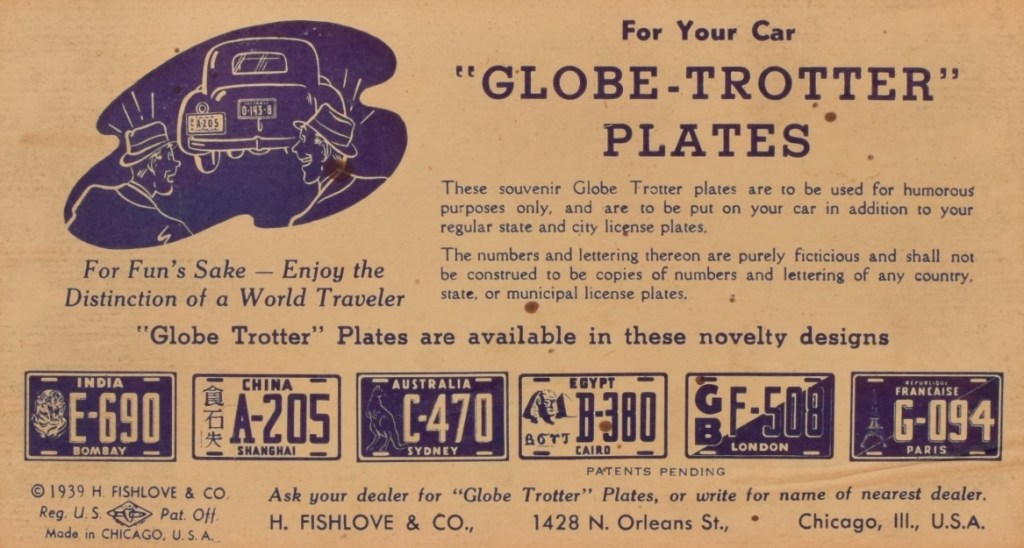
The fantasy designs are certainly eye-catching and significantly more interesting to the average person than each country’s standard license plates from the era, which generally would have been plain two-color designs with no graphics and little text aside from the registration number.

Every plate of each design was produced with the same fake registration number. How some designer at the Fishlove company came up with these particular combinations is likely lost to history. The prefixes use all of the letters from A to G, with the exception of D – was a seventh country planned but scrapped? Given the state of world affairs in 1939, it’s certainly possible some countries would be deemed inappropriate at the last minute.
Widely available across the United States, anecdotal newspaper articles indicate they sold well upon their debut. As prophesied by the cartoons on the original labels, laughs and confusion did result from their use.
However, like so many lighthearted pranks, the Globe-Trotter license plates were sometimes shut down by The Man. On June 30, 1939, the Martinsville Bulletin in Virginia reported that State Tropper P.C. Nowlin had “warned several owners about the use of such ‘Globe Trotter’ plates, and that he had recently received a communication from state headquarters with a specific ruling against their use.” The article further noted that the Virginia attorney general had banned them altogether. This hooliganism will not stand!
Canadians were just as game for the plates. In Saskatchewan, “curbstone observers were properly impressed the other night when they noticed a sleek new car parked nearby bearing license plates of Egypt and ‘Republique Francaise’ in addition to Saskatchewan plates. Came a cynic who examined the plates more closely, looked on their rear surface. Pasted thereon were paper slips, advertising ‘Globe-Trotter Plates…Put Some on YOUR Car.'” (The Leader-Post, June 19, 1939).

The summer after their debut, the Globe-Trotter licenses were still going strong north of the border. The Calgary Albertan warned readers on May 28, 1940 that “those Australia, India, China or Egypt license plates appearing on cars on Calgary streets don’t really mean that globe-trotters are flocking to Calgary,” and that the “colorful foreign plates” were available in many Calgary stores.
Second Series: Foreign Lettering

A second series of six plates debuted in 1939, providing an even more exotic flair by displaying the “registration number” in foreign script. These again included India, China, and Egypt, but also added Ireland, Greece, and Turkey (Australia, Great Britain, and France lacking exotic non-Latin alphabets).


Like the original series, these plates had an abundance of legalese and advertising on the back, this time printed directly onto the metal in lieu of an applied label.
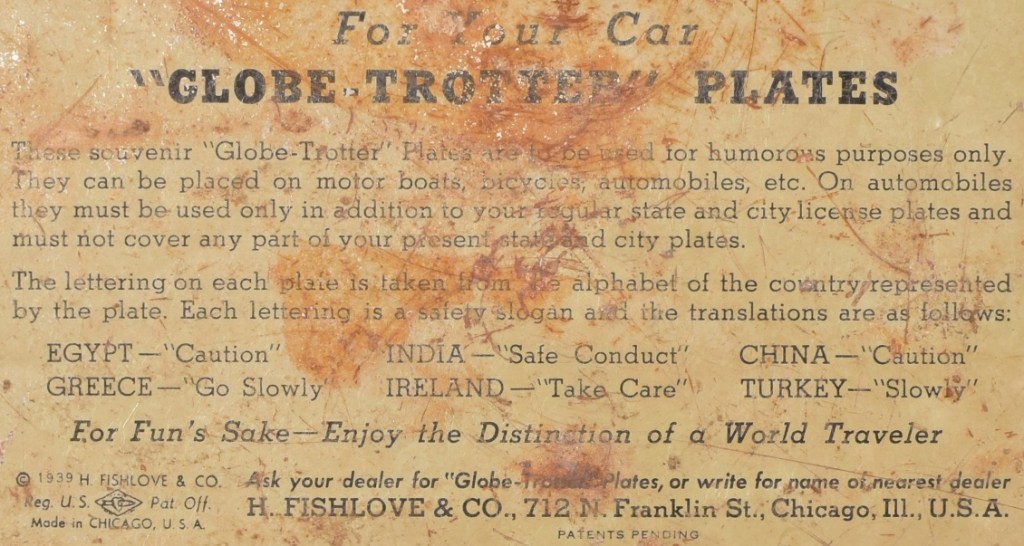
The text on the reverse listed all of the countries available in the series, along with a translation of the phrase included on each plate. Each country’s plate had also had a small-print English translation under the “registration number.”
EGYPT – “Caution”
GREECE – “Go Slowly”
INDIA – “Safe Conduct”
IRELAND – “Take Care”
CHINA – “Caution”
TURKEY – “Slowly”

Reception by the Public
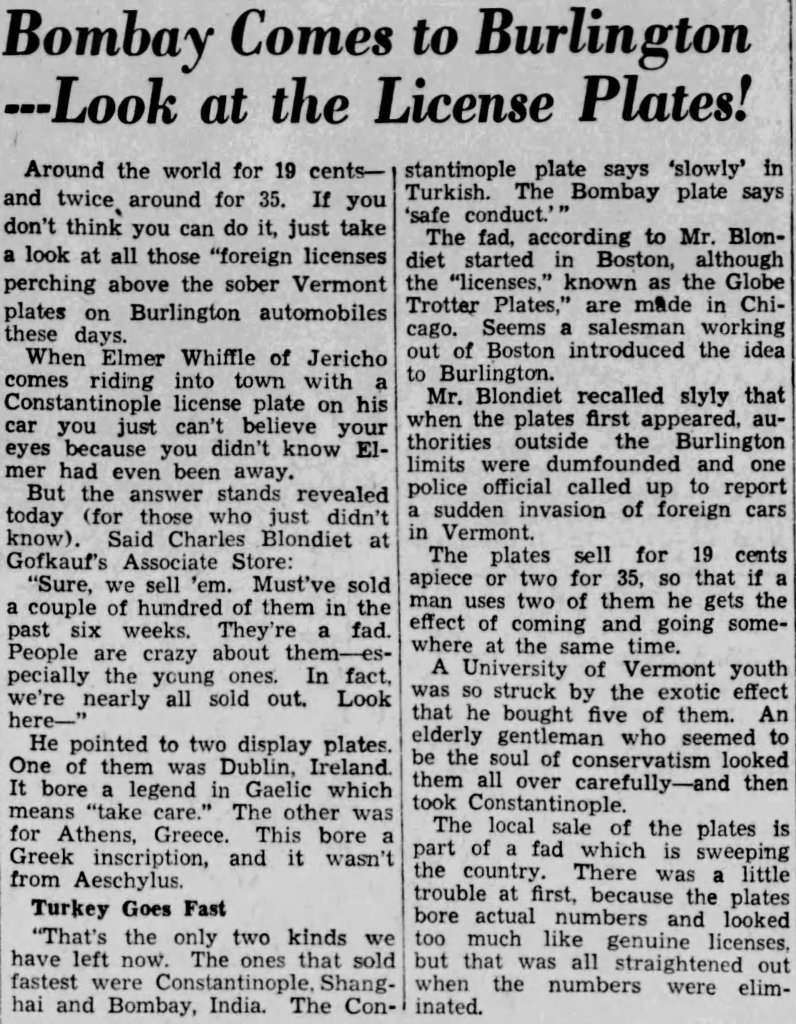
The license plates inspired multiple mentions in newspapers throughout the country. According to one storekeeper in Vermont, several hundred had been sold in a matter of weeks. Turkey, China, and India had taken the lead as top sellers, with Ireland and Greece the only ones in stock.
Below is a column from a Pittsburg newspaper in late 1939 describing an example of the “Egyptian” variety. Just one business noted it had sold 1,500 Globe-trotter plates!

Another Egyptian plate was profiled in a Nebraska newspaper a month later:

How long the novelty lasted is an open question. The series debuted in 1939, an ominous year in world history. By the end of 1941, the U.S. entry into World War II and the resulting metal restrictions would have completely put an end to novelty license plate production.
While not particularly rare or valuable today, they make interesting collectibles. Just don’t be fooled – they’re not real!
 Danny's License Plates