At a time when only about 9,000 motorized vehicles existed in Washington state, weekly auto sales numbers were still notable and merited attention in the automobile sections of local newspapers.
In Seattle, M.A. Miller of the Northwest Auto Company, adept at self-promotion, provided regular press blurbs to the Seattle Times in which he touted his sales numbers and extolled the virtues of the products he sold.
One such mention in June of 1911 pertained to the sale of an Apperson automobile to Andrew Prentice of Seattle:
“Manager M.A. Miller, of the Northwest Auto Company, local representatives for the Reo and Apperson cars, reports an exceptionally heavy business during the week just closed. He sold an Apperson car to Andrew Prentice, of Seattle, a Reo to C.H. Harris, of this city; an Apperson to E.H. Garner, of Everett; an Apperson roadster to Mrs. Tom Dalquist, of Bellingham, and Reo trucks to business houses at Tacoma, Everett and Bellingham.”
Seattle Times, June 4, 1911
Andrew Prentice’s purchase of an Apperson is notable for its direct link to a timeworn, homemade leather Washington prestate license plate in my collection: it spent several years adorning the car Prentice bought from the Northwest Auto Company that day in early June 1911.

Of typical construction from the era where license plates were owner-provided, it consists of aluminum house numbers attached to a leather pad, reinforced by a metal frame. At some point it lost a mounting clip (perhaps resulting in the addition of two mounting holes above the numerals), but otherwise is in reasonable enough shape after four years of traversing wet Washington streets and more than a century of storage and handling afterwards.
The Secretary of State’s ledger of motor vehicle registration activity between 1909 and 1913 is one of the few surviving license registers from the early years of automobiles in Washington state. It shows that this license number, 9319, was assigned on June 8, 1911, to Andrew Prentice of Seattle. The vehicle was a 30 h.p. Apperson, serial number 2073 – the very car mentioned in the Seattle Times four days earlier.

A handwritten note under his name says “N.W. Auto Co,” further confirming the sales success of M.A. Miller (this note likely indicates that the Northwest Auto Company was the legal owner – if Prentice was paying on credit – or perhaps that the dealership had remitted the license application on Prentice’s behalf).
Apperson Automobiles
Apperson automobiles are certainly not a household name today, but in the early 20th century they were known for power and sportiness (America’s First Sports Cars). The registration records for Prentice’s car list a horsepower of 30, which would put it at the bottom of the company’s lineup in terms of power. But still, it was not a mainstream purchase, nor a cheap one.
The license plate in my collection would have spent four years on Prentice’s Apperson, traveling around Seattle and beyond, until it was replaced by state-issued 1916 license plates in the summer of 1915. A partial volume of an alphabetical 1917 automobile registration directory survives in my collection, and luckily it’s the one recording Andrew Prentice’s vehicle for that year. It shows the Apperson was alive and well and still registered, traveling the locals roads with 1917 license plate number 16511.

The 1917 license directory provides a bit more information about the car: the “r” after Apperson indicates a roadster body style, the “12” the model year of 1912, and “33” is the horsepower rating (slightly higher than the 30 recorded in his original registration).
Early Beacon Hill Settler
When Prentice purchased his car and had his license plate made, his residence was listed as 1323 13th Ave S, Seattle, and ledger entries for his 1912 and 1913 renewal payments (recorded May 10, 1912 and June 2, 1913, respectively) listed the same address. Today, this location is a block south of the Pacific Tower, the prominent art deco tower that dominates the southern view from downtown Seattle (and that served as the original headquarters for Amazon).
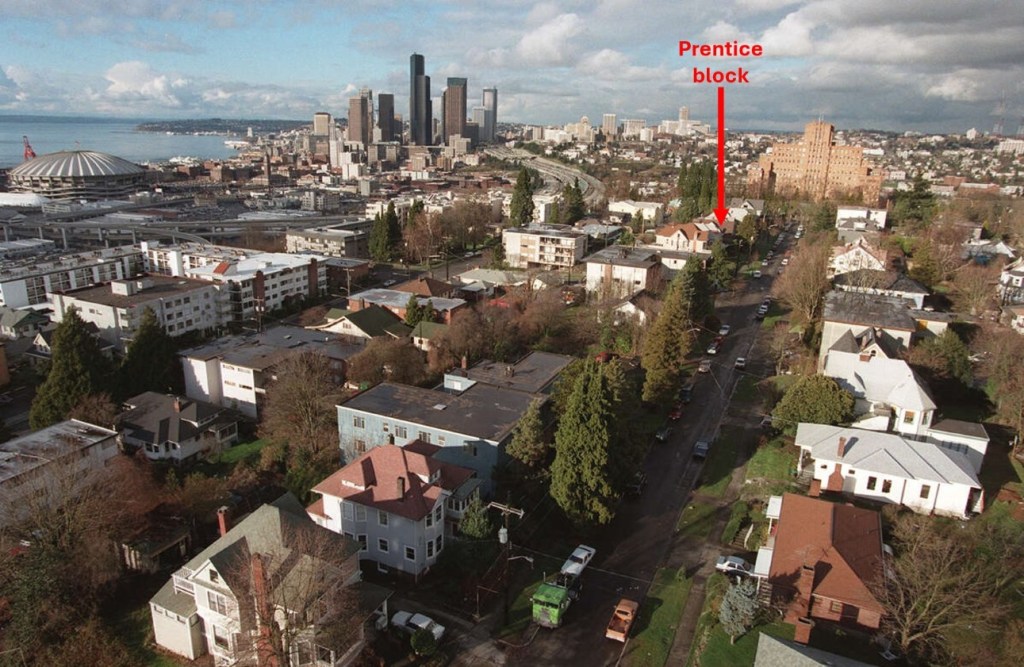
Prentice and his family planted deep roots in north Beacon Hill. At some point between the summer of 1913 and the spring of 1916, the Prentice family moved, but not very far: the 1917 license directory gives his address as 1341 13th Ave S, as do subsequent mentions of him and his family in local newspapers and census reports.

Their new house, 1341, shows as a vacant lot in the 1912 Baist map above (the southernmost house on the block is listed on the map as 1341, but today is 1349, with 1341 the next house to the north), and tax records show a construction date of 1913. Whether it was directly commissioned by Prentice or just suited the family’s needs better, it was a short move just down the street.
From Scotland, via Wisconsin
Prentice made a permanent home in Seattle, but it took a few stops along the way. His family emigrated to the United States from his birth country of Scotland while he was a child, settling in Wisconsin.
There, his father, Alexander Prentice, established a mill company that evolved into the town of Prentice.

Andrew and his brother Charles eventually left their eponymous hometown and established their own lives in rapidly-growing Seattle.
Prentice Family in Seattle
Andrew left Wisconsin with his wife, Yena, their sons Gordon, Rodney, and Harold, and daughters Jennie and Della.
Listed in the 1910 census as a salesman in the real estate industry, Prentice frequently appears in land notices in Seattle newspapers buying and selling plots of undeveloped land in a city that was very much still a work in progress.

The nascent automobile industry also served the family well. Prentice’s sons, Gordon and Rodney, managed the Sunset Electric Company, a successful auto parts company in the Northwest

Gordon Prentice in particular was a diligent businessman who saw additional success in the budding mass refrigeration industry. The family would eventually be linked to an even more prominent Seattle family: Gordon’s daughter, Barbara Prentice, would grow up to marry publisher John Blethen, of the famed Blethen family, longtime owners of the Seattle Times.
Death
Andrew Prentice died on New Year’s Eve 1923, at his home at 1341 13th Ave South. According to a brief obituary in the Seattle Union Record, he was born in Scotland and had lived in Seattle since 1892. His wife, Yena Prentice, and sons Gordon S. Prentice, Rodney S. Prentice, and Harold S. Prentice, daughter “Mrs. A.R. McLeod,” and a brother, Charles Prentice of Renton, all survived him.
His wife, Yena, lived the same house until her death in 1944, with the old leather license plate likely gathering dust in the basement or the garage. She lived well, frequently wintering in Honolulu, and at one point embarked on an impressive international road trip:
“Mrs. Andrew Prentice and her son, Rodney, left last Friday by motor for Vancouver, B.C., and sailed Saturday on the Empress of Japan for the orient, shipping their car. They will spend the next six or eight months visiting and motoring in Honolulu, Japan, China, Philippine Islands, New Zealand and Australia.”
Seattle Star, April 13, 1934.
That trip would be an amazing adventure today, but unimaginably challenging and interesting in 1934!
The make of the car is not noted, but it’s reasonable to assume it wasn’t the old Apperson.
 Danny's License Plates