The 50-state license plate spotting game is an enduring roadtrip staple for children and adults alike, a means to either stave off boredom or enthusiastically discover the geographically diverse origins of vehicles sharing the road.

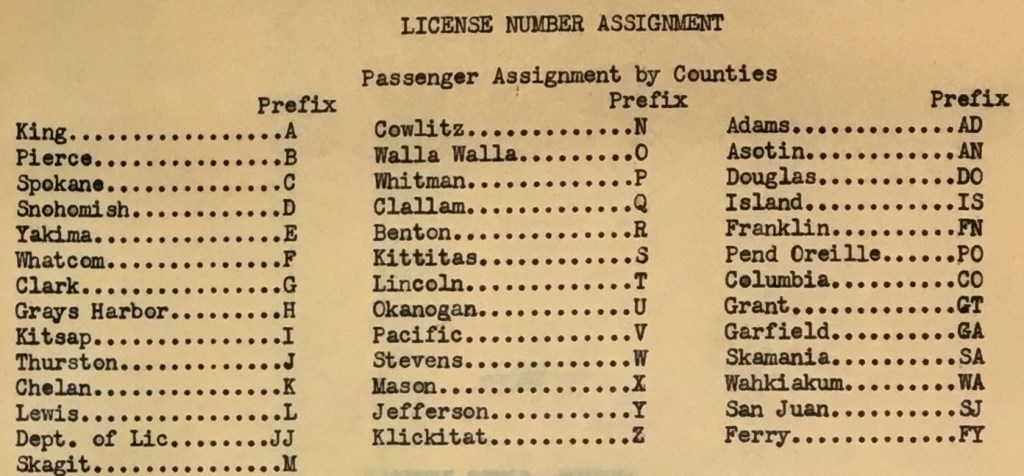
For many years, when Washington’s license plates were county-coded, such car-spotting could be done at an in-state level. Those who noticed or cared about such things could take great interest if an AN (Asotin County) showed up at the opposite corner of the state in Cape Flattery, if an islander sporting an SJ prefix (San Juan County) had made the effort to take a ferry to the mainland, or if one of them big-city folks with an A prefix (King County) was driving around the remote forests of Pend Oreille County. When county-coding was introduced to Washington’s license plates in 1935, matchbooks, postcards, and roadmaps were soon available listing the codes for all of the state’s 39 counties, which ranged from A to Z with 13 additional two-letter codes for the smallest counties.
But starting in 1939, a 40th code was added. License plates began appearing on the road with an “LD” prefix, which did not align to a particular county’s code. After three years, “JJ” replaced it, appearing from 1942 to 1957, and “JJ[x]” from 1958 and up. These codes represented the central Department of Licensing office in Olympia, administratively known as “County 40.”
The purpose and meaning of these non-county county codes always caused a bit of confusion for those not in the know, even back then. Some assumed that holders of these licenses were state VIPs; other common explanations were that the LD and JJ plates were issued to cars with paperwork problems, to out-of-state registrants, or for mail-in registrations. While all of those scenarios were partly true, the answer is fairly mundane: all it indicated was that the vehicle’s registration was processed through the main Department of Licensing office instead of a county auditor’s office.
1935-1938: Thurston high numbers
When county coding began in 1935 and license plate issuance was handled at the county level, the Department of Licensing headquarters still processed some registrations. In odd cases where additional paperwork was required, or registration was handled from out of state, the Olympia office used high-numbered hometown Thurston County license plates that were otherwise undistinguishable from other “J”-prefix licenses.

There was also an attempt to issue county-correct license plates to registrations processed through its central office: “In past years,” The Olympian noted in December 1938, “the department kept out a few [license plates] before sending each county its quota. When a motorist came to Olympia to straighten out his certificate of registration of title he was issued a license with his home-county prefix on it. This practice led to a waste of several thousand license plates annually since the department could not estimate accurately how many it would need for each county.”

Creating a new, DOL-specific license plate code was a logical alternative to the existing subpar options of either issuing a Thurston County license plate to someone residing outside that county (with the resulting confusion that could arise), or attempting to maintain a central inventory of other counties’ license plates (a planning/inventory nightmare and an administrative burden).
LD License Plates (1939-1941)
For the 1939 licensing year, the state created an entirely new “county” code assigned specifically to the Olympia home office of the Department of Licensing. Succinctly abbreviated as “LD” for Licensing Department, these stood out boldly on the roads of Washington as a new code type, at least to people that paid attention to license plate codes (there have been such nerds in all eras).
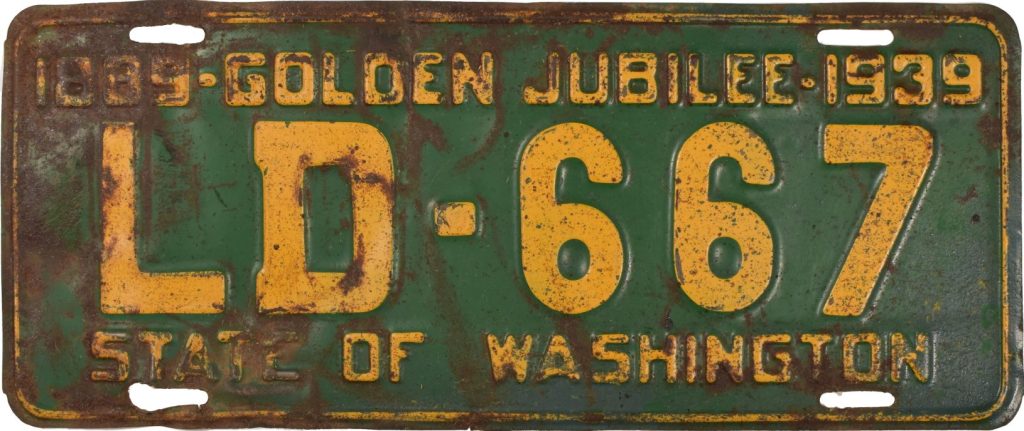
“Motorists who have been wondering if a new county had been added to Washington’s 39 were put at ease Friday by License Director Harry C. Huse who reported that the new 1939 auto licenses bearing the prefix “LD” were issued by the license department,” The Olympian assured an apparently anxious population on Christmas Eve of 1938.
The Olympian went on to explain that “all out-of-state autoists seeking to get Washington plates will get them from Olympia and receive “LD” plates, the same as others who have to get them from here after certain types of sales.” The editors, evidently not fans of the iconic, newly-debuted 1939 Golden Jubilee issue, ended the news brief with the note that “the color is the same, that poorly matched combination of green and gold.” Snark!

“LD” continued to be used in 1940 and 1941, and the public’s confusion endured. On January 11, 1941, alert citizen “B.U.” wrote to the “Mr. Fixit” column in the Seattle Star, asking how they could rat out their LD-licensed neighbors: “Mr. Fixit: I read in the paper last year than an LD auto license signified something was wrong with title or registration of an auto and was to be used only until investigated. In our town there are more than a dozen such licenses on cars of state employees. Where should this be reported?” Mr. Fixit’s reply assured B.U. that the neighbors were legit: “It shouldn’t be reported. You undoubtedly read than an LD license would be issued on a ‘cloudy’ title auto pending investigation. However, LD licenses are issued to anyone who purchases their auto license direct from the license department.”
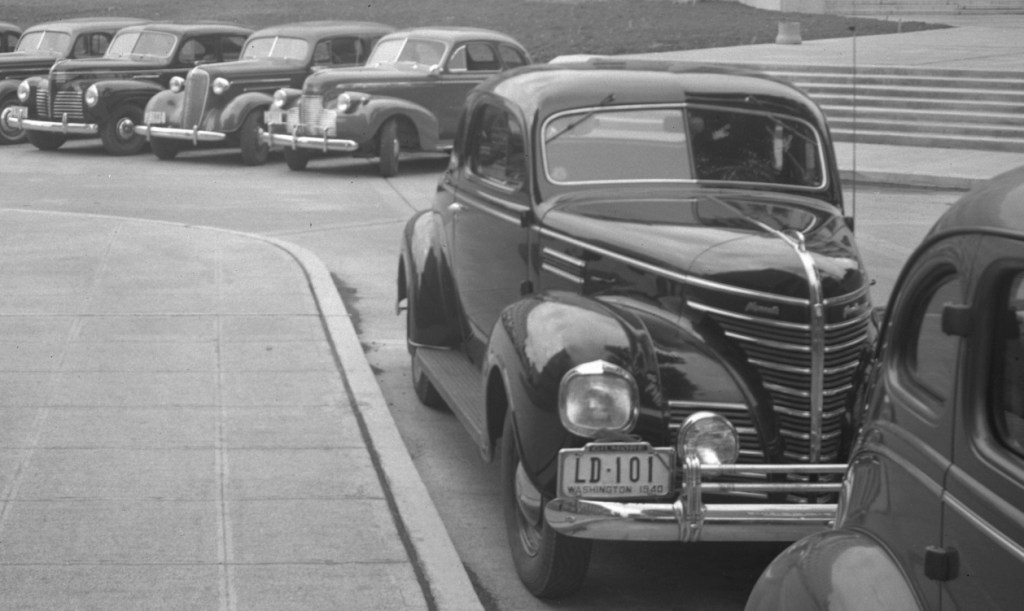

A “Mr. Fixit” column in the Tacoma Times just over a year later, on March 17, 1942, re-muddied the waters regarding sketchy paperwork a bit, reiterating that the JJ/LD license plates were “issued directly by the state license department, usually in cases where there is some flaw in the records of ownership or perhaps some doubt about the county to which it properly belongs.”
JJ License Plates (1942 and on)
The LD prefix lasted for three years before the state decided to change it for 1942. From this point onward, the main Olympia office was designed “JJ.” The use of “J”s was likely to make the plates appear more similar to Thurston County’s “J”-coded license plates.
If people were flustered by the introduction of the LD plates in 1939, another round of confusion resulted from the switch to JJ. F. Lloyd Crowe of Spokane learned the hard way when he received his 1942 license plates.
As secretary-treasurer of the Inland Automobile Association, Crowe made a bit more effort than the average motorist when licensing his car each year and chose to do so through the main Olympia office, receiving LD prefixes instead of the “C” that would normally be issued to a Spokanian (this probably enabled him to request a special number through his Department of Licensing contacts, as the Spokane County auditor was strict about not allowing such requests).
When Crowe received his 1942 license plates with the number JJ-333, even law enforcement was confused by the new prefix. “Much to his surprise,” the Spokesman-Review reported on December 10, 1941, “he was halted by a state patrol car the first day he appeared on the streets with his new 1942 license plates. Suspiciously the state patrolman wanted to know in what county Crowe obtained his automobile license. According to his list there was no county in the state with a JJ designation. Explanations followed, but since then Crowe has found that nearly every one else is equally curious about his automobile license number, and every day he spends much time explaining what JJ stands for.”
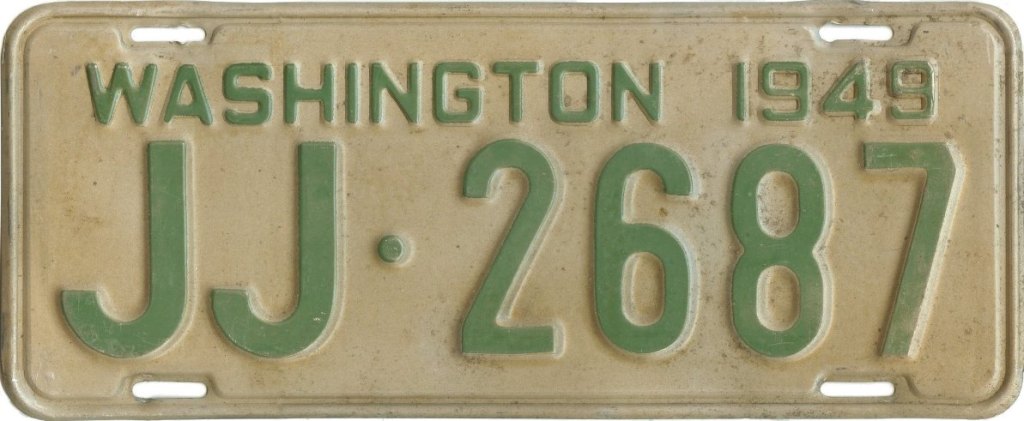
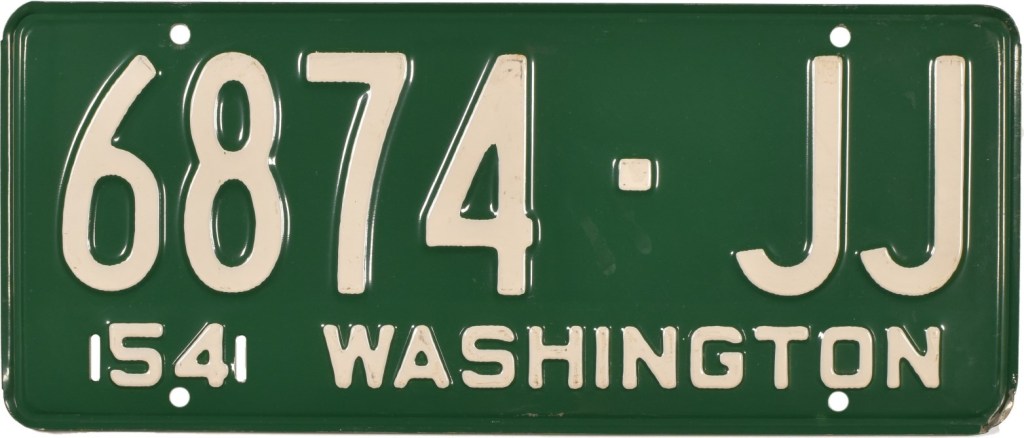
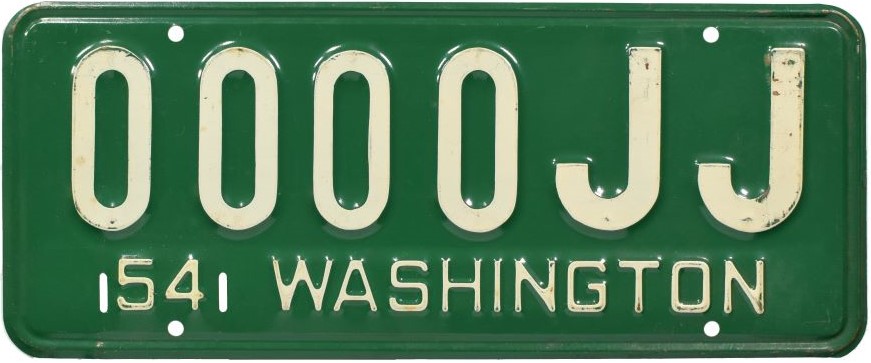
In 1958, when the state adopted the modern ABC 123 numbering format, county coding persisted, with changes to adapt to the new three-letter format. County 40 plate numbers began with JJA 000 and continued to progress through letters of the alphabet in the third position (JJB, JJC, JJD, etc.). This numbering scheme was repeated on the infamous Wash 63 base, continuing on into the 1968 issue. Once JJZ was reached, XXA and up was used through the 1970s.

By this time, license plate county codes, encompassing ranges of three letters scattered throughout the alphabet, were less noticeable. After county coding fizzled out in 1982, there was no easy way for the general public to determine the issuing office of a particular license plate.
Who received LD and JJ license plates?
Auto licensing was completed through county auditors (and still is, along with county sub-agencies). Most motorists registered a new vehicle, or renewed for the new year, by visiting their county auditor or a designated third party authorized to process licenses.
In a sense, LD and JJ plates could end up more frequently on the vehicles of “bigwigs.” With the Department of Licensing office adjacent to the capitol, it was natural that state officials and government employees would complete their licensing at that location instead of the Thurston County auditor. But as The Olympian explained in 1946, “anyone may obtain a JJ license by taking his out through the Department of Licenses [on the Capitol Grounds].”
A surviving volume of the 1947 Washington Automobile License Directory, published by Business Control, Inc. of Seattle, shows holders of “JJ” plates that year included notable Washingtonians such as William Cole, retired State Patrol chief; Department of Licenses head Harry Huse; future governor Albert D. Rosellini; and U.S. Senator and former Tacoma mayor Harry P. Cain.
Those names were interspersed with regular citizens from all parts of Washington state and beyond.
Many out-of-state addresses are present. The Quaker Oats Company in San Francisco was issued JJ-1308; intriguingly, JJ-3237 was issued to “R.G. or Kathleen C. Kauffman c/o U.S. Secret Service, the White House, Wash, D.C.” Albert Peterson of Palm Springs, California (issued JJ-376) was probably an early sunbird who wintered in California and renewed his car by mail. Individuals residing in military installations, both local, such as Ft. Lewis, and all across the country, were common recipients of JJ license plates, likely all falling into the category of mail-in registrations.
County 40 Today
While there is no longer a public counter at the Department of Licensing headquarters, County 40 still processes registrations. Any individual can order their annual license plate tabs through that office, although the tabs would be indistinguishable from any others.

License Plates Wanted
I am working on a year-by-year run of Washington LD and JJ license plates and still need several to fill gaps. Please contact me if you have any old Washington license plates you’re looking to sell – I’d love to chat!
 Danny's License Plates