
1915 was a turning point for the automobile in Washington state, as far as government regulators were concerned. By the summer, the state would abandon its ragtag prestate era of undated home-made license plates and implement a more sophisticated and structured licensing law, with professionally-made license plates issued annually in multiple vehicle classes. Nearly 40,000 vehicles were registered in the state, and it was clear that the automobile wasn’t a passing fad.
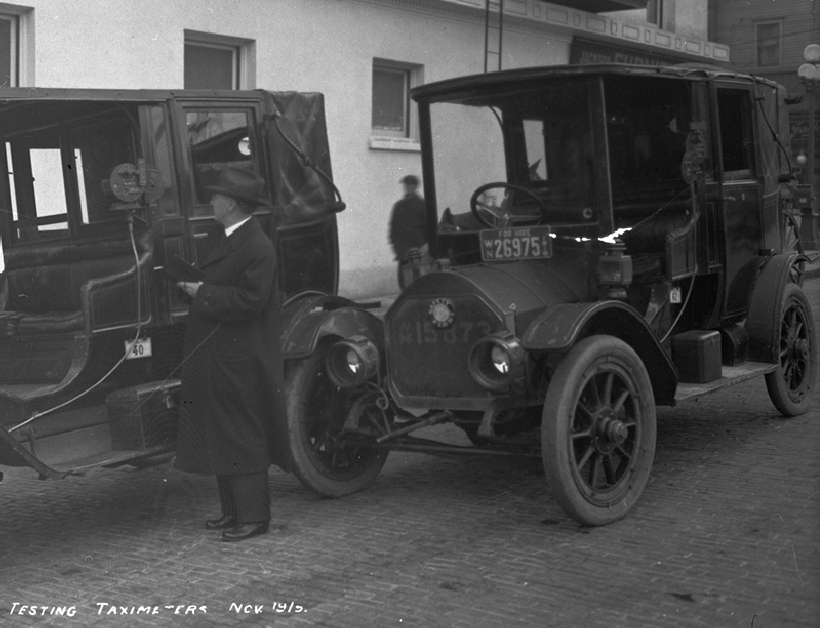
In Seattle, the dawn of the modern transportation era birthed numerous business opportunities in the car for hire industries. As taxis and chauffeurs proliferated, so too did the risk to public safety; anyone could become a driver simply by having access to an automobile. The state of Washington did not have any requirement for driver licensing until 1921, but the City of Seattle already recognized the need for drivers to be qualified and regulated. On January 7, 1915, the city council passed Ordinance 34159, requiring the licensing of any person driving a motorized vehicle for hire.

Effective February 8, drivers for hire would be required to prove eligibility to drive, and to carry elaborate leather booklets with photo identification and an assortment of official papers indicating their compliance with the city ordinance.
Seattle Ordinance No. 34159

Ordinance 34159 mandated that “every person driving an automobile or other motor vehicle for hire in the City of Seattle must be licensed as such driver.” The qualifications were far stricter than today: drivers must be at least 21 years old, pass a medical exam, be able to speak English, not be addicted to alcohol or drugs, and have the sworn testimony of two “reputable” citizens validating the driver’s “good moral character.” Written and driving tests (“through a crowded section of the city”) had to be passed. A Handwritten note saved in the City files notes “locations of hotels, theaters, hospitals, depots, docks” were topics to be tested on prospective drivers.
“What route would you take to drive from the Joshua Green building to the Providence hospital? From the Y.M.C.A. to Volunteer Park? From the Hippodrome to the Press Club?” The Seattle Times asked on February 8, 1915, the day the city ordinance was effective. “The foregoing are some of the questions asked jitney bus drivers and other chauffeurs who are being examined to comply with a recent ordinance to prove their fitness.”
Inspectors from the public utilities department would ride secretly as passengers to assess the drivers’ performance, and place an inspection sticker on the windshield after concluding the ride and identifying himself.
Private drivers were not subject to the law; they would remain free of any licensing requirements until Washington state started licensing all drivers in 1921.
Photos
More than half a century before photos were required on state drivers’ licenses, Seattle required self-supplied portraits on its documents.
Section 2(h) of Ordinance 34159 stated that: “Each applicant for a driver’s license must file with his application two recent photographs of himself of a size which may be easily attached to his license, one of which photographs shall be attached to the license when issued, the other to be filed with the application in the license department. The photograph of the licensee shall be attached to the license in such a manner that it cannot be removed and another photograph substituted without detection.”

Surviving examples show a range of photo styles; unlike the standard straight-on passport or license photo today, most of the photographs are formal studio portraits.
Wallet-sized license
Section 3 of Ordinance 34159 mandated the form of license to be issued by the city: “Upon satisfactory fulfilment of the conditions and requirements herein prescribed, the applicant shall be licensed by delivering to him a license with a suitable receptacle which shall be of such form and size as to contain the photograph of the licensee, the licensee’s signature, and shall contain blank spaces upon which a record of any arrest of the driver or of any serious complaint against him may be made, and it shall be the duty of the clerk of the court where such case is tried to inscribe on such blank spaces the disposition of any case at the time of the decision of the court.”

The “suitable receptacle” came in the form of tri-fold, wallet-like licenses with a snap close, and often served as a repository of related documents. Francis A. Harston’s 1925 license shown below came to me with a Seattle taxicab stand permit inside (issued to the Red Top Cab Co), Francis’s state-issued driver’s license, his union card, and a hunting permit.
Validity Periods and Fees
Section 4 stated: “Licenses shall be issued as of February first in each and every year and shall be valid to and including the thirty-first day of January next succeeding. The City Comptroller may renew such licenses from year to year by noting the fact of such renewal on the licenses.”
The fee for each original license was $2.50; renewals were $1.00; and replacement of a lost license $1.50.
Seattle Ordinance No. 48022
Pretty much everything in Seattle was regulated by Ordinance 48022, which passed on December 1, 1924, “providing for the licensing and regulating of certain occupations, businesses, vocations, trades, callings, amusements, places of amusement, exhibitions, entertainments, animals, motor vehicles, boats, place and establishments.”
Along with dog kennels, auctioneers, side sewer contractors, female employees dancing, miniature outdoor golf, Sunday dances, and pinball, for-hire drivers were subject to additional regulation.
The 1924 ordinance superseded earlier laws, and while the general requirements for operating vehicles for hire in the city did not change, the updated law separated driver licensing into three classes:

First Class licenses would “entitle the holder thereof to drive any kind or class of motor vehicle for hire within the City of Seattle.”
Second Class licenses were to be “limited to stages, sight-seeing cars, or other motor vehicles operating over a specified route and having a fixed terminal.”
Third Class designated drivers of “taxi-cabs, for hire cars, or other automobiles not operating on fixed routes, and having a passenger capacity of less than seven (7) persons, not including the driver.”
Each class was to be printed on different-colored paper.
Surviving licenses from this date and later thus display the licensing class on them. Third-class licenses, issued primarily to taxi drivers, appear to be the most common, based on surviving examples.
Later Years
In the waning days of World War II, while the world was ushering in the nuclear age, Seattle for-hire drivers were still carrying around licenses very similar to what had debuted in the brass era of the automobile.
This surviving example below, from the World War II era, is smaller than the original licenses, with only two sections instead of three, but otherwise is quite similar to anything issued in the nearly three decades prior.

Just before the end of the War, the old leather booklet gave way to a modern, laminated photo ID.
Seattle Ordinance No. 73763
Updated legislation governing for-hire drivers was passed on January 22, 1945, and brought the licensing process into the modern era. Here again, the City of Seattle was decades ahead of the State of Washington, which wouldn’t issue laminated photo-ID drivers licenses until the 1970s.
Section 108 described the new form of licenses:
The license shall be of such form and size as is required by the City Comptroller and on one side the photograph of the licensee shall be attached as herein required together with a fingerprint, the physical description of the licensee and the date of the license and his signature. The other side of the license shall contain the words ‘For-Hire Driver’s License — City of Seattle, Comptroller’s Department, Division of Licenses and Standards,’ and also the number of the license, and the name of the licensee, the date of expiration of the license. After the data herein required has been inserted on the license it shall be enclosed and sealed in cellophane or other durable transparent material or composition.
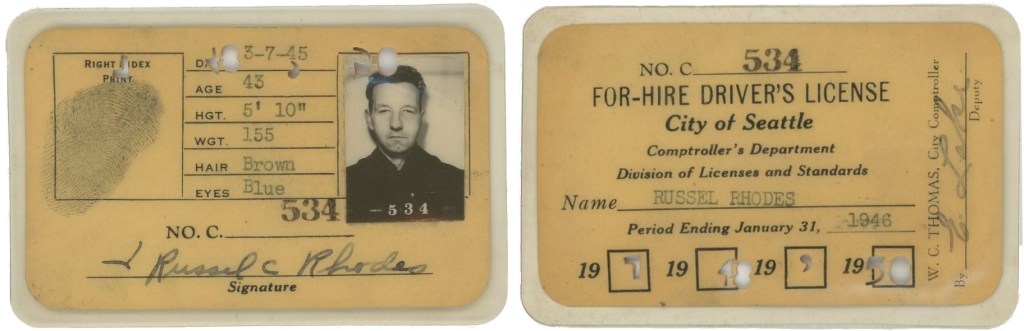
Certainly more legible and easier to carry, these lack the old-world charm and officiousness of the formal leather booklets that still turn up occasionally.
City of Seattle drivers licenses, license plates, and paperwork wanted! I am always looking for surviving examples to document or add to my collection. Please contact me with questions or items to share!
 Danny's License Plates