A metal license plate is a simple object that serves a basic purpose well. That hasn’t stopped inventors, entrepreneurs, or administrators from experimenting with new forms to save costs or materials. These have ranged from practical (renewals with tabs and stickers) to stupidly complicated workarounds.
At what was probably the more unnecessarily complex end of that spectrum, a Spokane man patented an elaborate license plate system in the early 1920s, which sought to replace metal plates with paper-based cards designed for use in an accompanying weatherproof metal display frame.
The device would probably be completely forgotten if not for a battered old ledger that surfaced in a Seattle antique store in 2024, full of certificates for shares in the Hollis Vehicle License Holder. What WAS the Hollis Vehicle License Holder, and why would it merit attention from investors?

Dating from 1922, this ledger recorded sales of shares of a patent, claimed by one Orlando B. Hollis of Spokane, Washington, for a unique license plate holder device that would require a fairly radical departure from how license plates were manufactured and issued.
The Hollis Vehicle License Holder
The patent filing boldly proclaims the following: “On February 8, 1921 there was duly issued to Orlando B. Hollis, United States Patent No. 1367659, a certain type of vehicle number plate for convenient display of license and automobile numbers, and that said Orlando B. Hollis has converted said patent and all rights thereunder into units under the name of Hollis Vehicle License Holder.”
What exactly was this invention for conveniently displaying license numbers? The patent filing provides a detailed drawing:

Hollis filed his patent application March 25, 1920, which was granted February 18, 1921.
The accompanying text on the patent grandiosely describes the invention:
To all whom it may concern: Be it known that I, Orlando B. Hollis, a citizen of the United States of America, residing at Spokane, in the county of Spokane and the State of Washington, have invented new and useful Improvements in Vehicle Number-Plates, of which the following is a specification.
This invention pertains to motor driven vehicles number plates and has for its object to provide a permanent frame and inclosure to be rigidly attached to the vehicle and into which the number card is inserted, to be removed and replaced by another card as occasion may require. This will effect a great economy as the frame and inclosure will be permanent and the number card can be of paste-board or other cheap material as the same will be completely protected from the elements.
The exact business case for this product is lost to history. The patent’s value proposition is to protect the license plate from road debris and weather, allowing license plates to be replaced by pasteboard cards. Selling the product would then require convincing licensing authorities to abandon metal license plates in favor of a cheaper form, saving manufacturing costs and also making shipping and storage easier and less expensive. Who then, is the customer for the holder? Would state governments buy these frame devices and issue them to vehicle owners, or would motorists be expected to procure them themselves?
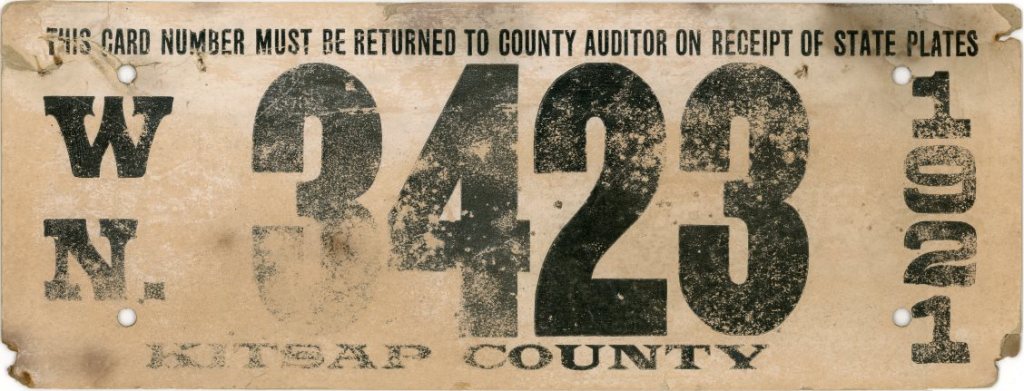
A little more than a year after the patent was granted, Hollis planted a short press blurb in the Spokane newspapers:
“The state of Washington wastes four carloads of steel annually on automobile license plates,” said O.B. Hollis, E41 Euclid avenue, yesterday. “It throws away $57,000 annually.” Mr. Hollis is the owner of the Hollis auto license holder, which he says will serve every purpose of the steel license plates, yet costs less in the long run.
“The metal plates cost 15 cents, mailing 8 cents and subsequent postage brings the cost up to an average of 30 cents,” he said. “We supply a metal case at a cost of 35 cents and supply the cards at two cents a pair. The mailing cost is a cent for the cards. The license holder protects the cards and its endurance is guaranteed for five years. The card bears the seal of the state and is the only part renewed yearly. Our holder will save the state $175,000 in five years.
“The Hollis license holder has been favorably received by state officials of Washington, Idaho, California, Texas, Colorado, Utah, Wisconsin, and Minnnesota. They have asked me to come again as they are not in a position to use it this year.”
Spokesman-Review, April 30, 1922
This proposal is a razor and blades model – selling not just the device, but the cards to go with it.
Washington State, for example, recorded 220,957 vehicle registrations in 1922. If Hollis were to sell two cases per vehicle, that would generate more than $330,000 in revenue, with another $9k from the cards. Even with a flat vehicle population (it was expanding quickly) over five years, Hollis would gross $45k in card revenue. The other states mentioned by Hollis as “interested” in his invention represented more than 2.4 million vehicles registered in 1922, according to the 1923 edition of Facts and Figures of the Automobile Industry.
Gaining state business was a long shot, particularly at home in Washington State. By the time Hollis started selling shares in his patent and issuing press releases, officials in Washington had already made serious investments to convert the jute mill at the Walla Walla Penitentiary into a license plate manufacturing facility. A February 16 article in The Olympian indicated the machinery would be in place by April 1, with the 1923 license plate production commencing soon thereafter.
Other strikes against the scheme include the relative ease of counterfeiting printed cards.
If Hollis made any inroads with state officials anywhere, it did not garner any attention in newspapers. Annually-issued metal license plates continued to function as the primary method for motor vehicle registrations throughout the United States.
Investors
By early 1922, Hollis was selling shares in the Hollis Vehicle License Holder company. The ledger now in my collection tells some history of his success with investors.

Hollis converted his patent into 500 shares, issued to himself on May 23, 1922, recorded on certificate #1. That same day he issued certificates #2 through #4 for 30 shares each to W.P. Russell of Spokane. Russell was a bit of a deadbeat; handwritten notes show that certificates #3 and #4 were cancelled for non-payment, which explains why both issued certificates were tucked into the back of the ledger.

Hollis sold shares to fellow Spokanians Matt Baumgartner, John E. Lincoln, Andrew Pouder, and W.P. Russell again. In June and July large batches of certificates were removed, with the recording stubs indicating they had been pre-signed and given to third parties to sell for a commission. In total, Hollis marked 243 of his 500 shares for sale, with a handwritten note indicating he was asking $50 per share on the last batch, giving his company a valuation of $25,000 (almost half a million dollars in 2024).
Whether this patent ever generated wealth is unknown, but highly unlikely. The last activity in the share ledger was July 11, 1922, less than two months after Hollis began issuing shares.
Orlando B. Hollis
O.B. Hollis probably did not need to realize a large profit on his invention. His name appears periodically in newspapers in the first quarter of the twentieth century, attached to a range of business ventures. Hollis held leadership positions in multiple mining companies in the Inland Northwest, had filed another patent in 1917 for an automatic sash lock, was mentioned in the Seattle Times as a car dealer at one point in the 1920s, and for a time served as the secretary of an electric company in Cashmere and a promoter of Washington state apples.
Orlando Beaugard Hollis was born in June 1863 in Missouri, and at a very young age became one of the earliest settlers of the Pacific Northwest, arriving in Lane County, Oregon in 1870 with his family. At the time of his patent, his siblings had spread out around Washington and Oregon, with deep roots still planted in Eugene, Oregon.
Notably, his namesake nephew, Orlando John Hollis (1904-2000) would become an important figure at the University of Oregon, serving as the dean of the law school for more than 30 years, and as interim president of the university during World War II.
Hollis died October 28, 1931. The 1930 census shows him living at the foot of Queen Anne Hill in Seattle with his wife, Henrietta, and a boarder. His listed profession was as a salesman in the “soap and chemical” industry.
 Danny's License Plates