2024 license plate shortage in Washington
A flurry of news stories in the late summer of 2024 (and earlier) alerted the public to ongoing license plate shortages in Washington state, with many counties and issuing offices completely out of stock and a large manufacturing backlog at the license plate manufacturing facility at the Walla Walla Penitentiary preventing resupply.
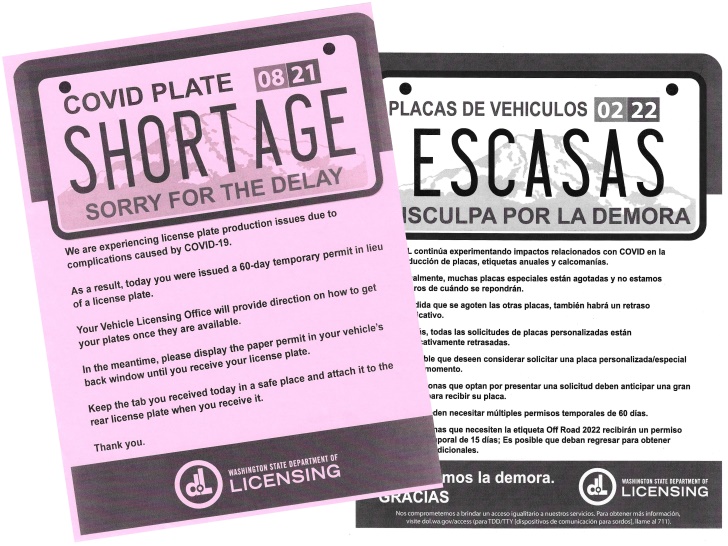
Inventory problems have been ongoing for more than two years. Public explanations have attributed the issue to labor shortages during COVID (with limitations on indoor gathering preventing full manufacturing shifts), insufficient inmate workforce, and aluminum supply constraints due to the post-COVID supply chain issues that affected every industry.

As of late summer 2024, staffing issues and a conversion to new, updated machinery at the factory are stated as the main culprits for current license plate shortages.
Aside from an increase in paper temporary license plates on the road, this extended period of manufacturing constraints will leave a permanent mark on the bumpers of Washington state.
In early 2022, Washington began relying on Waldale Manufacturing of Nova Scotia as an alternative supplier for license plates when demand could not be satisfied by the prison plant. Throughout 2022, 2023, and 2024, standard-issue license plate manufacturing was split between normal production at the Walla Walla Penitentiary and Waldale.
These Waldale-sourced license plates can be identified by a subtle manufacturing variation.
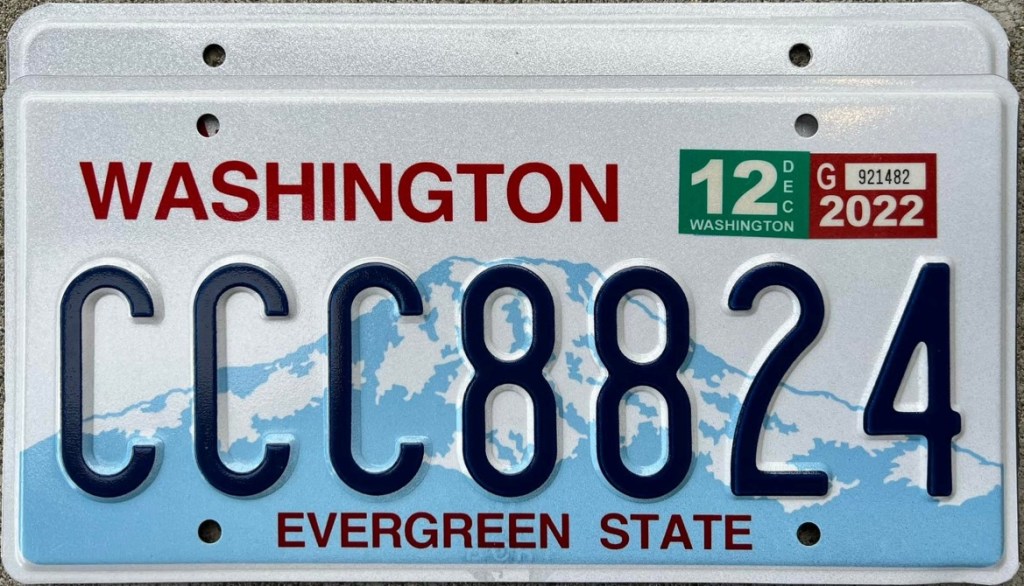
With Waldale using identical stamping dies and the same source of graphic sheeting, the license plates generally look the same, but the sharpness of the corner is the giveaway as to what was made where. Washington’s penitentiary stamps blanks with a fairly rounded corner, while Waldale’s products (including their normal production for other jurisdictions) have a sharper, more square corner.

Washington was making license plates in the early Cxx letter series when the issue surfaced, so the variation in borders can be seen in any passenger license plates in that range.
With new production online, if manufacturing bottlenecks are resolved soon, the second half of the Cxx plates should no longer be dual-sourced, and production will return to normal in Walla Walla.
1917 License Plate Shortages
The post-COVID era isn’t the first time license plate shortages affected motorists. More than a century ago, the First World War impacted the steel market so dramatically that there was no metal to be had for manufacturing license plates.
The Bellingham Herald reported on May 2, 1917, that the “soldiers in Europe may be wearing license plates now. At any rate the secretary of state has written to the county auditor to tell him that owing to the present condition of the steel market, the manufacturers of automobile number plates have found it impossible to fill their orders quickly. The orders for the State of Washington are now 10,000 behind. Many people who secured their temporary licenses some time ago have complained because of the fact that the metal plates had not been sent to them from the secretary of state’s office.”
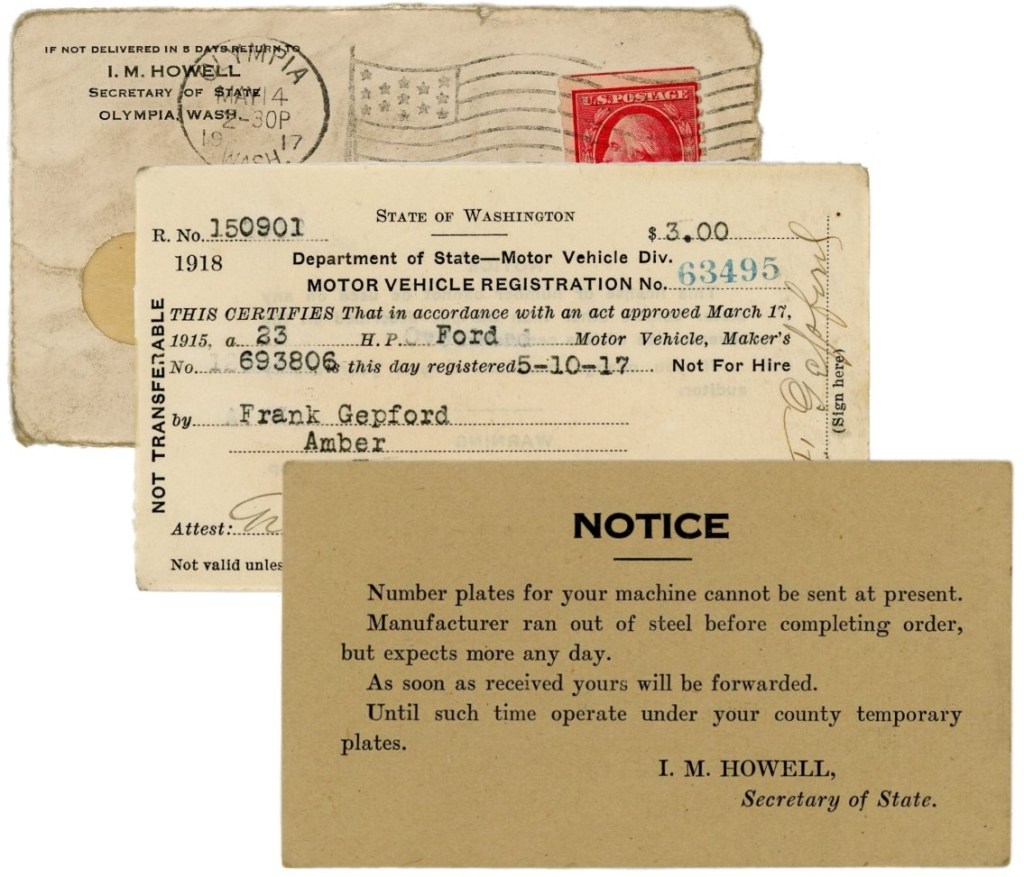
A small piece of surviving paper corroborates the story. In May 1917, Frank Gepford of Amber, Washington, a small community southwest of Spokane, registered a new Ford with his county auditor. When his registration documentation (for the 1918 licensing year) arrived from Olympia, it included a small note indicating that the license plates were unavailable due to the steel scarcity and, like 2024’s license plate shortage, instructed him to continue using his temporary licenses.

The license plates in question were 1918 issues, due to the non-calendar-year licensing program in place before 1921. The Pacific Coast Stamp Works company of Seattle was the supplier of Washington’s license plates at the time, as this predated the era of license plate production at the Walla Walla Penitentiary. The company also publicly blamed the war for its poor paint quality, noting that its paint expert had been drafted into duty.
Other Supply Constraints
Until the current supply issues, war was the consistent culprit of license plate supply issues in Washington, with massive demand spikes upending the metal markets and government rationing limiting what was available for non-military use. World War II almost completely disrupted license plate production for several years, with most states using windshield stickers, tabs, or fiberboard as license plate alternatives. The post-War years saw demand and supply imbalances similar to what the world experienced in the aftermath of the COVID shutdowns, again requiring many states to revert to non-standard licensing methods.
Early in the Korean War, the metal supply became so constrained that Washington could not make any license plates for a few months in late 1951, resulting in many cars being issued a simple window sticker to indicate their active registration.
Out-of-State Supply
Since 1923, there has only been one other time where Washington’s license plates were manufactured outside the Walla Walla Penitentiary (with a few minor exceptions for some low-volume oddball types), and it wasn’t due to supply chain issues. The factory – and its inventory – was completely destroyed by a fire in 1953, requiring Washington’s entire license plate supply to be provided by a company in Oregon until the plant was rebuilt.
 Danny's License Plates