While the world was celebrating the arrival of the year 2000 and crossing fingers that the Y2K Bug wouldn’t destroy civilization, the state of Washington was preparing to clean up the state’s license plates. With the Y2K new year came the mandate that every vehicle receive new license plates every seven years.
During the next 14 years, vehicle owners whose license plates were more than seven years old would receive new ones at their annual renewal, with the requirement to pay an additional fee. It would be one of the more-hated laws on the books.
A few years later, when Gov. Chris Gregoire solicited ideas from the public about laws that needed changing, axing the seven-year replacement rule was one of the most popular ideas of out some 2,000 submissions.
Seattle Times, December 15, 2014
The justification was that plates older than seven years old would lose reflectivity and have reduced legibility. In reality this was a flimsy excuse; license plates from at least the mid-1980s held up quite well in general. Indeed, it later came to light that there was never any study supporting a seven-year lifespan, and that it was an arbitrary figure provided by reflective sheeting vendors.
The long-term effect of the law was an overall modernization of license plates on the road in Washington. Until this point, it was common for license plates dating from as far back as 1963 to still be in service, mixed in with every other design variation that had come along since. Older cars continuously licensed in Washington state wore their history on their bumpers – many with plates that dated back to the era of county coding, providing a glimpse of the car’s origin story for those in the know.
The first phase of the replate mandate started in January 2000, when all license plates issued before 1987 were replaced with new ones when they were renewed for the year.
Starting in January 2001, newer plates issued between 1987 and 1989 were up for replacement at their next renewal, eventually fully phasing in the program where anything greater than seven years of age was flagged for replacement.
Eliminate Non-Reflectorized Plates
Washington last had a full general license plate reissue in 1963, when the derided “Wash 63” base was issued to every vehicle in the state.
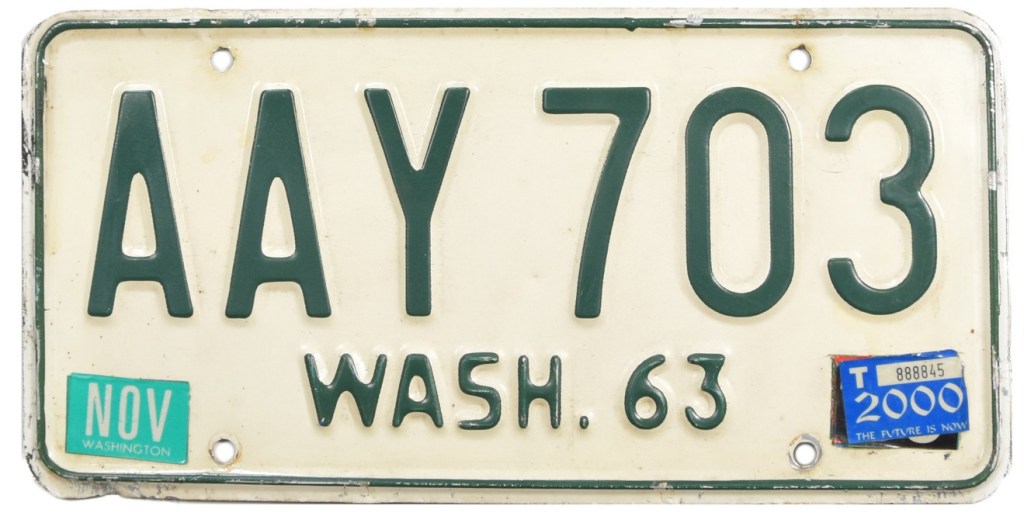
Any car continuously registered in Washington since then would have still worn the same license plate originally assigned, with a thick stack of renewal stickers and varying degrees of wear. Anything first registered between 1963 and 1967 had old-fashioned, non-reflectorized plates. Reflectorization technology was introduced in Washington, by state law, in 1968, and dramatically enhances nighttime legibility and safety. One reasonable objective of the replate legislation was to clear these old relics off the road.
Sell More Plates
A more cynical (and accurate) view of the law, which was later exposed in a 2014 Seattle Times investigation, was that its main intent was for license plate suppliers to sell more license plates.
From this perspective, the new law was a boon. Whereas in the past any vehicle registered in Washington would keep the same license plates indefinitely, this new program would ensure that every car receive a new set of license plates every seven years.
Was this necessary from a public safety standpoint? Not really; newspapers published plenty of letters from disgruntled motorists unhappy with changing out their perfectly fine plates and (most of the time) needing to memorize a new license number. This did have the benefit of standardizing the license plate format on the road (abandoning a mix of pre-1987 green/white old plates in the ABC 123 registration format mingled with the then-current Mt. Rainier design in 123 ABC format).
The reality was that the license plates of the era were well-made and in most circumstances remained perfectly legible.
New Plates to Owners
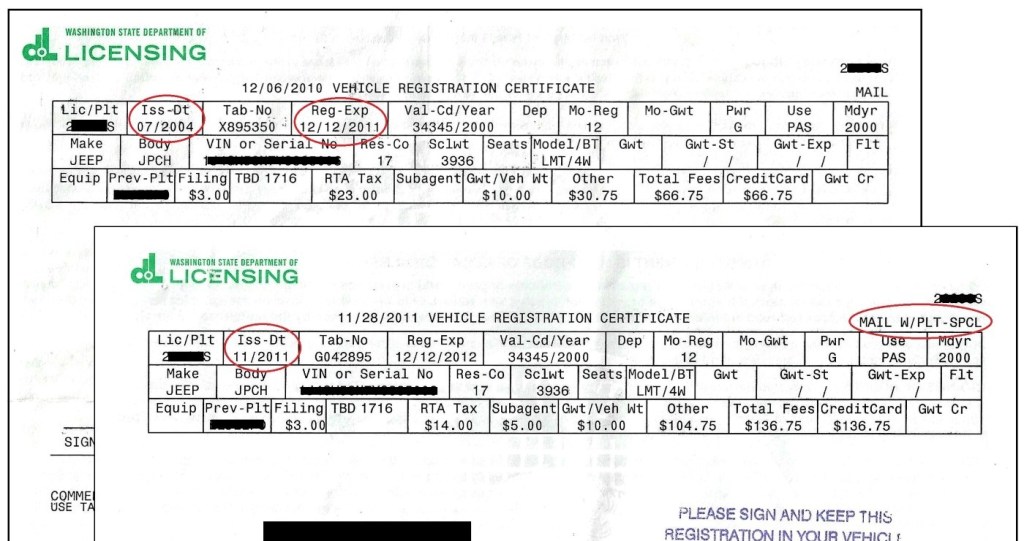
For anyone with a standard-issue license plate, mandated replacements were sent with new off-the-shelf numbers. The state (and newspaper op-ed pages) received many complaints from people who were attached to their existing numbers and objected to receiving new ones. In response, new legislation passed in April 2003 granted motorists the option to pay an additional $20 fee to keep their old number, in which case a new set was manufactured and mailed to the vehicle owner.
By this point, anything dating before the early 1990s had already been replaced, so reissued plates in this category looked fairly similar to the originals.
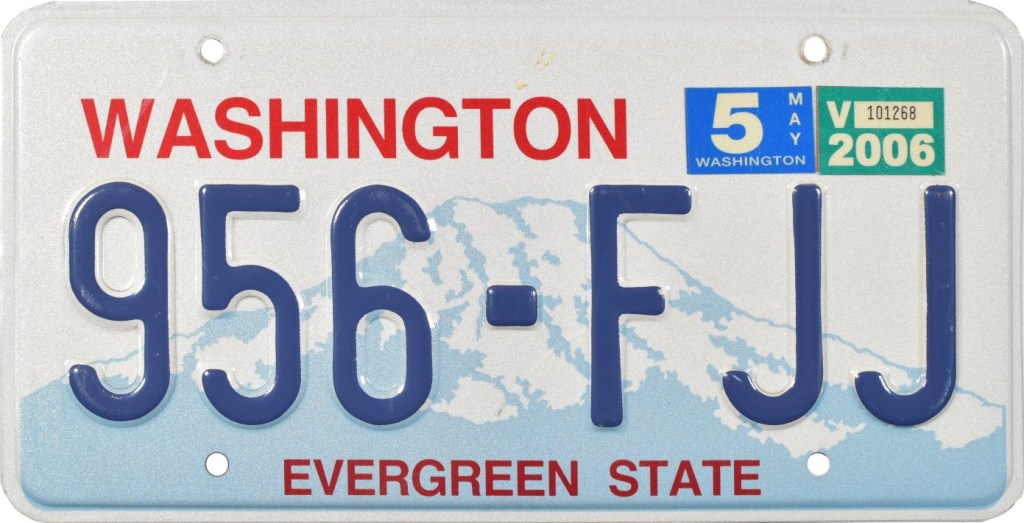
Only a nerd who pays attention to license plates an exceptionally observant person would be able to easily identify a remake, mainly by paying attention to the license number or stamping dies, which evolved for many characters after 2010.
Personalized and Optional Issues
Even from the beginning, some vehicle owners received new license plates with the same numbers. Anyone holding personalized, ham radio, or optional graphic design plates (supporting colleges, sports teams, etc.) would keep their number; these, unlike standard car, truck, or trailer license plates, were always assigned to the owner rather than to the vehicle. By default, replacements of these types were remade with the original number.
The law effectively eliminated the optional green/yellow “lemon” personalized base that since the 1970s had been a rare colorful alternative to the standard-issue design. Owners of these plates received the standard-issue Mt. Rainier design instead.
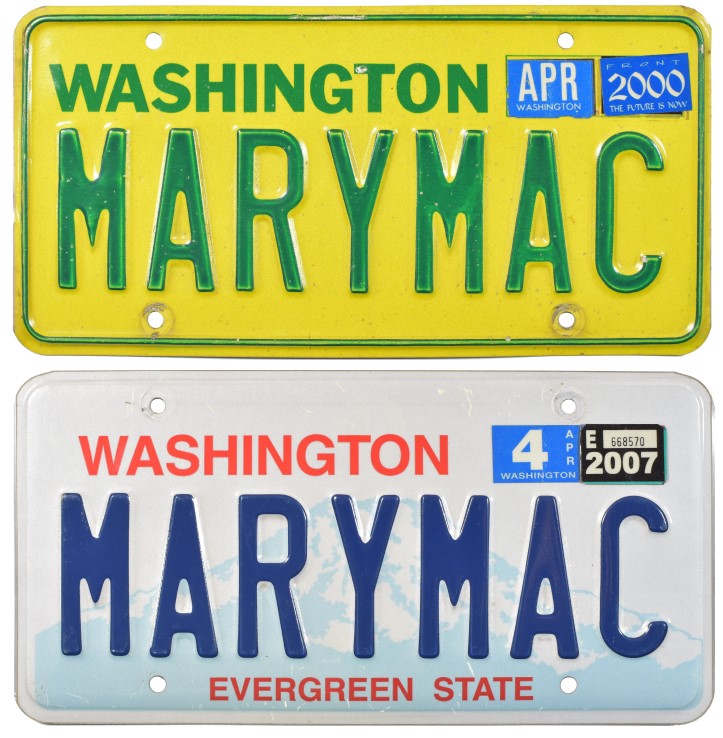
Holders of optional designs such as colleges, Square Dancers, and the Seattle Mariners received new plates with the same numbers, but always slightly different designs due to changes that had evolved in the years since first issue.
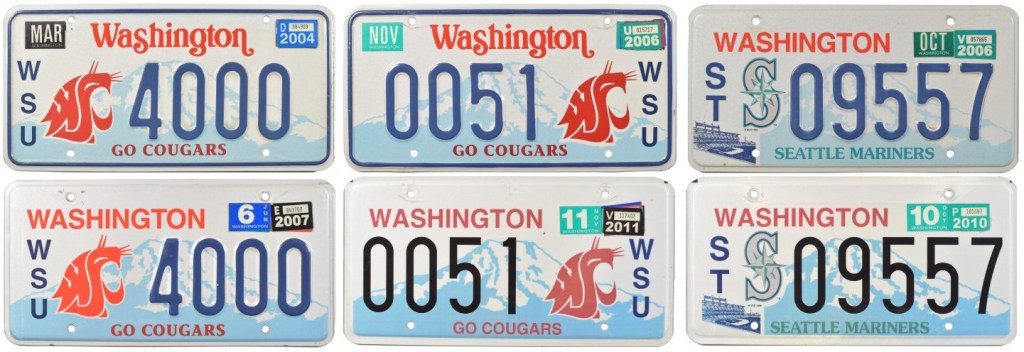
The example above shows three sets of plates. At left, Washington State University #4000. The top plate would have been issued in 1997. When it came up for replacement in 2004, the design had evolved to the offset block-letter state name sans embossed border. The second WSU plate, number 0051, was issued in 1999 (the WSU logo was moved to the right after number 9999 was issued in the original format; numbering started over again with the logo as a suffix to create a new series), and by the time its replacement was mandated in 2006, all optional designs had gone to a flat manufacturing process. Thus, its reissue is flat. The same fate befell the Mariners plates to the right.
Exceptions
Some vehicle classes were excepted from the seven-year replacement law: antique and collector vehicles, exempt classes (city-, county-, or state-owned vehicles), and commercial vehicles with a gross weight exceeding 26,000 pounds could keep their original plates.
Ending the Practice
The rolling replate practice finally died from legislation passed in early 2014, effective January 1, 2015. From that point forward, license plates no longer required replacement in a specific timeframe. Instead, new license plates would be mandated any time a vehicle changed ownership. Before that point, the plates had stayed with the vehicle, regardless of how many times it was bought or sold (spotting an old family car in traffic was a fun game). One additional change in the law was the new option to transfer standard-issue license plates between vehicles owned by the same person – if you like your license number and purchase a new vehicle, you can move the plates to the new one.
This compromise meant aged license plates would remain uncommon on the road, since any ownership change triggered the issuance of new plates. The cynical/realistic read on the law was that it still was a revenue generator, because studies showed the average vehicle was owned for five years: if selling more license plates was an objective, this new law would result in the state churning through more license plates than under the seven-year replacement program.
Today, the oldest license plates on the road in Washington state date back to about 2008 (with the exception of some vehicle classes mentioned earlier that were never subject to the replacement program), which for passenger vehicles generally includes the last two letter series (Yxx and Zxx) of the 123-ABC format that debuted in 1987. Older numbers originally issued around 1994 can still be spotted, but these are instances where an owner paid to keep the number and have a new set made. Vehicles older than 30 years can be registered with original license plates under the Year of Manufacture program, but this is more a form of personalized license plates.
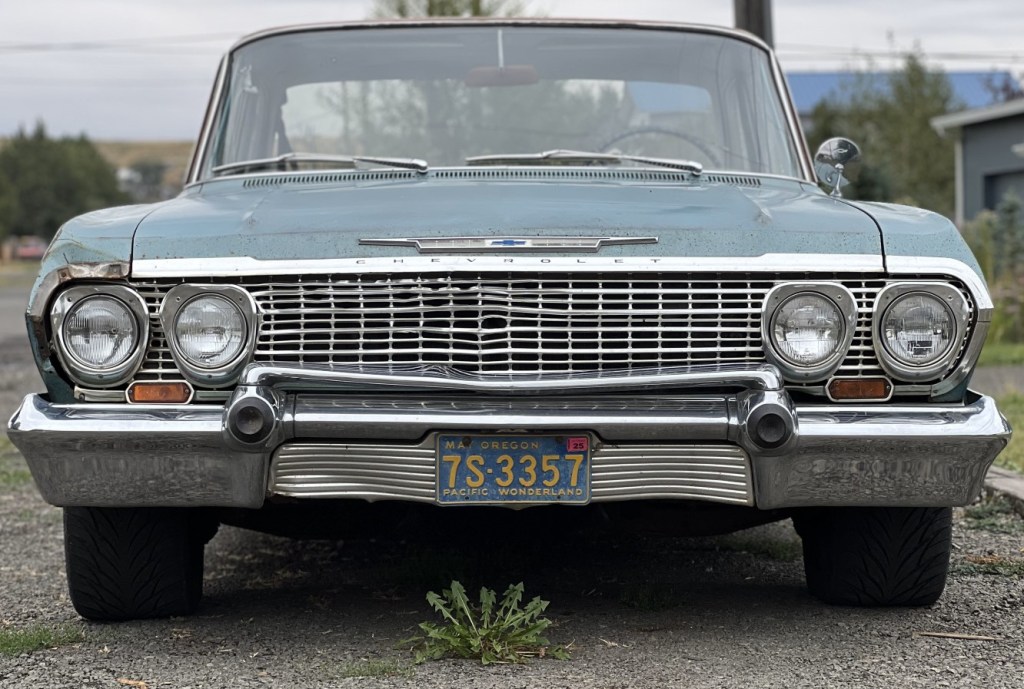
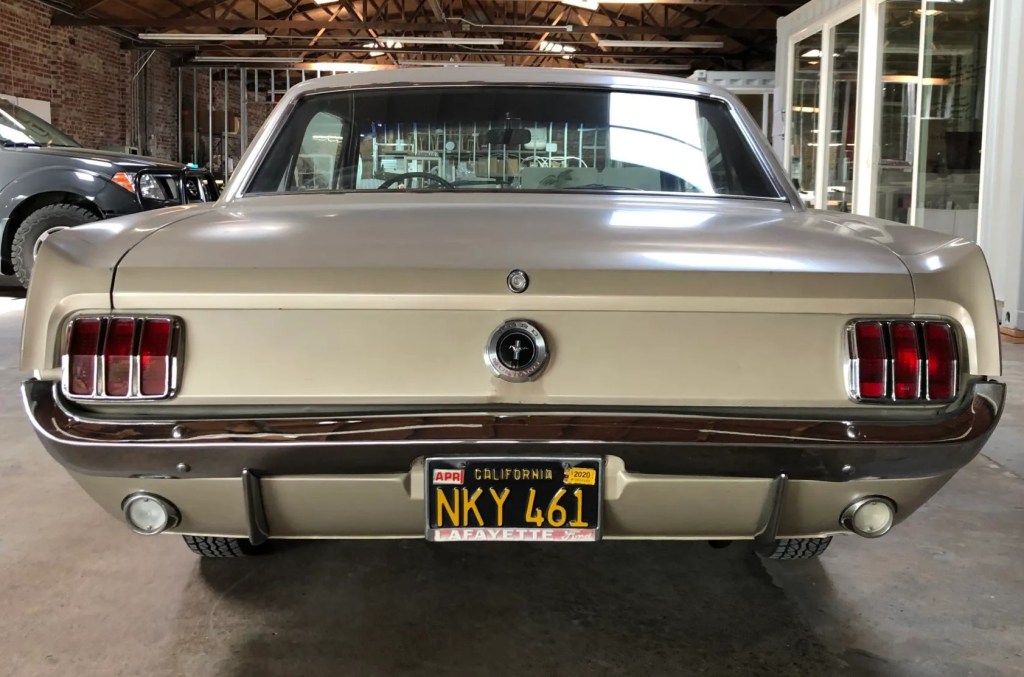
Driving south from Washington, it’s still possible to spot some very old license plates lingering in use today. Oregon has not reissued license plates since 1956, so as long as a vehicle has been consistently registered in-state, it could still have its original 1956 license plates with almost 70 years’ worth of stickers. California similarly has not completed a reissue since 1963, so the iconic gold and black plates can still live on attached their original bumpers.
 Danny's License Plates