
Legendary in American history and a defining part of Oregon’s identity, the Oregon Trail marked its centennial in 1943. The journey to the Pacific Northwest was long and arduous for settlers on the trail, and in the 20th century, efforts to commemorate it would also meet delays and obstacles.
In January 1941, Oregon state Senator W.H. Strayer, of Baker, proposed a bill that the 1943 license plates spell out “Old Oregon Trail 1843-1943” at the bottom to honor Oregon’s history and heritage. It would be the first time Oregon license plates had any slogan or commemorative message.
While popular in sentiment, approval wasn’t a slam dunk, with logistical issues creating conflict within the state legislature. The bill passed the House with an amendment that the special 1943 license plates be a larger-than-usual size, which the Senate rejected based on input from motor associations that wanted standard-sized plates that would fit license plate holders currently in use.
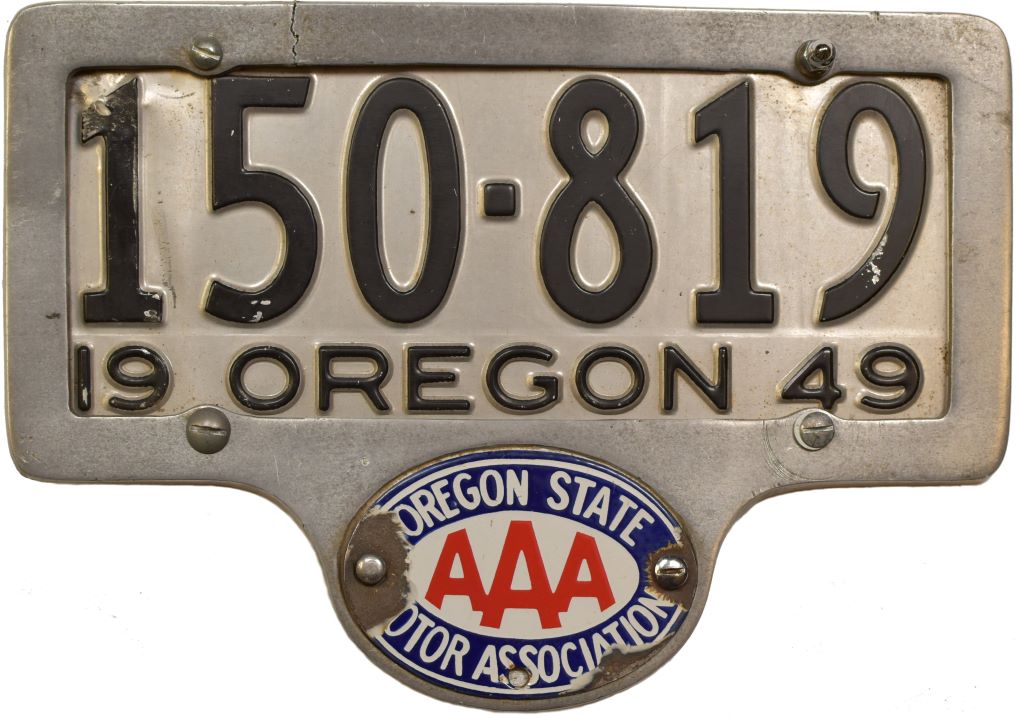
Why the controversy? Oregon’s license plates had been the same size since 1927 (and would remain so through 1955), with some exceptions that were taller in order to spell out the vehicle class (such as DEALER and CITY OF PORTLAND). Early design proposals for the 1943 plates called for a taller size to accommodate the commemorative text at the bottom. As noted in the objections of motor associations, license plate frames and holders were popular in the era, and a larger plate would cause issues for vehicle owners.
After the size amendment was deleted from the license plate bill (with officials noncommittal on the size, but with the law now silent on the requirement), it passed the Senate and was signed by the governor in mid-March. It was official: in less than two years, Oregon would have its first license plate slogan, joining the growing ranks of states promoting their history or industries on state bumpers.
Global politics had something else in store.
Metal for the War Effort
It didn’t take long after the Pearl Harbor attacks for the United States to gear up for war. License plates suddenly became a wasteful, low-priority item.
The writing was on the wall only a few weeks after the U.S. entered the Second World War. Oregon Secretary of State Earl Snell told newspapers on December 31, that “defense requirements probably will prohibit the use of steel in 1943 license plates, so it is likely that the 1942 plates will be used for at least an extra year” (Capital Journal, December 31, 1941).
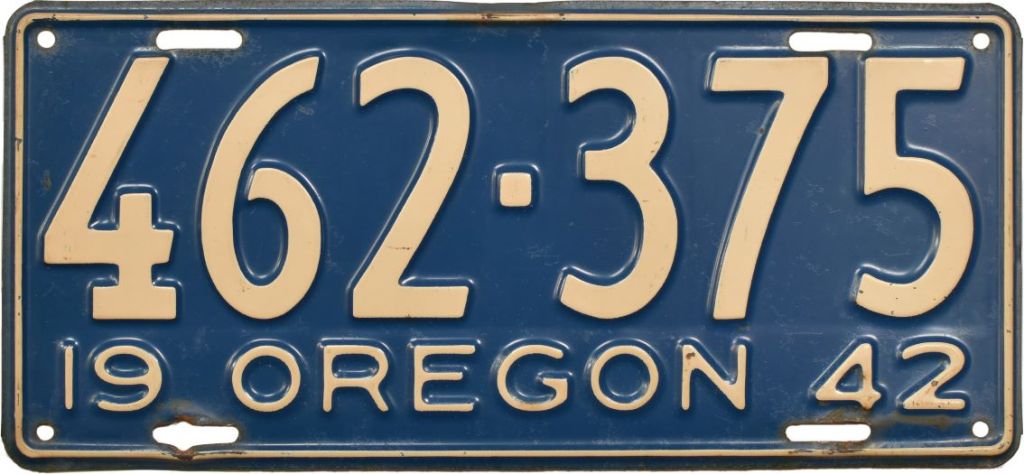
Facing the same restrictions as other states, Oregon officials had not yet determined what the solution to the metal shortages would be. The same article additionally states that the federal government “has asked states to adopt permanent plates, but legislative action would be required in each state, and most legislatures, including Oregon’s, don’t meet until 1943.”
By March 1942, state officials were publicly speculating that windshield stickers would be the likely workaround for 1943 licenses. While no license plates were to be produced, the Oregon Trail commemoration would still appear on the state’s auto licenses that year, in whatever form that took; it was an actual legal requirement. Secretary Snell “pointed out […] that the 1941 legislature enacted a law providing that the 1943 plates must carry advertising matter about that year being the 100th anniversary of the Old Oregon Trail. The plates were to bear the words ‘Old Oregon Trail 1843-1943” (Capital Journal, March 18, 1942).
In August, the state solicited bids for manufacturing the 1943 stickers. The design had already been finalized, and newspaper descriptions exactly match the final version that was ultimately produced. An enlarged mockup of that design was widely published in state newspapers in late September.
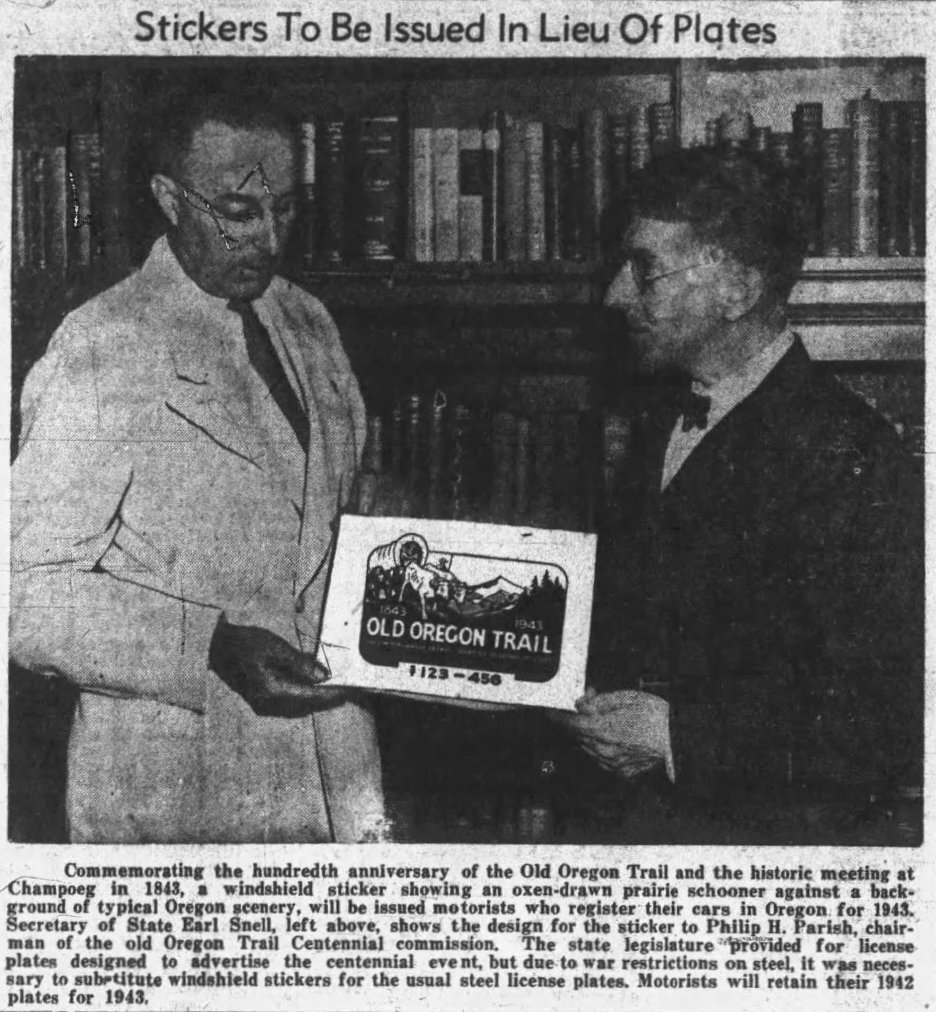
The Jeffries Banknote Company of Los Angeles was awarded the contract for the 1943 stickers (and would also manufacturer Washington State’s 1943 stickers). The company produced an ornate design that is indeed reminiscent of currency, and was probably more complicated and expensive than necessary, since Oregon and Washington both used other suppliers for the 1944 stickers.

Motorists were instructed that “the sticker is to be attached to the upper left hand corner of the right side of the windshield, directly behind the rearview mirror” (Lebanon Express, December 17, 1942). This was somewhat unorthodox placement; in Washington state and elsewhere, the location was at the bottom-left side of the windshield, closer to the driver’s side mirror.
And so, Oregonians did indeed commemorate the Oregon Trail on their vehicles, but for anyone anticipating a special license plate, it was a letdown. The proposed design would have been striking, and a notable deviation from the annual state-and-year basic format. Oregon’s neighbors had recently added some splash to their license plates: Washington and California had used special slogans on their 1939 issues (marking the 50th anniversary of statehood and the 1939 World’s Fair, respectively), with Idaho noting its 50th anniversary on its 1940 plates. Oregon wouldn’t adopt any interesting callout on its license plates until the PACIFIC WONDERLAND slogan in the early 1960s.
Oregon Trail license plates
Proponents of commemorating the Oregon Trail on license plates had another shot fifty years later, when the Trail’s sesquicentennial was observed in 1993.
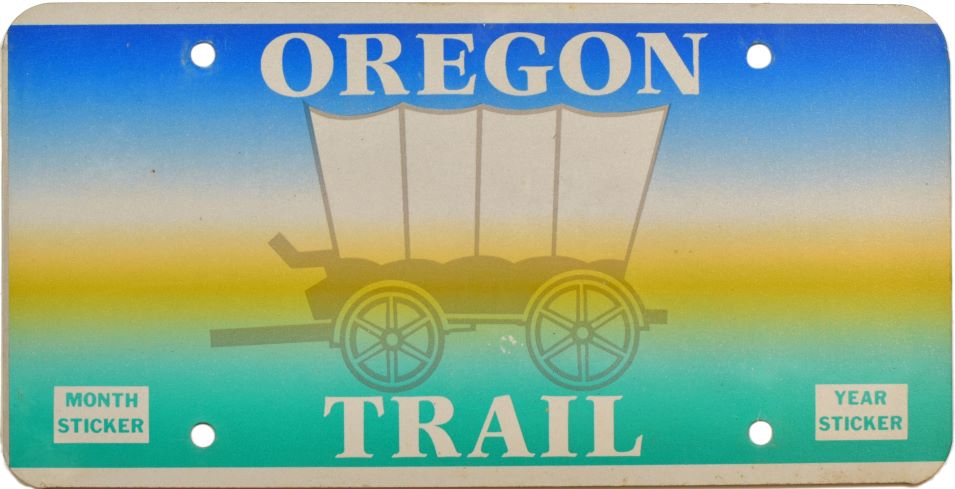
The first attempt to create an Oregon Trail license plate, in 1991, failed, with little interest expressed by the state legislature. The petitioner, Bill Perl, expressed his disappointment in a glum letter to newspaper editors:
I would like to thank the people who signed my petition for an Oregon Trail commemorative vehicle license plate. The respective bill, Senate Bill 498, died in the State Transportation Committee during the 1991 legislative session. No hearing was held so I had no chance to speak for the plate before the committee.
A staff person with the Oregon Trail Coordinating Council told me that they supported the idea and lobbied the Legislature for it to no avail. That effort was appreciated.
As far as I know, there will be no special license plate for the 1993 Oregon Trail Sesquicentennial, either the one that I submitted or any other. The losers are the people of Oregon. There are no winners. I did my best
Bill Perl, Lakeside, OR – letter to the editor, Corvallis Gazette-Times, November 29, 1991
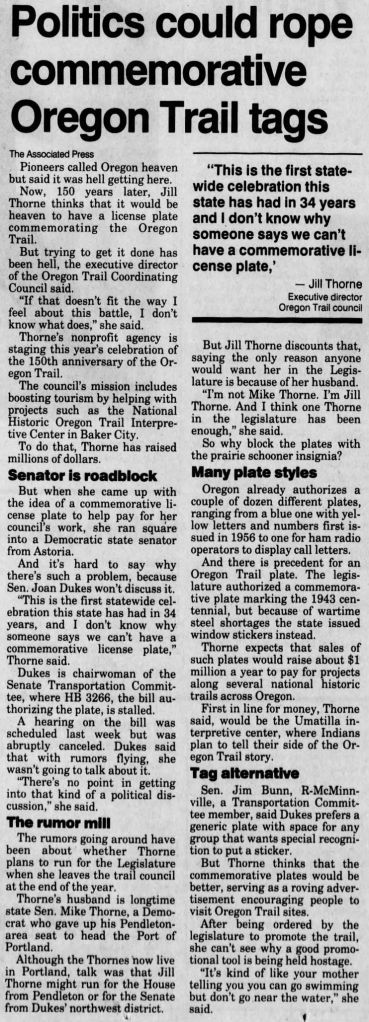
The sesquicentennial year had already arrived when the issue was resurrected in February 1993, with a new bill for a commemorative plate submitted in the legislature. By May it was under debate in committee. ”Rep. Michael Payne, D-Baker City, said the measure would help the state develop tourist attractions that in turn would provide jobs in his and other districts” (Statesman Journal, May 11, 1993).
The Trail plate bill faced roadblocks in the state legislature, first in the House, where Rep. Chuck Norris (no, not that Chuck Norris) held it in committee under the objection that Oregon had too many special license plates (possibly a reasonable opinion today, but laughable in 1993), and then in the Senate committee by Sen. Joan Dukes.
Political agendas were behind the license plate holdups, as explained in several Oregon newspapers in July 1993:
The bill finally passed the legislature in early August 1993, with the plates available to the public on November 4, 1993, for an additional $5 fee.
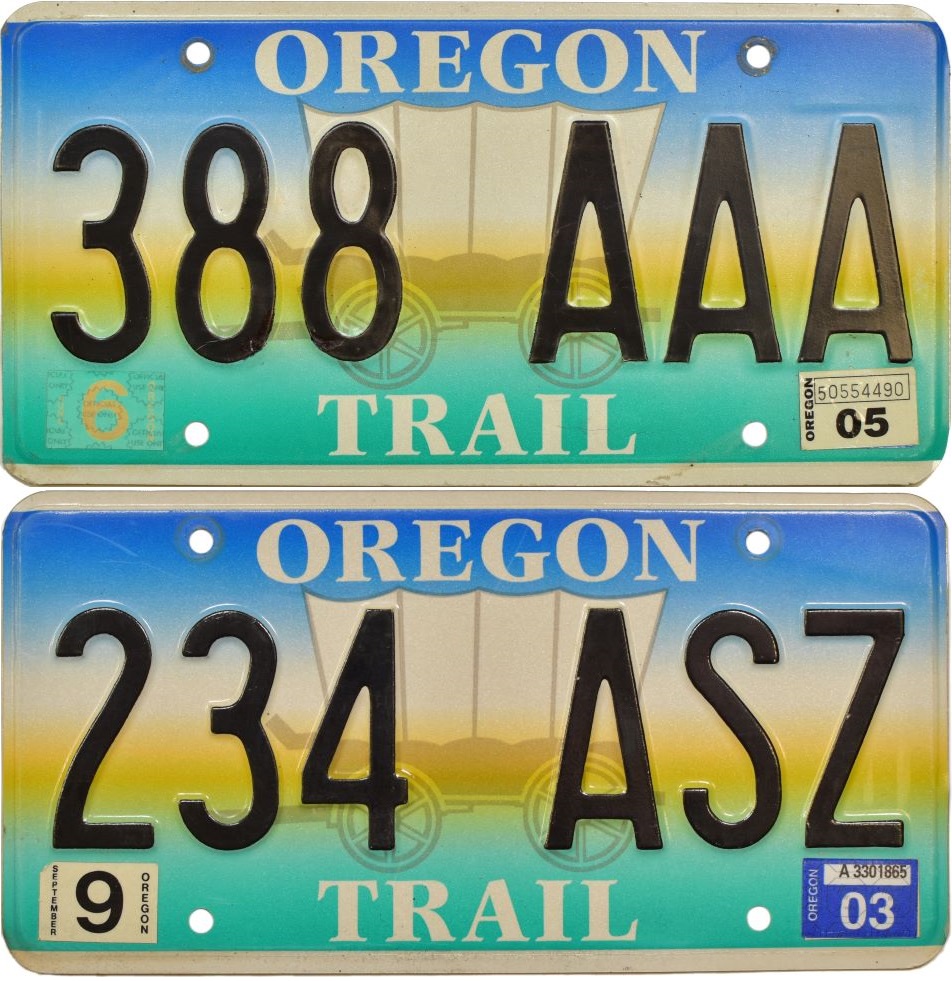
The final design did not call out the dates of the sesquicentennial (1843 to 1993) because the intent was to promote the trail and its historic sites indefinitely. The plates were intended to be issued through 1995.
The Trail plates were popular, and a common sight on Oregon roads throughout the 1990s and into the 21st century. Production lasted through 1997, and the plates were issued until remaining stocks were depleted.
The Statesman Journal noted on November 20, 1999 that fewer than 1,000 remained on-hand at the DMV. More than 460,000 had been issued at that time, with more than 10 percent of Oregon vehicles displaying them.
While hardly as common as in their heyday, Oregon Trail plates are still on the road more than 30 years after they debuted.
Fewer than 20 years remain until the Oregon Trail bicentennial. Will it receive a third commemoration?
 Danny's License Plates