“Neighborliness is a nice thing,” the Spokesman-Review stated on January 13, 1941, “but the three United States most western and northern possessions carried it too far this year, peace officers believe.
“Oregon, Washington and Alaska have the same color scheme, white on green, for their 1941 automobile license plates, a fact that will harry patrolmen when the heavy tourist season begins.”

In the era of annually-issued license plates, licensing officials usually coordinated with their counterparts in nearby states to avoid similar formats that could hamper effective identification. Something slipped through the cracks for the 1941 license plates, however.
The blame seems to rest with our southern neighbor
Spokesman-Review, January 13, 1941
“No one seems able to explain why Oregon and Washington have the same color plates, but the blame seems to rest with our southern neighbor, since this state [Washington] has followed its traditional plan of reversing colors of the former year,” the Spokesman-Review went on to say.
The newspaper had a point: it was easy for anyone to predict Washington’s 1941 plate colors. Washington indeed had a long practice of alternating colors, swapping green and white annually from 1926 to 1934 (with a one-off switch to black and orange in 1928), then blue and white for 1935 through 1937, returning to green and white in 1938. With the exception of the 1939 issue, which deviated to a yellow/green scheme to commemorate the state’s 50th anniversary, Washington would continue to use green and white through the 1980s.
The blame, then, clearly did belong to Oregon.
The similar formats caused some consternation among law enforcement and newspaper editors. The newspapers did, however, note the very obvious differences between the two designs (mainly, the state name and year positions, the style of the number dies, and Washington’s use of a letter prefix for a county code, in contrast to Oregon’s all-numeric scheme for passenger vehicles).
Police Concerned
The big fear, as is almost always cited in relation to license plate legibility, was bank robberies.
“Oregon-Washington License Similarity Worries Police,” was the headline in mid-January:
Similarity of Oregon and Washington license plates is going to cause a lot of confusion this year, Acting Detective Capt. Peter Olson of the police auto theft detail said yesterday.
The two states’ plates are of identical color scheme – white numbers and letters on a green background.
In Washington the name of the state appears on the top of the plate and in Oregon the name is on the bottom. Oregonians boast of a more streamlined type of lettering and figures.
Another item which distinguishes the Washington plate from those of Oregon are the letters which appear ahead of the figures on the Washington licenses. These letters indicate the county in which the license is issued. Oregon uses no such system.
But in cases of bad accidents and robberies, the excited bystander only sees white numbers on a green background and authorities are fortunate if witnesses can furnish them with most of the numbers appearing on the plate.
“We have many Oregon tourists and a good many Washington cars drive in Oregon every year,” Olson said. ”With the year hardly started we already are noticing persons confused over the similarity of the plates.
“When a bank robber jumps into his get-away car, a bystander quickly notes the color of the plate and automatically thinks of it as being from his state. Then he tries to take down as many numbers as he can.
“The bystander won’t have a chance to notice whether or not it is an Oregon or Washington license.”
Seattle Post-Intelligencer, January 19, 1941
If you were looking to commit crimes in the Pacific Northwest, 1941 was your year.
If mass confusion and thievery did thrive that year, it wasn’t well-documented.
Not the first time
The same situation had happened twenty years earlier, when Washington and Oregon again had white on green license plates on the road at the same time. In this instance the designs were much similar, although the state abbreviations and dates were on opposite sides.
Oregon, once again, was at fault.
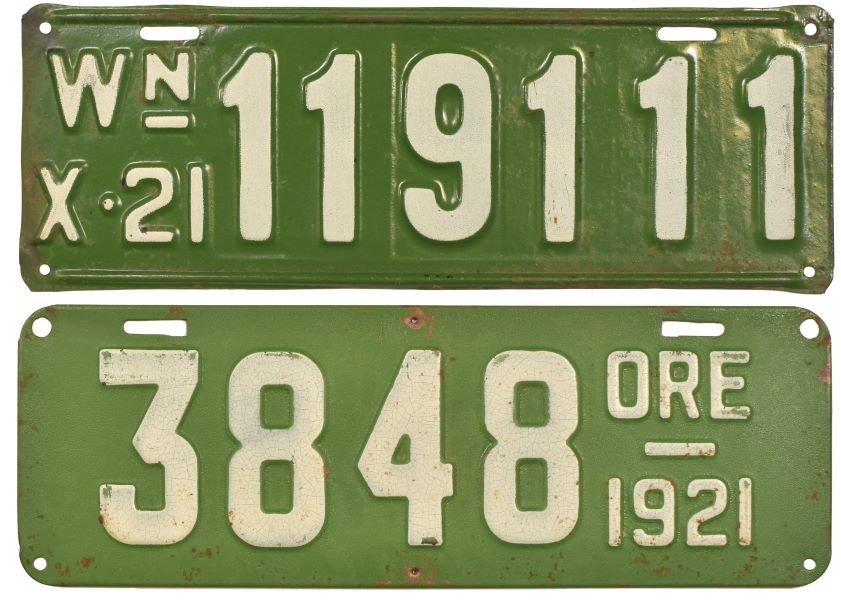
Under Washington’s licensing conventions at the time, the white on green plate was valid from March 1, 1920 until February 28, 1921, while Oregon used a calendar-year system where its 1921 issue was on the road only during 1921. Washington’s design debuted ten months before Oregon’s. Unfortunately for would-be bank robbers, there was only two months of overlap where both Washington and Oregon had similar license plates.
Oregon Secretary of State Sam Kozer made a point to note, in an April 20, 1921 blurb in the Oregon Statesman Journal, that the 1922 “color combination has not been decided upon, but it will be a combination giving a contrast with the colors of other neighboring states.” (The state picked black on yellow for 1922, which contrasted nicely with Washington’s white on brown).
Coordination in 1948
Similar color issues were avoided in 1948 due to deliberate consideration from Oregon officials. Oregon’s design for that year had red numbers on a natural aluminum background, a choice that was unpopular due to legibility issues. In this case, it was Washington to blame for Oregon’s misfortune.
In response to newspaper complaints about the new design, Harry S. Schenk, former Assistant Secretary of State, wrote a letter to the Oregonian explaining how the red color came to be. ”In January, 1947, Irwin-Hodson, the plate makers, submitted three colors for use on the ’48 plates. Green was immediately discarded because the state of Washington uses it exclusively. This left two colors, pale yellow and red. The manufacturer stated no other colors were available due to the shortage of enamel.” (Oregonian, January 7, 1948).
Samples were made using the yellow and red colors, and separate tests by the highway commission and the Oregon State Police unsurprisingly found the red color to have better visibility.
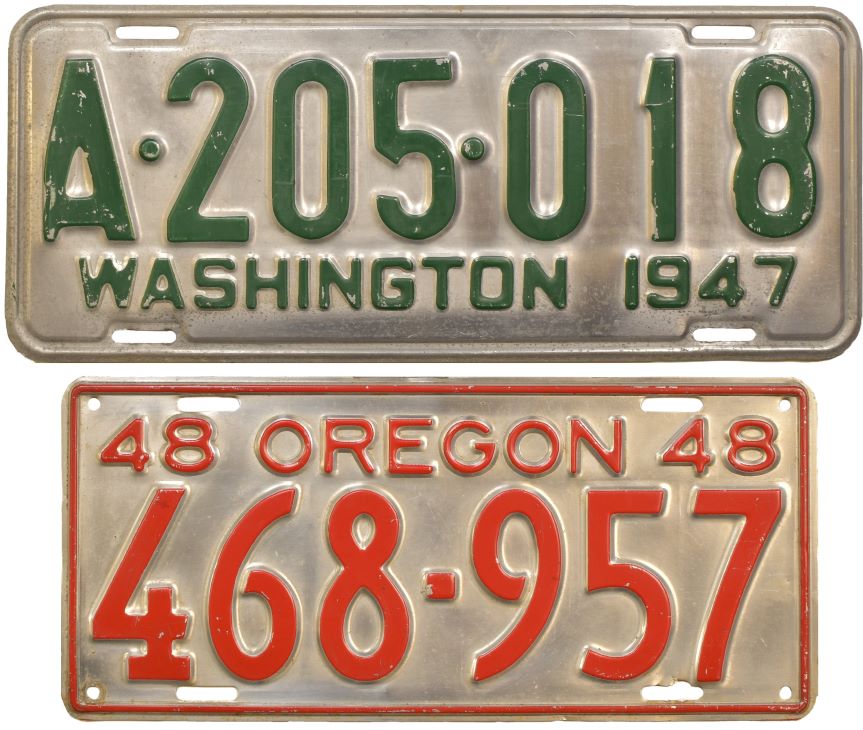
By the late 1950s, the issue was mostly moot, as both stated adopted multi-year baseplates with different color schemes. Oregon stuck to gold and blue, and Washington to green and white. The current designs from both states have been in place for more than three decades and bear little resemblance to each other. Thankfully, the confusion of 1941 is just a distant memory.
 Danny's License Plates