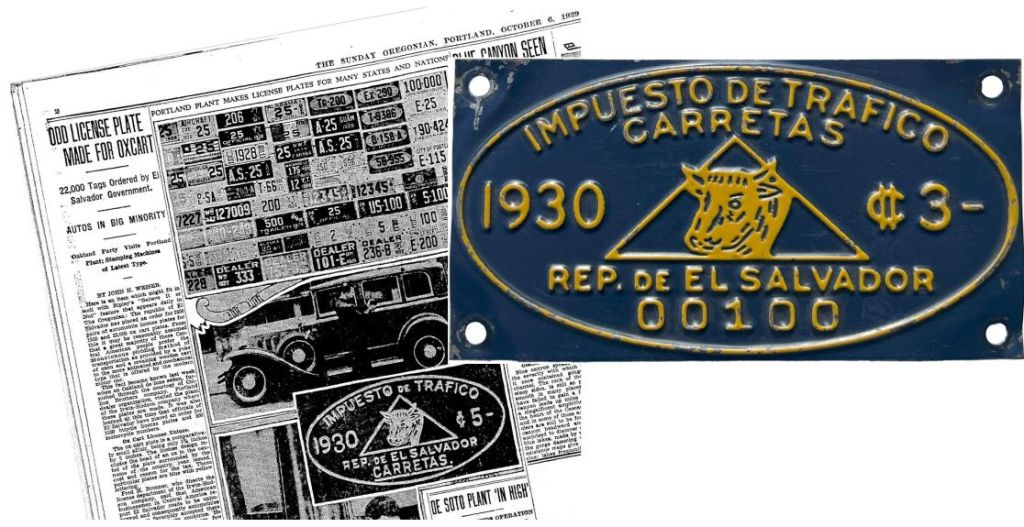
The idea that an ox cart would require a license plate was just too crazy to handle, based on the newspaper coverage it received.
In the fall of 1929, the Portland Oregonian visited the license plate factory of the Irwin Hodson company and published a profile and photos of the company’s operations. Of particular amusement to the writers was the company’s recent order from the El Salvador government, which included 2,650 pairs of automobile license plates and a much larger quantity – 22,000 – ox cart plates.
That ox carts required licenses and in such great quantity was simply unbelievable to the newspaper writers, and was fit, according to them, for inclusion in Ripley’s “Believe It or Not!” They went on to surmise that El Salvadoreans “prefer the monotonous plodding method of transportation as provided by yoke of oxen and a creaking wooden cart to the more animated and mechanical type that is offered by the modern motor car.” The mockery hasn’t aged particularly well, and glosses over the fact that automobiles were still expensive and roads in many places in the world were still underdeveloped (not much unlike the western United States only a generation before the article was written).
The Oregonian‘s article from October 6, 1929 was republished in dozens of newspapers over the following month, edited down to focus on the ox cart license.

The Irwin Hodson Company was, and still is, a giant in the license plate manufacturing industry, having made a majority of Oregon’s license plates over the last century and a long list of products for other states and countries. The Oregonian‘s article from October 1929 noted that at the time, Irwin Hodson was making license plates for Oregon, Idaho, Montana, Utah, Nevada, Alaska, Yukon Territory, El Salvador, Costa Rica, and Haiti.

The plate in my collection was found by me in Oregon. Given the serial number of 00100, this was likely a sample or prototype plate made by Irwin Hodson and probably never saw a “creaking wooden cart” in Central America.
Still, it’s a very interesting plate, especially with the associated newspaper coverage from its day. My plate differs in a few ways from the version published in the newspaper. The noted tax/license amount is less, reflecting either a different registration class or some variation between early specs and a final product. Also different is that the newspaper photo depicts a plate lacking any serial number, while the physical plate does have one, relocating the license class to the top of the ox design.
Both versions carry the same legend, “Impuesto de Trafico Carretas,” and an abbreviation of the country name, República de El Salvador. Impuesto de tráfico is Spanish for traffic tax, and carretas translates as carts.
Cart licenses in a very similar format were issued in El Salvador at least as far as the 1980s.
Full text of the Oregonian‘s coverage of the ox cart licenses is below.


 Danny's License Plates