By now the Boys in the Boat story is well-known by anyone with a passing interest in Seattle history, thanks to Daniel James Brown’s bestselling book, and with this month’s release of the George Clooney-directed movie, the University of Washington rowing team’s triumph at the 1936 Olympics will reach a global audience.
One artifact from my collection of vintage Washington state driver’s licenses has ties to a similar Olympic story.
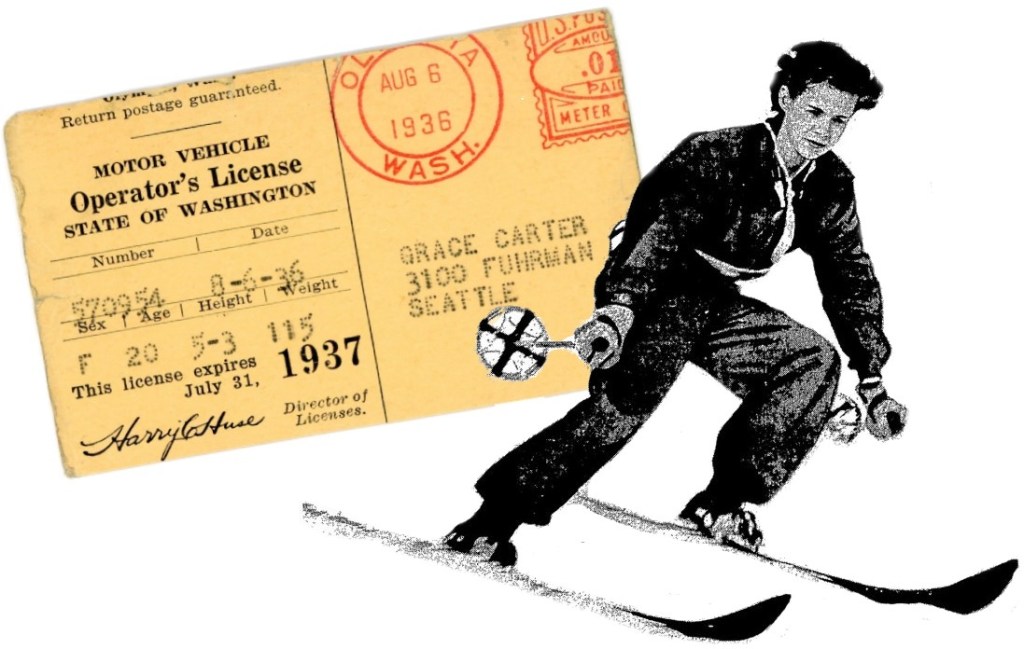
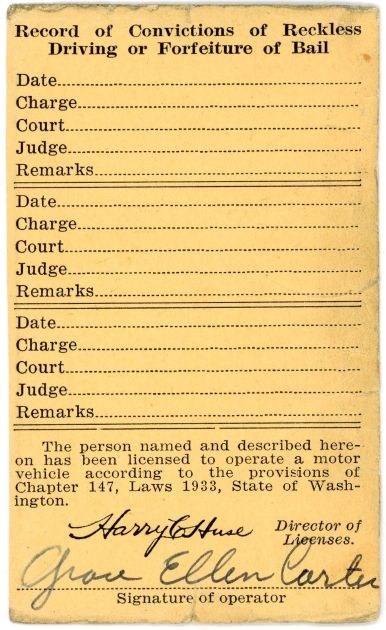
This Washington state driver’s license was issued to Grace Carter of Seattle in August 1936.
Who was Grace Carter? At the time this license was issued to her, she was one of the top, pioneering downhill skiers in the Pacific Northwest. Only months before this license was issued, she had just returned from Europe, where, at the age of 19, she represented the United States at Hitler’s Olympics.
The “Boys in the Boat” went on to lasting triumph in the 1936 Summer Olympics in Berlin, but Grace Carter and several other Washington state athletes also journeyed to Germany earlier that year for the Winter Olympics, held in Garmisch-Partenkirchen, Germany.
Washington’s winter Olympians did not fare as well as the UW rowers, but Grace Carter made a serious mark in the sport of downhill skiing.
Grace Carter: Champion Downhill Skier
Grace Carter (March 28, 1916 – January 23, 2002) was, according to her bio in the U.S. Ski and Snowboard Hall of Fame, “one of the top women skiers in the United States between 1936 and 1940 and the winner of the first national slalom championship.”
Born in Chicago, Grace made her way to Seattle as a teenager, and discovered skiing after graduating high school at the age of 16. She quickly became a star among the Northwest skiing community, and took advantage of the region’s natural offerings beyond the ski slopes.
“Grace Carter is a real lover of outdoor sports,” said the Seattle Star in a December 7, 1935 article covering her departure for the Olympics. “Before departing on the grandest experience of her young lifetime she was not only an expert skier (became the foremost woman skier in the Northwest two years after taking up the sport) but she was an ardent follower of horseback riding, fishing, hunting, sailing and swimming.”
Her passion, however, was clearly in the mountains. As she recounted in a 1983 newspaper profile:
“We would drive all night, in a Model A Ford with no heater, to Mount Rainier – the south side. There was 5,000 vertical feet of good snow there, but no lifts. We could climb 1,000 vertical feet per hour, so we would climb up 3,000 or 4,000 feet and make one swell, long run down a day.
Skiing used to be more mountaineering than it is now. People can’t climb in those cat suits they wear today, nor in those plastic boots and bindings they wear.
One winter 30 of us, mostly from Seattle Roosevelt high school, chipped in $1 a head to rent a mountain cabin for the season. By spring it was under 30 feet of snow, so we tunneled in to it. Then we started having races. We had no way of starting people individually; everyone went at once. It was called a ‘geschmozzle’ start. You pointed your skis straight downhill and took off. The first one who turned chicken and checked his ski sideways usually lost.
Grace Carter Lindley, Minneapolis Star-Tribune, April 10, 1983
Money was tight at the height of the Depression, and Grace’ boots were homemade by a friend. The must have been well-made, as Grace won the Pacific Mountain Slalom Championship in 1934 and continued to dominate local ski competitions.
Journey to the 1936 Winter Olympics
“Seattle and Tacoma will send five men and women to the Olympic Winter Games in Garmisch-Partenkirchen, Germany, assuming Seattle and Tacoma are as eager to see them in international skiing competition as they were to see them in national competition,” the Seattle Times announced on October 5, 1935.
Grace Carter had been selected, along with fellow Seattleites Don Fraser and Darroch Crookes, and sisters Ellis-Ayr Smith and Ethelynne “Skit” Smith of Tacoma. Fundraising drives commenced to help finance their journeys to Europe, despite early fears that U.S. participation in the Olympics would not materialize due to “the England-Italy-Ethiopia situation on the one hand and the Jewish-Nazi situation on the other” (Seattle Times, October 27, 1935). By late October the ski clubs were holding dances and selling ski buttons, with the proceeds funding the teams’ travels.
Those travels had to start well in advance of the Olympics. Grace and three of her counterparts departed Seattle aboard the Oregon Express on November 30, 1935, for a monthlong journey to France via the Panama Canal.
Grace was employed at the time as a switchboard operator at the Seattle Star newspaper. The Star heavily covered the journey of its own employee, regularly publishing Grace’s dispatches during the ship’s voyage and the run-up to the Olympics.

Throughout Grace’s many published letters is an obvious joie de vivre and love of detail. She was clearly having the time of her life, traveling across the world to compete in a sport she truly loved. “This ski business beats working for a living by miles,” she stated in a letter published January 16.
“Have never felt so carefree…the days are cloudless…the nights so beautifully serene….Am sitting in the prow, feet propped on the rail, watching the waves from the bow—endlessly curling, splashing and frothing. Don’t suppose it can be read, but writing by a tropical moon is swell! Shall soak in the moonlight and go to bed.” (Seattle Star, January 7, 1936).
“Maybe it’s the Northwest’s Year”
Seattle Star, January 7, 1936
“Maybe It’s the Northwest’s Year,” said the Seattle Star on January 7, 1936. “An Olympic year, this one, and more Northwest athletes than ever before will be competing for the United States at Berlin.” The Star went on to mention Grace and her fellow skiers, a bevy of local swimmers, the University of Washington “Boys in the Boat” crew, and UW and WSU track stars who all could be Olympic contenders.
For the women skiers, their arrival in Europe was only another step in the Olympic journey, with more training and competition to earn a spot on the Olympic team. The Oregon Express was already five days behind schedule when it reached the Panama Canal, and the delayed arrival in Europe cut short the skiers’ training programs, crucial to earning a spot in the final Olympics team.

Grace and company spent more than a month in Europe in preparation for the games, moving across countries and venues, from Munich, Germany; St. Anton-am-Arlberg, Austria; Davos, Switzerland; and Zell-am-See, Austria. Grace’s letters convey little stress, other than money shortfalls, instead showing her love for the experience she was having. In particular, the villages of Austria struck a chord with her: “One gets the feeling that these people are thrifty and clean and live happy lives in their gayly painted old houses. Doing the hard work of getting a living from their mountain farms and going with glad hearts to their tiny churches to thanks the God that put them in a world so beautiful, so simple, and shown such a happy way to live. I suppose you all at home will think that I’ve lost my mind writing such stuff but it is all this way—as I have told you! Their way of living seems so much truer and as were meant to live…than the bustle and excitement and scramble of a modern life in a modern city.” (Seattle Star, January 28, 1936).
In spite of the delay and reduced opportunities to train, Grace and her Tacoma friend Ellis-Ayr Smith made the next round closer to Olympic competition. “The Northwest Olympic team candidates, Ellis-Ayr and “Skit” Smith of Tacoma and Grace Carter of Seattle, arrived days late at St. John—had but 10 days to provide to Otto Fuhrer, famed Austrian skier and coach of the American women’s team, that they were among the eight best of 14 candidates. Ellis-Ayr and Gracie made the grade—were named recently on the eight-woman squad that will furnish four competitors to carry Uncle Sam’s colors in the Olympic Games.” (Seattle Star, January 28, 1936)
While Grace and Ellis-Ayr Smith both made the eight-person team, neither made it into Olympic competition. Grace Carter did earn the prestige of membership on the U.S. Olympic team, but as an alternate.
The Seattle Star summarized the collective disappointment while alluding to Grace and team’s underdog status as relative neophytes in the sport:
With thousands of words coming daily from Carmisch-Partenkirchen, Germany, where athletes from the world over are in final training for the Olympic Winter Games, February 6-16, we of the northwest reserve our greatest interest for the few words or sentences that tell of our Tacoma and Seattle skiers.
Most of those words brought disappointments, too keenly felt perhaps, when we consider that northwest skiing is barely out of its swaddling clothes—that it had never witnessed European skiing until Hannes Schroll, great Austrian skiman, rocketed down the fog-bound slant of Mount Rainier last April in the national slalom and downhill championships.
Final team selections, announced by United States Olympic team officials in the past two days, indicate that the northwest’s five skiers—Ellis-Ayr and Skit Smith of Tacoma and Grace Carter, Don Fraser and Darroch Crookes of Seattle—will not see action in the games proper.
Grace Carter has been named first substitute on the American women’s Olympic ski team but will action only in the case of injury to one of the first four competitors. Ellis-Ayr and “Skit” Smith of Tacoma failed to even make the alternate classification.
Seattle Star, February 4, 1936
The consensus among ski officials and commentators, in the aftermath of the poor US showing at the Olympics, was that American skiing was underdeveloped. “Our Skiing Wrong; European Style Much Superior,” declared a Seattle Times editorial on February 4, 1936. Skiing in the western United States was still a new sport, and athletes simply did not have the experience of Europeans who grew up skiing the Alps.
Might become one of the world’s great skiers
She didn’t compete in the Olympics, but Grace’s European journey wasn’t over: the Star reported on February 21 that “SHE DID improve so rapidly, show such will to learn, and courage, that Mrs. Dudley Wolfe, manager of the American squad, recently wrote the Washington Ski Club requesting that Grace by allowed to remain in Europe for the F.I.S. races at Innsbruck today and tomorrow, and the famous Arlberg-Kandahar downhill at St. Anton, March 15.”
I have never seen a girl with more gameness and sporting spirit and courage.
Alice Damrosch Wolfe, Manager USA Girl’s Ski Team
According to her U.S. Ski and Snowboard Hall of Fame bio, her competition in these events brought her to national prominence. While she “dropped out before finish” in the last meet, the Seattle Times wrote on March 24 that “Grace Carter has developed into as brilliant a skier as Mrs. Dudley Wolfe, manager of the American woman’s team, said when she wrote The Times a month ago. She improved more than any other girl on the American team.”
Well—you should be proud of her. I have never seen a girl with more gameness and sporting spirit and courage. She gives a zip to the entire training squard.
She and the Smiths had a hard time at first because they arrived late and the other girls had their skiing legs. We had to send in the names of eight girls to the Olympic Committee by January 15. Even though Grace and Ellis-Ayr were behind some of the girls we dropped off we kept them on the squad because we could see they were good skiers—given a little more time to catch up. Gace has come ahead by leaps and bounds. At first she had only courage and her legs. But she started getting more technique every day. It was wonderful to see her improvement. Frankly—given another year of GOOD TEACHING—I think she might become one of the world’s great skiers. She has all the dash and fire which so many good skiers lack.
I am very anxious for her to stay over for the two great races of Europe—F.I.S. (Federation International de Ski) in Innsbruck, Feb. 18, and the Arlberg-Kandahar, here on March 15.
In Europe these two races have a higher rating even than the Olympics. Olympics had a lower standard as there are only amateurs in the race. In the other two races the amateurs can really see how they stand against the world’s greatest racers.
I feel that if your club could arrange for Grace to stay you will be proud of her.
Alice Damrosch Wolfe (Manager, USA Girls’ Ski Team for Olympics and FIS), published in the Seattle Times, February 12, 1936
While she never was able to compete in the Olympics, and did not take home any prizes from her other European competitions, Grace nevertheless returned to Seattle in late spring having established herself as a major talent with abundant potential in the sport.
Life in a Seattle houseboat

What was Grace Carter’s life back home like?
The address listed on Grace Carter’s driver’s license is 3100 Fuhrman Ave, Seattle, which today registers no buildings: Fuhrman Avenue house numbers progress from 3018 to 3102, between which is a very short section of Allison Avenue headed straight into Portage Bay.
The answer to this mystery is simple: Grace Carter lived the full Seattle experience in a houseboat, just like the protagonist of another iconic Seattle story.

Newspaper ads confirm it: 3100 Fuhrman Ave was a houseboat publicly advertised for rent several times in the 1920s and 1930s. Who wouldn’t want to live in a “snappy” houseboat?
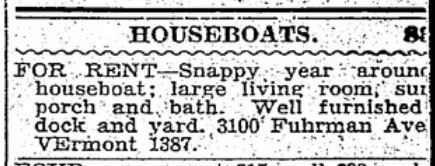


In her 1983 profile in the Minneapolis Star-Tribune, Grace reminisced about her time in Seattle. She bought a canoe with her modest income as a recent high school graduate and told of living in a houseboat with her mother, rented at $8 a month.
From her perch on the edge of Portage Bay, Grace Carter would have had a clear view down the Montlake Cut towards the University of Washington Shell House. She continued to be near Olympic greatness, as the Boys in the Boat surely rowed past her house on many occasions.

Later Life
Skiing remained a part of Grace Carter’s life after her European journeys, but the Pacific Northwest didn’t. In April 1937 she married fellow Olympic team skier Al Lindley (who had also been an Olympic rower, crewing for Yale and winning a gold medal at the 1924 Olympics) and moved with him back to his native Minnesota, where she would live the rest of her life.
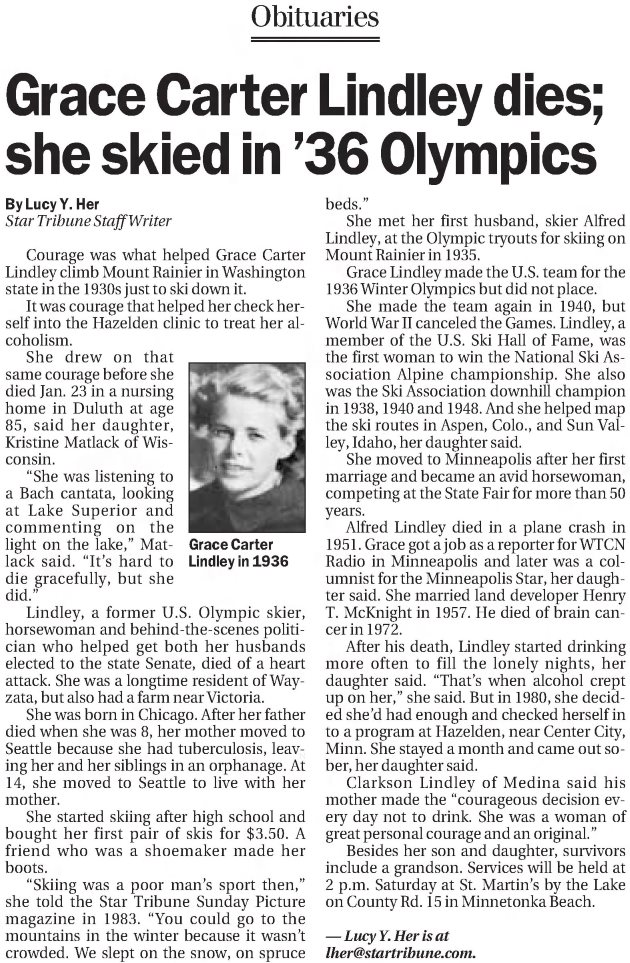
Part of the appeal of collecting ephemeral items like license plates or old driver’s licenses is discovering the history behind them. Most of the time little of interest is unearthed, but Grace Carter’s backstory was an unexpected treasure to stumble across through cursory historical newspaper searches for what had been to me just an ordinary old license when I procured it.
 Danny's License Plates