Washington state law states that license plates “Must designate the name of the state of Washington without abbreviation” (RCW 46.16A.200 (1) (c)). This reasonable and innocuous requirement made its way into legislation as a consequence of one of the greatest atrocities ever foisted upon residents of the Evergreen State (according to some vocal opinion-writers).
By 1958, license plates in Washington had evolved into the setup we know today, where a plate is issued to a vehicle and revalidated with an adhesive sticker each year. The 1958-series plates were intended to be used for five years, then replaced by a new state-wide issue, with all vehicles in the state receiving new plates by January 1963. These 1963 plates were to be used for another five years.
As a cost-saving measure, the state decided to emboss the first year of expiration onto the plates and avoid printing and distributing adhesive stickers for 1963, resulting in a claimed savings of fifty thousand dollars.
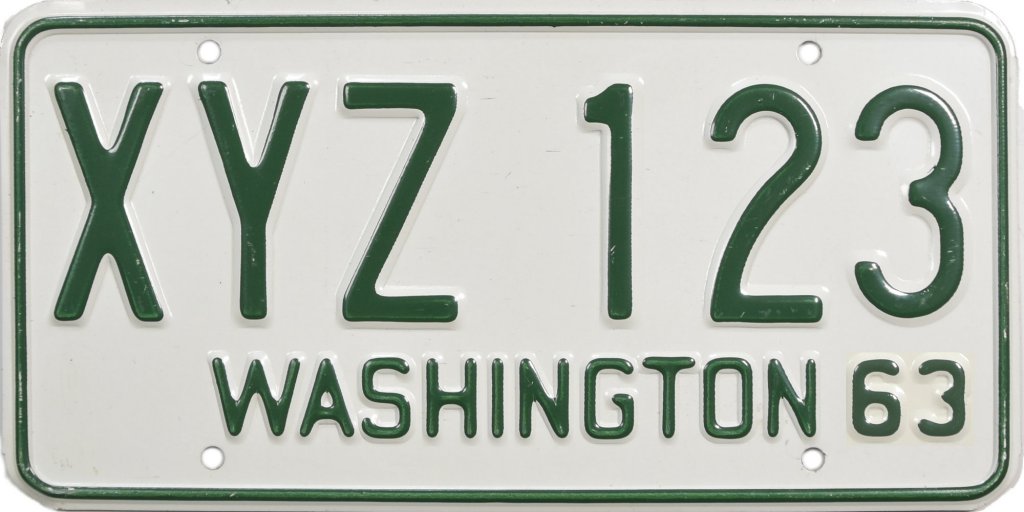
Space for stickers
However, Washington was due to implement a staggered registration system in 1964, where the then-current practice of every vehicle’s registration expiring on December 31 would be abandoned in favor of a 12-month validity period based on the original registration date of the vehicle (the process which is used today). This would require the addition of a year sticker AND a month sticker to each license plate in 1964. To accommodate an embossed “63” and two future stickers, the Department of Licensing chose to shorten the state name to WASH.

Public outrage
Umbrage was taken! When the design was unveiled, it unleashed a torrent of bad press and angry editorials from citizens appalled by the shortening of the state name to “Wash.” The average citizen had never been so opinionated about license plate design.
“This unsightly condensation may be legal at the Post Office, but it is generally avoided by those with a high regard for the distinguished name of a great state.” Seattle Post-Intelligencer editorial, Dec 1, 1962
“It is almost inconceivable that those responsible for such things would not have enough good taste or pride in their state’s name to want to see it spelled out completely on anything so permanent as a metal license plate. The state wouldn’t think of using ‘Wash.’ even on its official letterheads and we’ll never understand why it is willing to use it on the plate.” Longview Daily News editorial, Dec 3, 1962
“One bright spot does appear, however, in an otherwise gloomy picture. Washingtonians will beginning in January, be able to drive about the United States helping to spread the gospel of good grooming.” Yakima Republic editorial, quoted in Longview Daily News, Dec 6, 1962
“When you are working with type you select the type face that will enable you to say what you need to say in the space at hand. To say you can’t spell out ‘Washington’ and still have room for six numerals in a space 12 inches long is ridiculous.” Longview Daily News editorial, Dec 27, 1962
“Well, we admire [the DOL’s] zeal for saving money but we’re still skeptical that it was necessary to shorten a great name to an unglamorous verb which will do little to build up the state’s image.” Bellingham Herald editorial, Dec 27, 1962
“Perhaps the Father of His Country should have changed his name to a short one like Cox or Mix. Then our state License Department would not have been tempted to cut his name in half and let the whole nation think that his state is too penurious to use his whole name.” Spokesman-Review editorial, Dec 28, 1962
“[T]o have that ugly ‘Wash.’ circulated all over the continent on automobile license plates for the next five years is the stupidest form of adverse publicity we could have asked for. A California chamber of commerce could not have dreamed up a better way to poke fun of us.” Letter to the editor, Seattle Times, Dec 30, 1962
The Longview Daily News was particularly incensed by the design, devoting a fair amount of editorial space to the issue. The Tacoma News Tribune, looking on the bright side after an extensive take-down of the bland license plate design, noted that “local laundry truck drivers are happily displaying the plates which advice everyone to ‘Wash.'”

Not the first WASH
Those who had been paying closer attention to Washington state bumpers noted that this was not, in fact, the first time Washington license plates had been soiled by “WASH.” This abbreviation had been used extensively on non-passenger vehicles since 1958, when the state name was shortened to grant space for the vehicle class.

WASH had made limited appearances on other types even before that. Production of the 1954-1957 license plates was outsourced to the Screw Machine Company of Portland, Oregon after the license plate mill at the Walla Walla Penitentiary burned down. Some smaller-volume vehicle types were produced with the same stamping dies and layouts Screw Machine was already using for other clients (including Oregon, Hawaii, Alaska, and Arkansas), which required abbreviation.

And so, starting in 1954, every motorcycle in the state was WASHed, and the undignified abbreviation even appeared on the cars of Washington’s elected members of Congress (one can only hope that the easy joke about “cleaning up DC” was not squandered).
However, these abbreviations escaped the attention of the general public until they showed up on the bumpers of their own private cars in 1963.
The state responds
The issue gained so much notoriety that the 1965 state legislature added language to the motor vehicle laws mandating full spelling of Washington, “commencing with the next general issuance”, which was planned for 1968.
Although the law did not immediately require a change in license plates, the Department of Licensing, perhaps tired of the drama, had already acted. “Abbreviation WASHed off License Tags,” proclaimed an April 6, 1965 headline in The Olympian. “State Licenses Director Douglas Toms said Tuesday all of the new plates coming out of the prison have the state’s name spelled out in full and the abbreviation Wash. will soon be fading.”
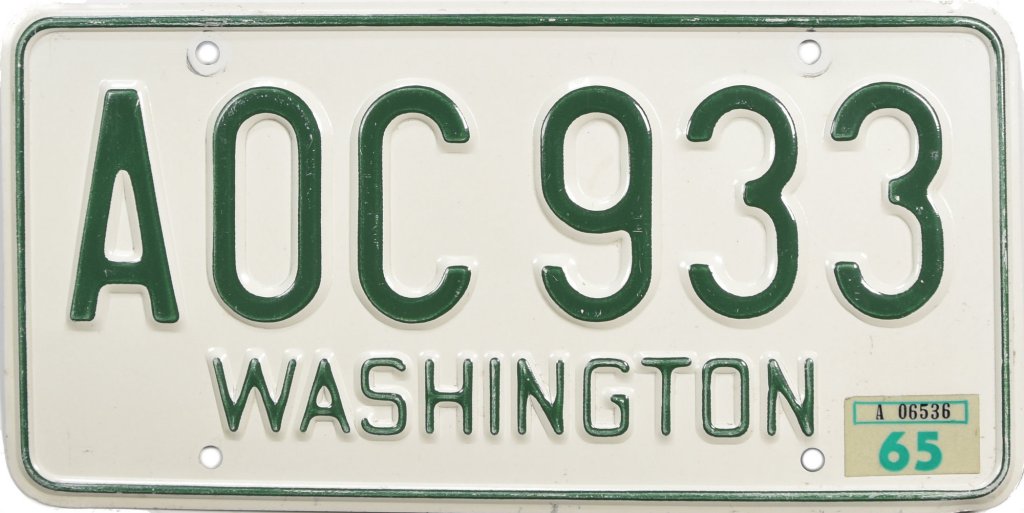
After existing supplies of the hated WASH 63 were used up, the revised design, sans embossed year, appeared on the road. Most non-passenger vehicle classes continued to use a noncontroversial “WN” abbreviation until a redesigned base was issued in 1968, and from 1970 onwards all license plate types were issued without any abbreviations.
Staggered registration delayed
The cause of all the drama, the staggered registration law, was soon moot. Originally legislated in 1957 for a 1959 implementation, it had been delayed multiple times due to logistical and budgetary complications. The legislation was finally repealed in March 1963, only a few months after the WASH 63 plates first appeared on roads, and more than a decade would transpire before it was finally implemented in 1977.
A lasting legacy
The infamy would live on for close to four decades. The state never did implement a complete reissue of license plates; as long as the vehicle continued to be registered in Washington, all plates from the 1963 issue onward continued to be valid. WASH 63 plates could be seen on Washington roads all the way until 2000, when legislative changes mandated the replacement of all license plates more than seven years old. Fortunately, when month tabs finally arrived in 1977, there was room for them.
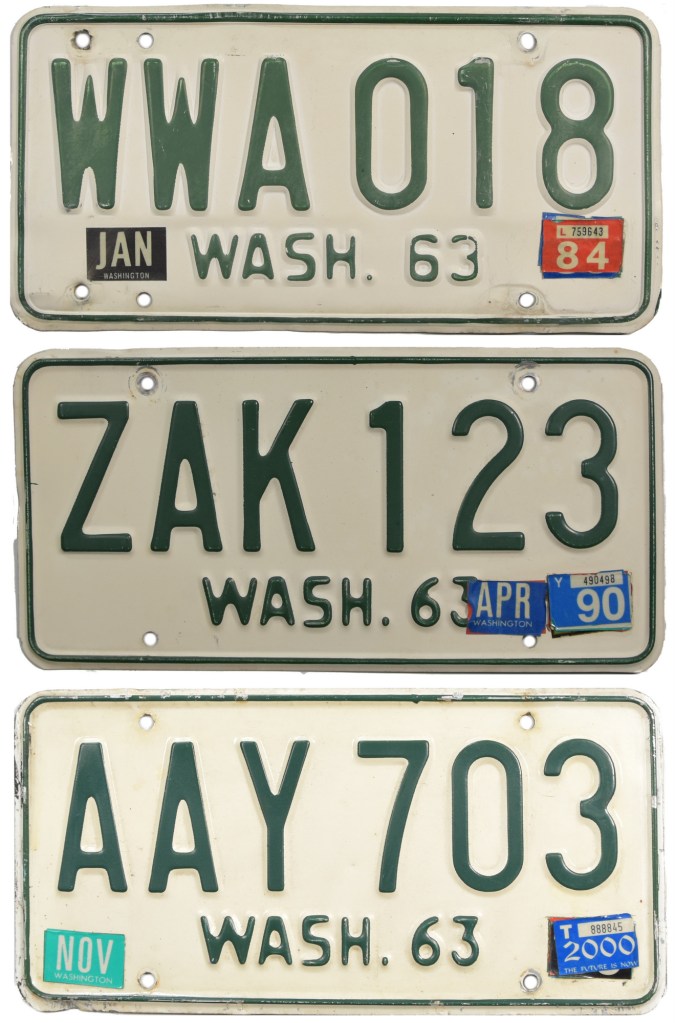
Washington state code continued to have the same 1965 language mandating a full state name starting with the “next general issuance” all the way until 2009, when it was finally revised to the more clear language on the books today, forbidding any abbreviation to the great name of Washington. In a world full of controversies, at least one has been washed away.
 Danny's License Plates